

随着地表金矿资源日趋匮乏、勘查难度持续加大,开展隐伏金矿勘查既是增加资源储量的关键途径,也是实现资源可持续利用的必然选择(朱日祥等,2015;陈喜峰,2024)。湖北省枣园金矿位于桐柏—大别金—钼多金属成矿带东段,曾以黑龙潭和卸甲沟等典型构造蚀变岩型金矿成为重要黄金产地(陈国荣等,2023)。随着浅部资源开采日趋枯竭,当前亟需向深部及外围拓展找矿空间。
1 成矿地质背景
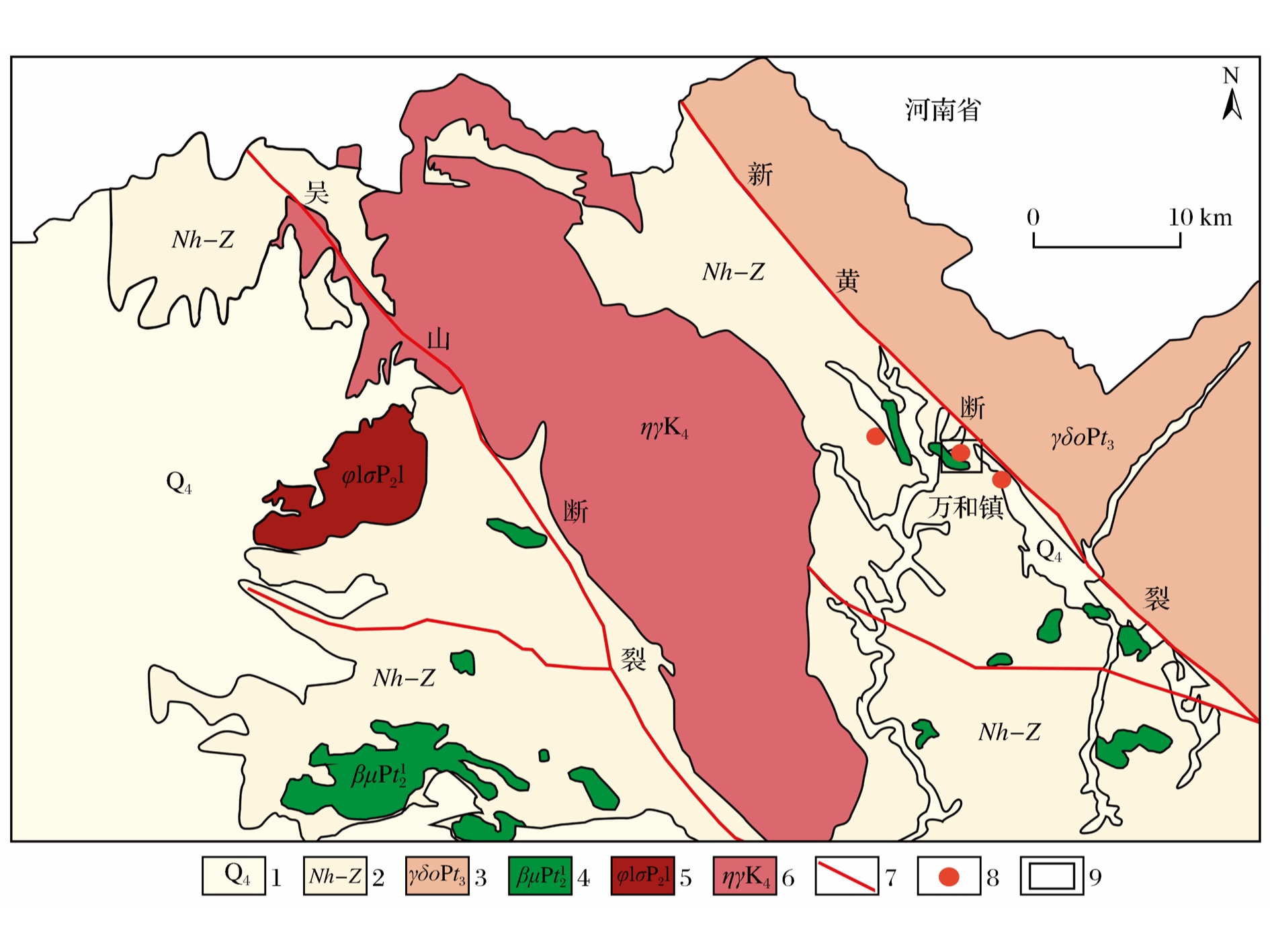
枣园矿区隶属于湖北省随州市随县万和镇(图1),大地构造位置处于扬子板块与秦岭—大别造山带结合部的随枣走廊,地势总体北东高、南西低,北东部属桐柏山低山区,南西部为丘陵浅切割区(Niu et al,2022)。
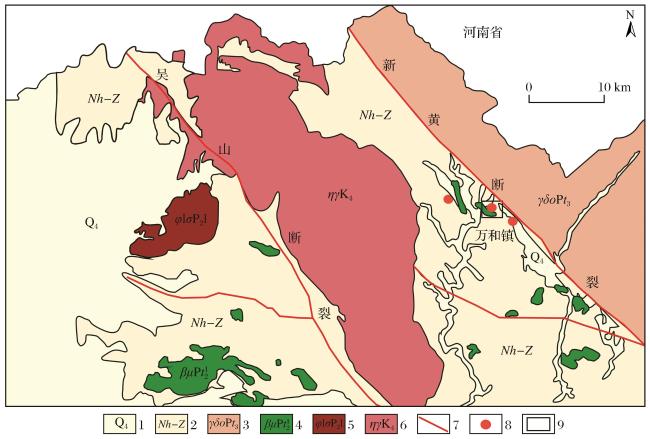
图1 矿区大地构造位置图(修改自Niu et al,2019)1.第四系;2.变质地层区;3.新元古代花岗岩质片麻岩;4.南华纪变辉绿岩体;5.古生代大阜山基性—超基性岩体;6.中生代七尖峰复合花岗岩;7.断裂;8.金矿点;9.研究区 Fig. 1 Tectonic location map of the ore district(modified after Niu et al,2019) |
区内出露地层以中—晚元古界大狼山群变火山碎屑岩、震旦系变基性火山熔岩和沉积岩,以及局部分布的寒武系炭硅质板岩为主;新黄断裂带南西侧断续出露白垩—第三系砂岩和砂砾岩;河流沟谷零星分布第四系黏土和亚黏土。区内断裂较发育,以NW向新黄断裂和吴山断裂为主。新黄断裂走向NW,倾向SW,倾角为60°~80°,构成一条重要的金、银、铅锌等多金属成矿带;吴山断裂同样走向NW,倾向SW,倾角为55°~70°,以发育宽达数十米的糜棱岩带为特征,沿断裂分布有金、银、铅锌、铜钼及萤石等多种矿床(点)(向祥辉等,2017)。矿区内岩浆活动强烈,发育晚元古代基性侵入岩—次火山岩和中生代重熔型花岗岩(如七尖峰岩体)。区内脉岩比较发育,种类较多,各种脉岩在不同地段发育程度不同,其中伟晶岩脉主要分布在七尖峰复合花岗岩体内;花斑岩脉主要分布在七尖峰复合岩体至新黄断裂之间的变质地层内;其他脉岩则分布在新黄断裂以南的变质地层中(胡起生等,2003)。此外,金矿化与碎裂岩带紧密共生,常见黄铁矿化、硅化、绿帘石化及绢云母化等蚀变(Cheng et al,2012)。
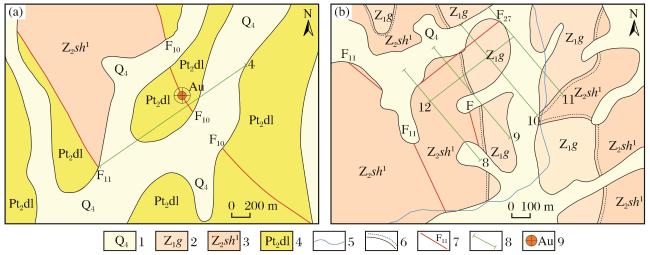
研究区内主要出露上元古界震旦系下统过路湾组、上统尚家店组下段和第四系。过路湾组岩性以各类钠长片岩为主,常见绿色片岩与白云钠长片岩互层(图2)。尚家店组下段自上而下依次为含炭白云钠长片岩/石英片岩、变粗晶白云钠长片岩、石榴白云钠长片岩和白云石英片岩,其中夹有白云石大理岩透镜体。第四系为松散黏土和砂砾沉积。断裂以F11和F27为主。F11断裂呈NW向,是导矿构造,控制着金矿体,带内主要由蚀变碎裂岩和碎裂岩化糜棱岩组成。F27断裂呈NE向,具多期活动特征,可见含黄铁矿和方铅矿的硫化物石英脉。区内岩浆岩出露较少。除第四系和白垩系之外,地层普遍经历区域变质作用和动力变质作用。围岩蚀变以硅化、绢云母化和黄铁矿化为主。其中,硅化和黄铁矿化与金、银矿化关系密切,矿化最富集部位见于强硅化的富硫化物石英脉中。
2 样品采集与分析
按照“已知到未知”的研究思路,在矿区内已有工程控制的4#剖面上开展地电化学集成技术找矿可行性及有效性试验研究,剖面全长390 m,按照20 m点距共布20个测点,点号为1~20[图2(a)]。在未知区内,按照100 m×20 m的勘查网度共布设地电提取测线4条,测线主体沿NW向构造走向布设,同时垂直构造走向布设控制测线,另平行F27断裂布设地电提取测线1条,未知区与已知区同属同一构造—地层单元,地质背景、覆盖条件具有良好可比性,测线点距与已知区保持一致,共106个测点[图2(b)]。本研究采用桂林理工大学隐伏矿床研究所研发的低电压偶极地电提取装置进行采样,该装置具有低电压、小电流、便携及提取效果好等优点(刘攀峰等,2018)。
野外工作时严格遵循地电化学提取测量技术要求。首先利用手持GPS定位采样点,在每个测点挖掘2个间距1 m、深度约为30 cm(见残积层土壤为准)的圆坑。采集土样后,分别于两坑内放置离子收集器的阳极和阴极,各注入500 mL提取液,充分搅拌后按取土顺序回填。持续供电48 h之后,取出阴阳极碳棒并拆下其上的聚氨酯泡塑,密封编号保存(赵欣怡等,2022)。
野外采集的聚氨酯泡塑样品晾晒后送至中国有色桂林矿产地质研究院测试中心。样品经湿法消解预处理后,采用电感耦合等离子体质谱仪(ICP-MS)进行元素分析(唐瑞等,2021)。每批次50个样品中插入5件重复样以监控分析精密度,同步插入5件国家一级密码标准物质进行同步分析,以监控分析准确度和系统误差,测试结果显示各元素报出率为100%,密码标准物质合格率与重复样合格率均为100%,分析质量符合规范要求。土壤样品晾晒烘干,将样品过筛至100目,由桂林理工大学隐伏矿产研究所分别利用DDS-307型电导率仪和MilestoneDMA-80测汞仪进行分析测试。所有测试仪器均经检定校准,仪器检出限、精密度和相对误差均符合国家地质试验测试规范要求,测试数据可靠、误差可控。其中,土壤离子电导率样品每批按10%比例抽检;土壤热释汞样品每批插入标样进行监控,并按10%比例抽检,分别统计对数偏差,结果均未出现超差。
3 方法找矿可行性试验研究
3.1 4#线剖面地质特征
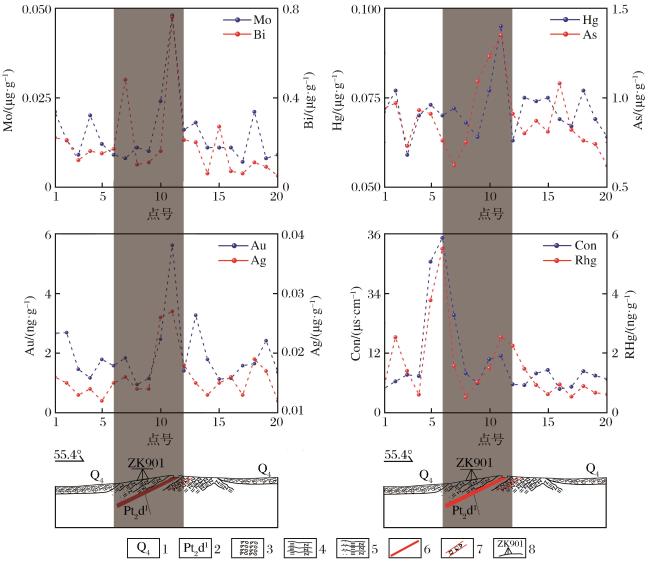
4#剖面位于未知区西北部的连家湾。该剖面包含一个见矿钻孔ZK901(图3)。该地质剖面出露地层为大狼山群,岩性以白云钠长片岩为主,局部夹绿泥钠长片岩、白云石英钠长片岩和绿泥白云钠长片岩等。该剖面地表第四系覆盖强烈,难见断裂露头,通过对民采坑进行调查,在剖面上发现一条构造断裂带。岩性为具有弱褐铁矿化、绢云母化和硅化的破碎构造角砾,可见破碎石英岩和白云钠长片岩碎块角砾发育,推断其走向为165°~185°,倾角为50°~54°。
3.2 4#线剖面地电化学综合异常特征
通过绘制元素含量剖面图发现,地电化学提取和土壤离子电导率、土壤热释汞均呈现出不同程度的异常。由图3可知,在已知4#线剖面上,异常主要分布于6~12号点之间,异常宽度为120 m,与深部矿体位置吻合度较高,在此范围内,各元素均出现明显峰值。
地电提取Au元素异常形态呈“双峰状”,异常范围为0.95~5.62 ng/g,该范围内Au的峰值点为11号点,峰值为5.62 ng/g,为背景值的3.5倍,异常范围与已知矿体的赋存部位呈良好的对应关系;13号点作为一个次级峰值,峰值为3.27 ng/g,对应于已知金矿体东侧的褐铁矿化蚀变带,是矿化蚀变作用的直接响应。Ag元素的异常形态呈“单峰状”,异常范围为0.014~0.027 μg/g,峰值点为12号点,峰值为0.027 μg/g,为背景值的2倍,异常形态完整,能够很好地反映矿体信息。
Mo元素异常形态呈“单峰状”,异常范围为0.10~0.76 μg/g,峰值点为11号点(0.76 μg/g),为异常值的5倍;Bi元素异常形态呈“兔耳状”,异常范围为0.008~0.048 μg/g,峰值点为11号点(0.048 μg/g),为背景值的4倍,Mo和Bi元素为典型的高温元素,在此范围内与已知矿体位置对应,在热液体系中常与Au元素共生,均具有较强的指示作用。由图3可知,二者异常峰值与Au元素异常峰值对应良好,且与已知矿体中该异常峰值的赋存部位呈显著对应关系。
As元素异常形态呈“单峰状”,异常范围为0.62~1.35 μg/g,异常形态较好,峰值点为11号点(1.35 μg/g),为该区域提取的最大值。Hg元素异常形态与As元素极为相似,呈“单峰状”,异常范围为0.63~0.95 μg/g,异常形态完整,在已知矿体上方响应显著。
土壤离子电导率(Con)异常形态呈“兔耳状”。异常峰值分别位于6号测点和11号测点,土壤离子电导率(Con)异常峰值分别位于6号和11号测点,其中11号测点对应矿体出露近地表端,6号测点为单元素、电导率和热释汞多指标综合异常圈定的异常尾端。该现象源于矿体自身发生电化学溶解形成原电池效应,溶解产生的矿化信息在电场力或其他力的驱动下,迁移并富集于矿体两端对应的地表土壤中(汤国栋,2021)。土壤热释汞(RHg)异常形态与土壤离子电导率异常极为相似,呈“兔耳状”,其中6号和11号测点为异常区内的峰值点,异常峰值为5.5 ng/g,是背景值的5.6倍。该异常对矿体及褐铁矿化、硅化、断裂蚀变带的指示显著。
通过在已知剖面开展地电化学集成技术可行性试验研究可知,该方法在矿体上方均有异常显示,异常位置与矿体位置吻合度高。因此,地电化学集成技术在该地区寻找隐伏金矿体是可行且有效的。
4 地质—地电化学找矿模型构建
4.1 找矿标志
地质找矿标志:研究区出露地层主要为中元古界大狼山群、上元古界下震旦统过路湾组及上震旦统尚家店组。钻孔验证结果表明,金矿体主要赋存在上元古界震旦系尚家店组的白云钠长片岩和白云石英钠长片岩中。区内以NW向新城—黄陂断裂带为主,以多条含次级羽状断裂的近E向断裂为辅助构造,两类断裂对成矿具有显著控制作用,区内绝大多数金银、多金属矿点均分布于上述断裂带交会处。研究区围岩蚀变受断裂破碎带控制,呈带状分布,与金矿有关的蚀变主要有硅化、绢云母化和黄铁矿化,其次为绿泥石化和碳酸盐化等。
地电化学找矿标志:在已知4#线剖面上开展的地电化学集成技术找矿可行性、有效性试验研究发现,地电化学提取的Ag、Au、Hg、RHg和Con等异常范围与己知矿体吻合度高,可见上述指标均可作为寻找深边部隐伏金矿的有效地电化学找矿标志。
4.2 地质—地电化学集成技术找矿模型构建
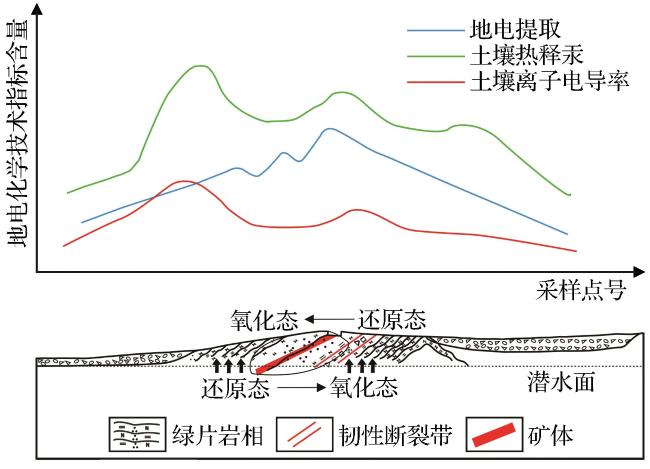
从研究区成矿地质背景可以看出,金矿主要赋存于上震旦统尚家店组白云钠长片岩层中,矿体围岩普遍发育硅化,局部可见绢云母化和黄铁矿化。矿区地质构造活跃,尤其是与区域构造走向相吻合的NE向构造,为岩浆和含矿热液的上升创造了空间。同时,这些构造产生的次级断裂也成为矿产富集的场所。因此,矿体的倾斜方向与地层倾斜方向大致相同,而断裂为地电化学集成技术检测到的离子提供了理想的传输路径。综上所述,结合已知4#线剖面的地质—地电化学特征及未知区地电化学综合异常特征,构建出枣园地区寻找隐伏金矿的地质—地电化学综合找矿模型(图4)。
5 找矿应用
5.1 单元素异常特征
表1 研究区地电方法提取各元素特征值统计Table 1 Statistical of characteristic values of elements extracted by geoelectrical methods in the study area |
| 元素 | 原始数据 | 迭代后 | ||||||
|---|---|---|---|---|---|---|---|---|
| 最大值 | 最小值 | 均值 | 标准偏差 | 变异系数Cv1 | 均值 | 标准偏差 | 变异系数Cv2 | |
| Au | 31.12 | 0.8 | 2.93 | 3.55 | 1.21 | 1.91 | 0.73 | 0.38 |
| Ag | 0.115 | 0.009 | 0.0169 | 0.0096 | 0.57 | 0.0157 | 0.0046 | 0.30 |
| Hg | 0.167 | 0.01 | 0.032 | 0.02 | 0.61 | 0.031 | 0.014 | 0.45 |
| As | 3.52 | 0.32 | 0.86 | 0.45 | 0.52 | 0.77 | 0.26 | 0.33 |
| Mo | 1.10 | 0.04 | 0.14 | 0.11 | 0.79 | 0.12 | 0.05 | 0.42 |
| Bi | 0.109 | 0.002 | 0.016 | 0.014 | 0.88 | 0.013 | 0.006 | 0.48 |
|
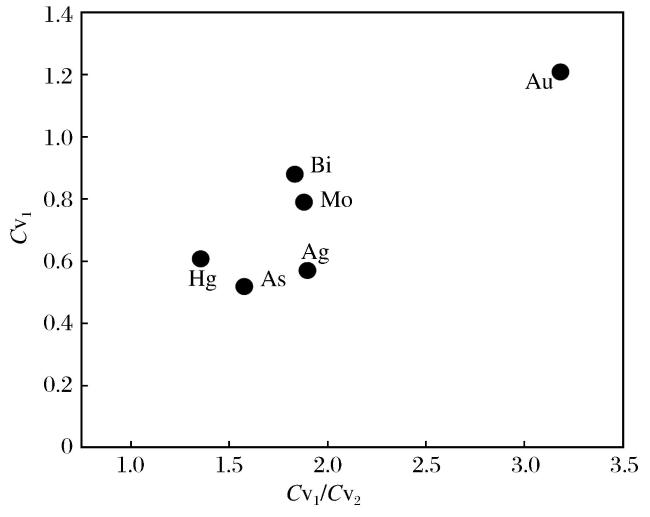
由图5可知,Au元素的离散程度最大,表明其元素含量变化幅度较大且高值点突出,是本区最具成矿优势的元素;Ag、Mo、As、Hg和Bi元素的变异程度次之,且Cv1/Cv2比值均大于1,表明这些元素也具有一定的成矿潜力。
表2 研究区各元素异常分带值Table 2 Anomaly zoning values of various elements in the study area |
| 元素 | 异常分级指标 | ||
|---|---|---|---|
| 外带下限 | 中带下限 | 内带下限 | |
| Au | 4.19 | 6.43 | 9.55 |
| Ag | 0.021 | 0.025 | 0.032 |
| Hg | 0.048 | 0.055 | 0.069 |
| As | 1.14 | 1.39 | 2.16 |
| Mo | 0.20 | 0.25 | 0.45 |
| Bi | 0.023 | 0.027 | 0.051 |
|
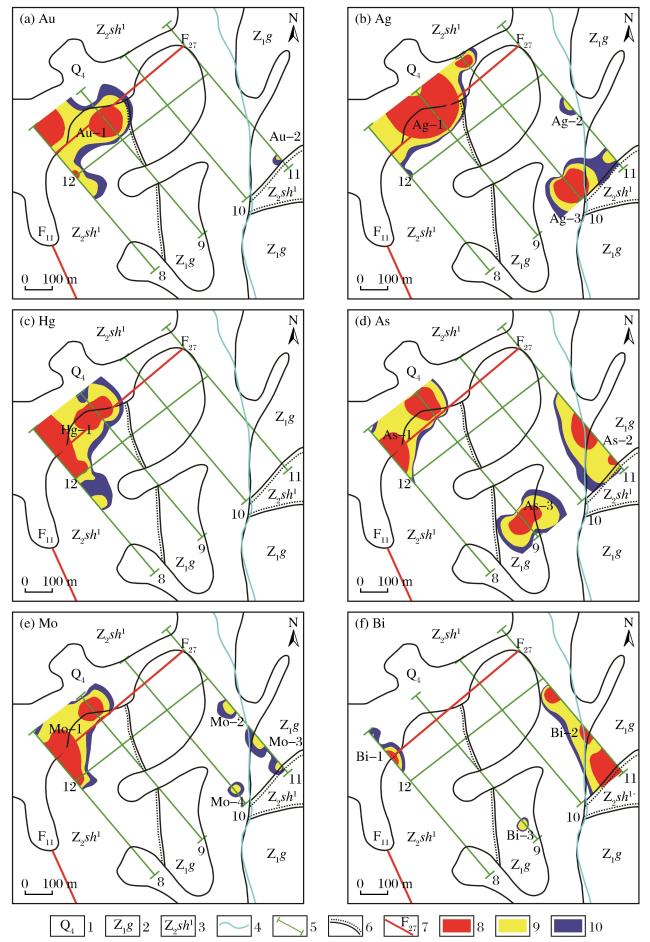
由图6可知,研究区主要发育2处Au元素异常。Au-1异常位于未知区西部,异常峰值为31.12 ng/g,为异常下限的7.5倍,异常面积约为0.04 km²,异常强度高且分布集中。异常呈NE向展布,与F27断层走向一致。该处出露上元古界上震旦统尚家店组大理岩,发育含多金属硫化物石英脉,脉体两侧见绢英岩化。8号和9号测线分别从异常内、中、外带穿过,异常呈现清晰的三级浓度分带特征,并显示向外部延伸的趋势;Au-2异常位于未知区东北部,处于研究区边缘,仅由外中带组成,该处异常强度较小,出露地层为过路湾组,异常区域不整合接触界线展布。该不整合面为构造薄弱带,后期构造—岩浆活动易使其破碎形成导矿、储矿空间;其古风化壳发育的黏土矿物与有机质,可吸附还原含矿热液中的Au元素,促使成矿元素沉淀富集(顾雪祥等,2008;杨天赐等,2025)。与之套合极为相似的Hg元素异常也位于未知区西部,呈NE向展布,处于F27断裂处,其含量最大值为0.167 μg/g,是异常下限的3.5倍,异常面积为0.033 km2,异常强度高且范围大。Hg元素具有易蒸发的特点,对于隐伏构造具有一定的指示效果,矿体和围岩空隙、裂隙越发育,连通性越好,越有利于Hg元素的富集(蓝天等,2018)。
在未知区,As、Mo和Bi元素异常与Au元素具有一定相似性,均呈现显著异常特征。As异常峰值为3.52 μg/g,是异常下限(1.14 μg/g)的3倍,共圈定3处异常,As-1异常位于西北部,强度高且范围大,富集于上震旦统尚家店组,并沿F₂₇断裂呈NE向展布,与Au异常的核心富集区重叠;As-2和As-3异常分别处于东部、南部的上震旦统过路湾组,均具完整三级浓度分带且对应区域发育不整合接触界线。Mo异常峰值为1.1 μg/g,是异常下限(0.20 μg/g)的5.5倍,共圈定4处异常,Mo-1异常位于西北部,与Au-1异常核心区共处于F₂₇断裂带,Mo-2、Mo-3和Mo-4异常分布于东部、南部的过路湾组,异常三级浓度分带完整且对应区域发育不整合接触界线。作为高温钨钼族元素,Mo常赋存于花岗岩类浅色矿物中,可随热液系统长距离迁移富集,其异常分布反映深部岩浆热液的成矿贡献(赵欣怡等,2022);Bi异常峰值为0.109 μg/g,是异常下限(0.023 μg/g)的4.7倍,共圈定3处异常,Bi-1异常位于西北部,沿F₂₇断裂富集于尚家店组,Bi作为高温亲硫元素,与Au常赋存于同一黄铁矿化载体中,其异常由构造控制隐伏矿体引发的特征,与Au异常的构造控矿规律一致。Bi-2和Bi-3异常处于东部、南部的过路湾组,均具完整三级浓度分带且对应区域发育不整合接触界线(刘延斌等,2018)。As为典型的低温前缘晕元素,Mo和Bi则为典型的高温尾晕元素,三者在研究区具有相似的地球化学空间分布模式,暗示着该区存在强烈的剥蚀活动,也可能反映了该地区存在多期次多阶段的成矿活动(李莲,1986)。
Ag异常峰值为0.115 μg/g,是异常下限(0.021 μg/g)的5.5倍,在未知区共圈定3处异常。其中Ag-1异常位于研究区西北部,异常强度高且范围大,主要富集于上震旦统尚家店组,沿F₂₇断裂呈NE向展布,与Au-1异常核心区对应关系较为契合;Ag-2和Ag-3异常位于未知区东部,Ag-3异常主要富集于上震旦统过路湾组,异常三级浓度分带完整,区域内发育不整合接触界线。作为典型亲硫元素,Ag与Au同属热液成矿系统的核心伴生元素,成矿过程中二者以硫化物络合物形式同步迁移,在断裂部位因物理化学条件突变共同沉淀(史磊等,2024)。
由单元素异常图(图6)可以看出,异常区域主要位于未知区西部和东部,个别元素在南部也具有不同程度的异常。其中西部异常强度高、范围大,各元素套合情况良好。说明成矿与断裂密切相关,断裂的空间展布在较大程度上决定着矿体的空间赋存,也说明地电提取测量法的效果显著。
5.2 土壤热释汞及离子电导率异常特征
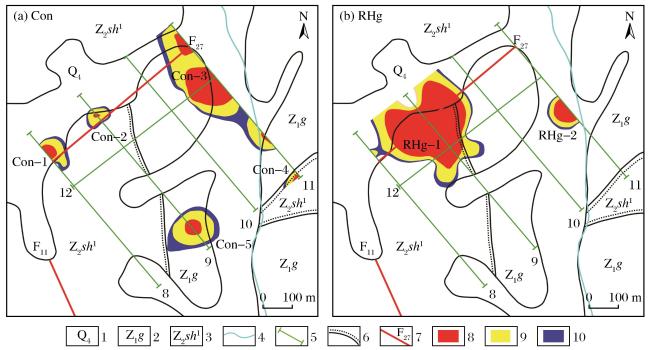
土壤离子电导率和土壤热释汞异常展布总体呈现出沿NE向延伸,异常分带明显(图7)。土壤离子电导率异常面积为0.037 km2,异常峰值为39.8 μs/cm,在研究区可圈定出3处异常区。第一处异常位于研究区西北部,由Con-1和Con-2组成,呈不规则面状分布,异常规模不大,主要集中在8号和9号线4、5、6号点,该异常展布方向与F27断裂带的走向高度一致,表明该断裂为深部矿化离子向上迁移提供了主要通道;第二处异常位于研究区东北部,由Con-3和Cin-4组成,异常主要集中在11号线,Con-3异常规模较大,呈条带状分布,在该区以黏土、亚黏土和砂砾为主。Con-4异常较小,处于上震旦统尚家店组和下震旦统过路湾组的不整合接触带附近。第三处异常位于研究区南部,异常规模较大,呈似圆状分布。热释汞异常规模较大,异常面积为0.039 km2,在F27断裂带附近有大规模的异常,与地电化学提取各元素异常套合较好。这是由于汞具有较强的穿透力并以气态形式持续沿构造破碎带上升等特点(邹东风等,2020)。
6 成矿靶区预测
综合成矿地质条件、地电化学单元素异常特征、土壤热释汞和离子电导率异常的套合情况,将未知区异常划分为三级找矿靶区(图8):Ⅰ类靶区成矿条件最优,异常组合最完整;Ⅱ类靶区次之;Ⅲ类靶区显示一定找矿线索。该分级体系为后续勘查工作提供了明确方向。
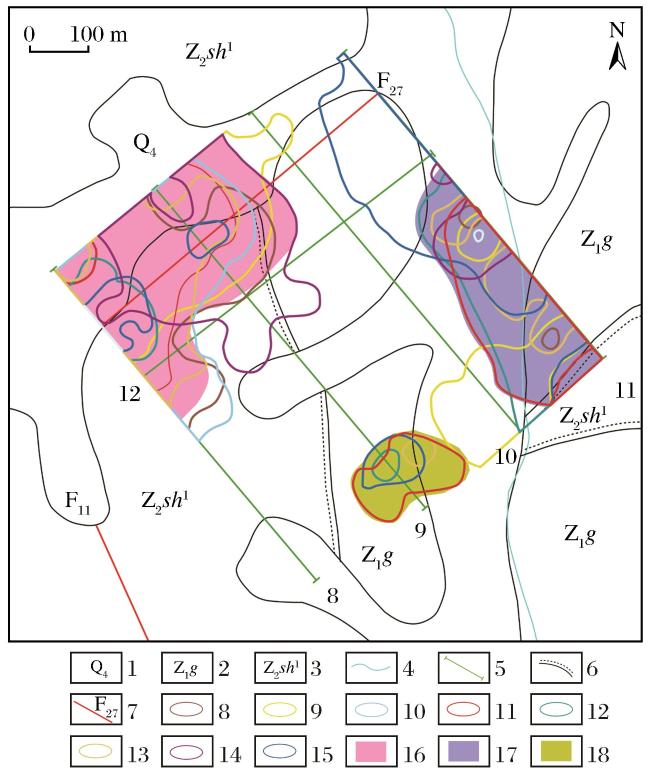
Ⅰ类靶区:位于未知区西部,由Au、Ag、Hg和As等单元素以及土壤热释汞和电导率异常组成,其中Au元素异常规模较大(0.041 km2),强度高,元素异常与地层套合性良好,具有极大的找矿潜力。推测异常是由一条NE向断裂带(F27)控制。区内发育高、中、低温元素,反映该区域成矿具有多期次和多阶段性(刘文韬等,2025),是寻找隐伏金矿(化)体的最有利区域。因此,该靶区具备较高的找矿潜力,是后续勘查工作的优先目标区域。
Ⅱ类靶区:位于未知区东部,面积为0.028 km2,主成矿元素Au地电化学提取异常规模与地表强度相对较小,但区内已发现品位达10×10-6以上的金矿体,深部矿化信息明确。同时,该区与金成矿密切相关的Ag、Bi和Mo等指示元素异常清晰,规模及强度均较大,土壤热释汞和离子电导率异常亦呈现出清晰的三级分带特征,与矿化元素异常空间套合良好。此外,异常区内部发育不整合接触界线,具备优越的地层—构造控矿条件。综合前人工作成果与本区实际矿化线索、地电化学综合异常特征分析,认为该区域具有可靠的找矿潜力与验证价值。
Ⅲ类靶区:位于未知区南部,面积为0.016 km2,由Mo、Bi和As元素组成,元素间套合度较高,异常分带明显,同时,异常区域内有不整合接触界线展布,表明仍具有一定的找矿潜力,但是主成矿元素及伴生元素异常规模小,延续性一般,与土壤离子电导率、热释汞异常套合度不高。暂将该区划分为Ⅲ类靶区,值得开展进一步验证性研究。
7 结论
(1)在已有工程控制矿体的剖面开展找矿可行性试验研究,结果表明地电化学集成技术能够反映深部矿体赋存位置。该技术对于厚层第四系覆盖区具有显著的应用效果。充分说明利用地电化学集成技术在研究区寻找隐伏金矿(化)体是可行且有效的。
(2)以上震旦统尚家店组白云钠长片岩等赋矿层位、NW向及次级断裂控矿构造,以及硅化、黄铁矿化等围岩蚀变作为地质标志,以Au、Ag和Hg等元素异常,以及土壤离子电导率和热释汞“兔耳状”异常作为地电化学标志,构建了隐伏金矿地质—地电化学综合找矿模型。该模型融合了地质成矿特征与地电化学技术优势,既为未知区找矿提供了科学指导,也为同类覆盖区隐伏金矿勘查提供了有效技术范式。
(3)根据研究区地电化学综合异常特征以及土壤离子电导率、热释汞异常特征,结合研究区成矿地质特征,以构建的地质—地电化学综合找矿模型为指导,在研究区开展找矿预测,共圈定出Ⅰ类、Ⅱ类和Ⅲ类找矿靶区各1个,其中,Ⅰ类靶区最具有成矿潜力。

 甘公网安备 62010202000672号


