

锌在合金制造和防腐涂层等方面发挥着重要作用,被广泛应用于基础设施建设、汽车制造、机械制造和房屋建造等行业(夏丛等,2025)。镉是一种稀散金属,在颜料制造、塑料稳定剂、碲化镉晶体和太阳能材料等行业得到广泛应用(于扬等,2024)。锌资源需求持续增长和易选锌矿日益匮乏共同推动了铁闪锌矿高效回收利用研究的深入发展。
铁闪锌矿是由于铁原子取代闪锌矿中的部分锌原子形成的,这种原子取代导致铁闪锌矿的可浮性降低、分选难度提高。硫化锌矿浮选体系中常含有镁层状硅酸盐矿物,蛇纹石是其中之一;蛇纹石易过磨泥化,微细蛇纹石颗粒通过泡沫夹杂和异相凝聚等方式进入锌精矿,导致锌精矿品位降低、氧化镁含量增高(李小黎等,2021;Liu et al,2021a;李煜等,2025)。此外,在锌湿法冶炼工艺中,镁离子具有比锌离子更低的标准电极电位和更高的水解pH值,会导致浸出液中镁离子浓度逐渐升高,进而带来管道结晶和液体流动性变差等问题(李耀山,2024)。
针对蛇纹石恶化硫化矿选矿指标的问题,国内外学者在选矿降镁工艺和浮选降镁药剂2个方面进行了大量研究,选矿降镁工艺主要是阶段磨矿—选别、新型磨矿介质应用和磁罩盖降镁等方面(Li et al,2022;张婷等,2025),常用的降镁抑制剂有磷酸盐、碳酸盐、羧酸类、膦酸类、纤维素类、壳聚糖和木质素磺酸盐等(Liu et al,2021b;郑润浩等,2024;环艳等,2025)。谢海云等(2021)针对云南兰坪某锌含量3.14%、氧化镁含量16.11%的高镁锌矿,结合细磨解离和水玻璃—六偏磷酸钠组合抑制含镁矿物,在-0.045 mm粒级含量为90%的细度条件下,采用“一粗一扫三精”浮选流程,获得锌品位为52.53%、锌回收率为90.19%的锌精矿。由于原矿性质和选矿工艺的差异,加上矿物间交互作用复杂,业界尚无通用的蛇纹石抑制剂能够实现在各类矿石浮选中高效稳定地降镁除杂。
河北某高镁低品位锌矿中Zn、Cd和MgO含量分别为1.60%、50.60×10⁻⁶和34.47%,铁闪锌矿与含镁脉石矿物共生关系复杂。为降低氧化镁含量获得合格的锌精矿,采用工艺矿物学、浮选试验与机理研究相结合的方法,确定了降镁效果良好的组合药剂,获得了较好的锌精矿产品指标,试验结果为高镁低品位铁闪锌矿回收利用提供了可行的技术思路。
1 样品性质
1.1 原矿化学多元素及锌物相分析结果
表1 原矿化学多元素检测结果Table 1 Chemical multi-element test results of raw ore |
| 成分 | 含量/% | 成分 | 含量/% | 成分 | 含量/% |
|---|---|---|---|---|---|
| Zn | 1.60 | Al2O3 | 1.66 | S | 1.09 |
| Cu | 0.08 | SiO2 | 37.66 | As | 27.8 |
| Pb | 0.01 | CaO | 5.56 | Cd | 50.60 |
| TFe | 3.38 | K2O | 0.36 | Au | <0.10 |
| MgO | 34.47 | Na2O | 0.28 | Ag | 3.96 |
|
表2 原矿锌物相检测结果Table 2 Zinc phase test results of raw ore |
| 锌相别 | 含量/% | 分布率/% |
|---|---|---|
| 合计 | 1.61 | 100.00 |
| 硫酸锌 | 0.01 | 0.62 |
| 氧化锌 | 0.07 | 4.35 |
| 硫化锌 | 1.51 | 93.79 |
| 其他形态锌 | 0.02 | 1.24 |
1.2 原矿矿物组成及共生关系
表3 矿物组成及其含量检测结果Table 3 Test results of mineral composition and its content |
| 矿物 | 含量/% | 矿物 | 含量/% |
|---|---|---|---|
| 铁闪锌矿 | 1.81 | 钙铝榴石 | 0.40 |
| 蛇纹石 | 69.31 | 白云母 | 0.33 |
| 辉石 | 11.15 | 黄铁矿 | 0.20 |
| 角闪石 | 2.58 | 磁黄铁矿 | 0.15 |
| 绿泥石 | 2.55 | 橄榄石 | 0.11 |
| 方解石 | 2.43 | 白云石 | 0.09 |
| 斜长石 | 1.95 | 黄铜矿 | 0.06 |
| 硅镁石 | 1.36 | 榍石 | 0.05 |
| 绿帘石 | 1.22 | 磷灰石 | 0.04 |
| 石英 | 1.11 | 电气石 | 0.02 |
| 钾长石 | 0.93 | 高岭土 | 0.02 |
| 黑云母 | 0.67 | 碳酸盐矿物 | 0.98 |
| 磁铁矿 | 0.48 |
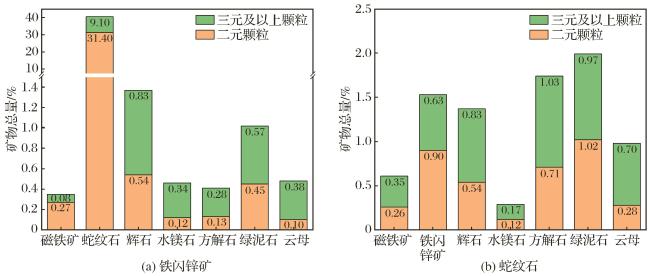
1.3 铁闪锌矿和蛇纹石嵌布特征
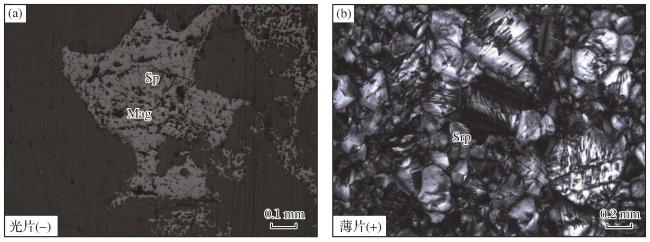
1.4 电子探针分析结果
利用电子探针定量分析,研究了原矿中铁闪锌矿的微量元素含量。结果表明,Fe含量为5.33%~8.13%,平均含量为6.17%;Mn含量为0.33%~0.94%,平均含量为0.47%;稀散元素Cd主要赋存在铁闪锌矿中,其含量为0.09%~0.17%,平均含量为0.13%。
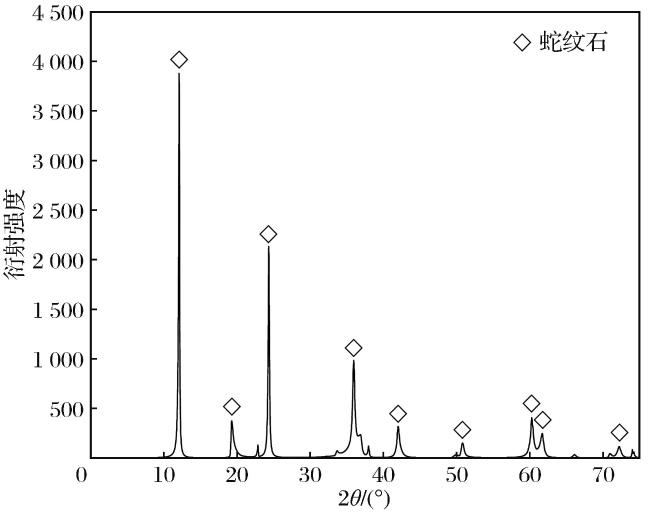
1.5 蛇纹石纯矿物
2 试验方法
2.1 浮选条件试验
每次取1 000 g样品进行磨矿,磨矿产品移入XFD3.0 L型单槽式浮选机中,设置叶轮搅拌转速为1 992 r/min,浮选前调浆2 min,浮选浓度约为33%,然后依次加入调整剂、捕收剂和起泡剂,进行浮选。泡沫精矿与槽内尾矿分别脱水干燥、称重和取样,检测Zn、Cd或MgO含量,推算得出回收率,再综合判定试验效果。
2.2 FTIR分析
在浮选槽中加入蛇纹石和去离子水,再加入过量柠檬酸+六偏磷酸钠,充分搅拌30 min后,将矿浆过滤,并使用去离子水将滤饼洗涤2次,随后在40 ℃条件下烘干。在玛瑙研钵中,将100 mg光谱级纯度的KBr与1 mg待测样品充分混合,研磨至-2 μm,取适量样品放于模具中压制成透明薄片,在Nicolet Is5红外光谱分析仪中进行分析,得到待测样品的红外光谱图。
2.3 SEM-EDS分析
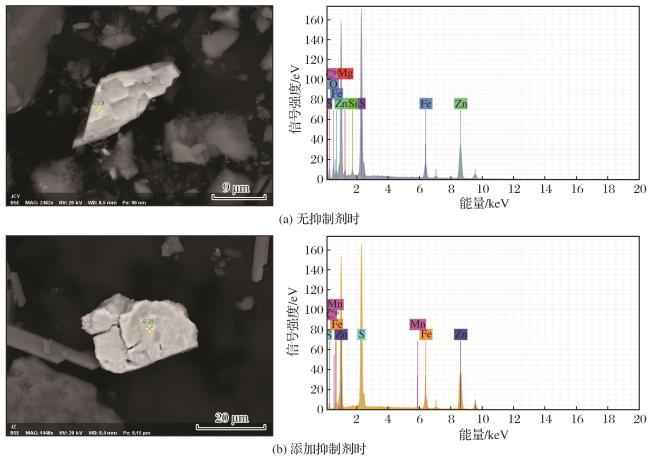
移入XFD3.0 L型单槽式浮选机的原矿磨矿产品经充分搅拌后,抽取适量矿浆经过滤脱水后,于40 ℃条件下烘干24 h,制备药剂作用前样品;磨矿产品经充分搅拌后,加入柠檬酸+六偏磷酸钠(药剂用量参照浮选条件试验确定),按相同脱水干燥步骤制备得到药剂作用后的样品。利用ZEISS SIGMA 300型扫描电镜能谱分析仪,观察研究抑制剂作用前后铁闪锌矿表面元素含量变化和形貌特征变化。
3 试验结果与讨论
3.1 抑制剂种类试验
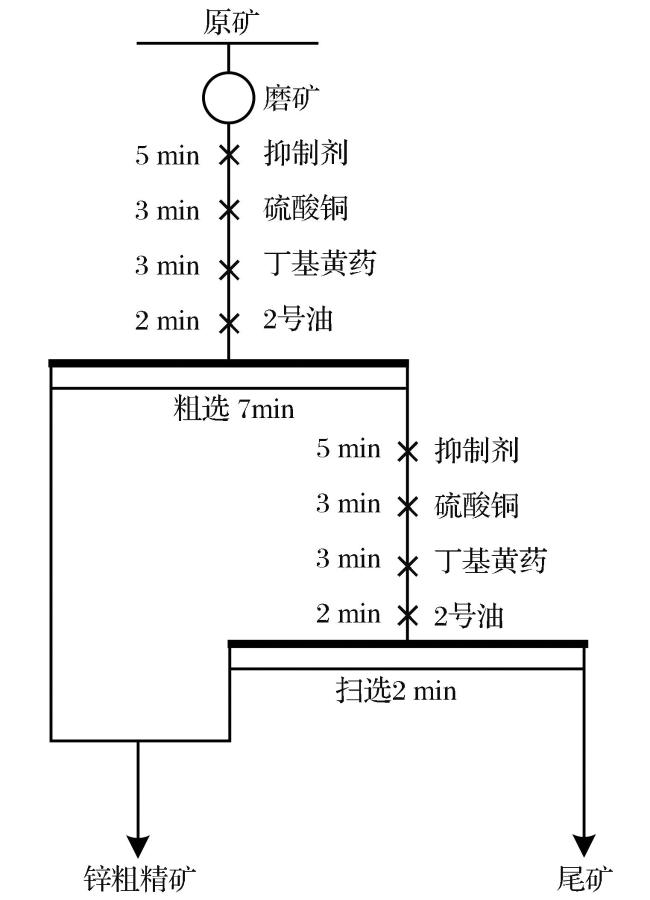
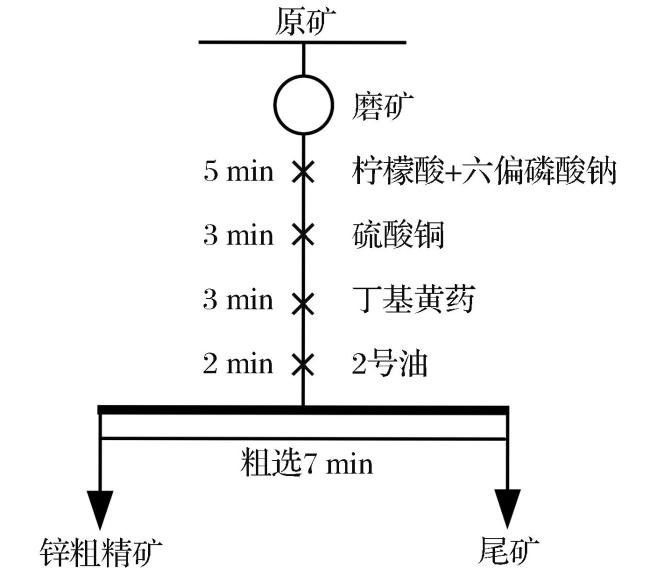
原矿中含有大量蛇纹石,在磨矿过程中会产生蛇纹石微细颗粒,使浮选矿浆的表观黏度增加,并通过异相凝聚和泡沫夹杂等形式恶化锌矿物浮选过程,解决易泥化蛇纹石对浮选环境的不利影响是获得良好分选效果的关键问题。参考铁闪锌矿的浮选实践和矿石性质,粗选试验条件如下:磨矿细度(-0.075 mm含量)为67.89%、CuSO4用量为500 g/t、丁基黄药用量为100 g/t、2号油用量为24 g/t,SHMP、CMC、BETZ、HPA和SOPH分别代表六偏磷酸钠、羧甲基纤维素、柠檬酸、植酸钠和2-羟基膦酰基乙酸钠,组合抑制剂CMC+SHMP、BETZ+SHMP、HPA+SHMP和SOPH+SHMP的用量均为800 g/t+800 g/t,单一抑制剂SHMP用量为1 600 g/t。粗选药剂用量与扫选药剂用量之比为2∶1,研究抑制剂种类对锌浮选指标的影响,试验流程和结果分别如图4和图5所示。
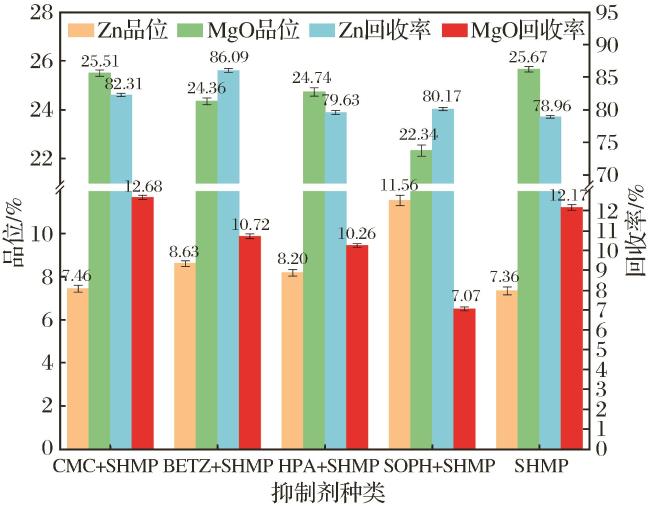
由图5可知,锌粗精矿中Zn、MgO的品位和回收率受5类抑制剂的影响不同,锌品位变化范围为7.36%~11.56%,锌回收率为78.96%~86.09%;MgO品位变化范围为22.34%~25.67%,MgO回收率为7.07%~12.68%。当抑制剂为柠檬酸+六偏磷酸钠时,锌粗精矿回收率最高,锌品位较高,分别为86.09%和8.63%,其中MgO的品位和回收率分别为24.36%和10.72%。因此,后续试验选择柠檬酸+六偏磷酸钠作为蛇纹石抑制剂。
3.2 磨矿细度对浮选指标的影响
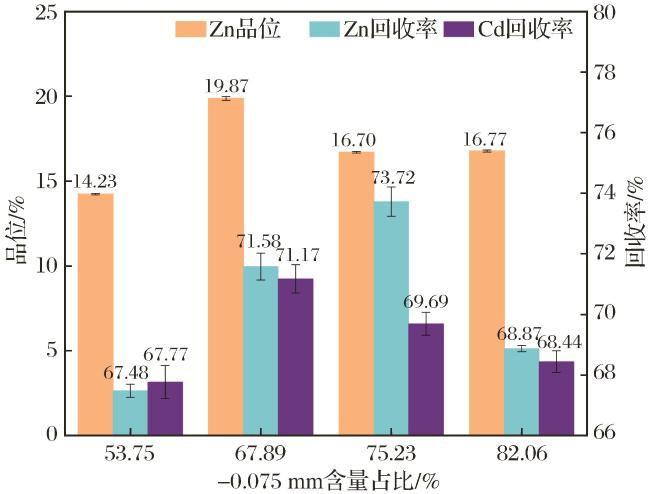
由图7可知,镉回收率、锌品位及锌回收率均随着-0.075 mm粒级含量的增加呈现出先升高后降低的变化趋势,当-0.075 mm粒级含量超过75.23%后,锌回收率和镉回收率均降低。综合考虑回收率和磨矿成本,确定适宜的磨矿细度(-0.075 mm含量)为75.23%。
3.3 柠檬酸用量对浮选指标的影响
在破碎磨矿过程中,蛇纹石沿(110)和(010)晶面发生破裂后,产生带不饱和键的镁质子,从而使蛇纹石表面带正电(车宇航等,2023);蛇纹石破裂面的镁质子能够被柠檬酸溶出,从而降低矿浆中蛇纹石与闪锌矿的表面电位差,有效缓解2种矿物之间的异相凝聚(Liu et al,2021b)。参照图6进行锌粗选试验,磨矿细度(-0.075 mm含量)为75.23%,SHMP的药剂用量为800 g/t,CuSO4的药剂用量为500 g/t,C4H9OCSSNa的药剂用量为100 g/t,2号油的药剂用量为24 g/t,BETZ用量分别为200,400,600,800 g/t,研究锌、镉和氧化镁浮选指标受柠檬酸用量的影响;试验用水的pH值为7.68,未添加浮选药剂的矿浆初始pH值为8.22,仅加入SHMP试剂后pH值为8.16,矿浆加入BETZ+SHMP调降2 min检测矿浆的pH值,试验结果见图8。
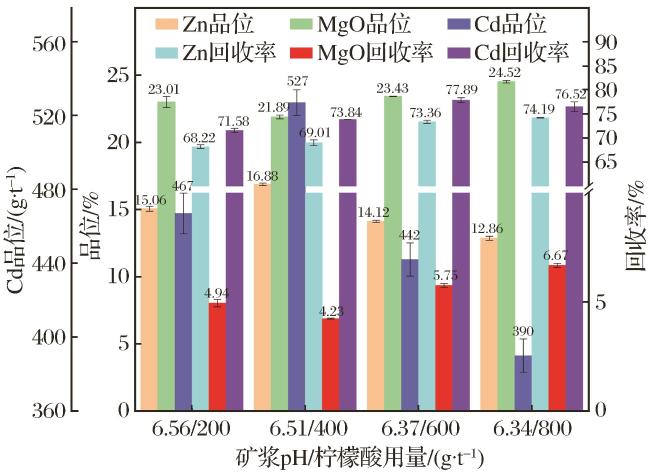
由图8可知,将柠檬酸用量由200 g/t提高至800 g/t,矿浆pH值由6.56降低至6.34,锌品位由15.06%升高至16.88%再降低至12.86%,锌回收率不断增加,镉品位和回收率均呈先升高后降低的变化趋势,氧化镁品位和回收率均呈先降低后升高的变化趋势。当柠檬酸用量为600 g/t时,锌粗精矿中锌品位和锌回收率分别为14.12%和73.36%,继续提高柠檬酸用量,锌粗精矿中锌品位降低,而锌回收率增加幅度较小。综合考虑,确定适宜的柠檬酸用量为600 g/t,此条件下矿浆pH值为6.37。
3.4 六偏磷酸钠用量对浮选指标的影响
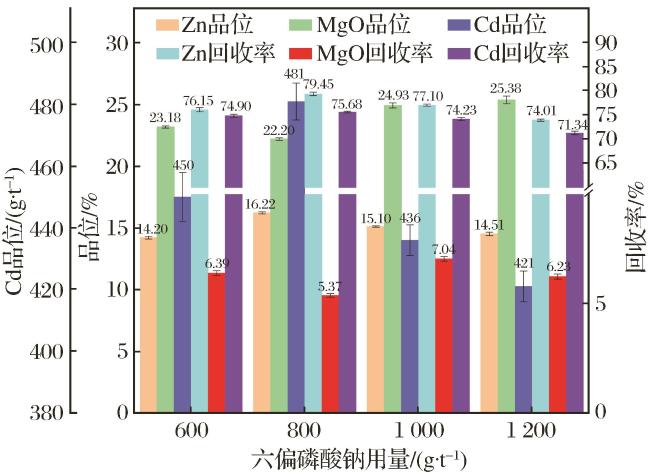
由图9可知,随着六偏磷酸钠用量由600 g/t增加至1 200 g/t,锌品位由14.20%提高至16.22%后降低至14.51%,锌回收率由76.15%提高至79.45%后降低至74.01%,氧化镁品位由23.18%降低至22.20%后升高至25.38%,氧化镁回收率由6.39%降低至5.37%后升高至7.04%,镉品位和镉回收率均呈先升高后降低的变化趋势。综合考虑,确定适宜的六偏磷酸钠用量为800 g/t。
3.5 CuSO4用量对浮选指标的影响
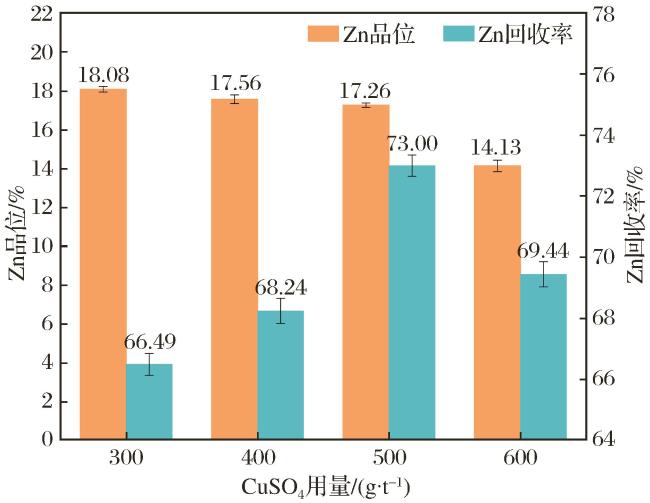
Fe3+取代闪锌矿晶格中的Zn2+形成铁闪锌矿,这种晶格成分变化既降低了矿物天然可浮性,又阻碍捕收剂在锌矿物表面的有效附着,从而增加了铁闪锌矿的回收难度,铁闪锌矿常用的活化剂是CuSO4(胡泽伟等,2025,Kong et al,2025;Ma et al,2025)。按照图6进行锌粗选试验,固定试验条件如下:磨矿细度(-0.075 mm粒级含量)为75.23%,BETZ药剂用量为600 g/t,SHMP药剂用量为800 g/t,C4H9OCSSNa用量为100 g/t,2号油用量为24 g/t。CuSO4用量分别为300,400,500,600 g/t,考察锌品位和锌回收率受CuSO4用量的影响,试验结果见图10。
3.6 丁基黄药用量对浮选指标的影响
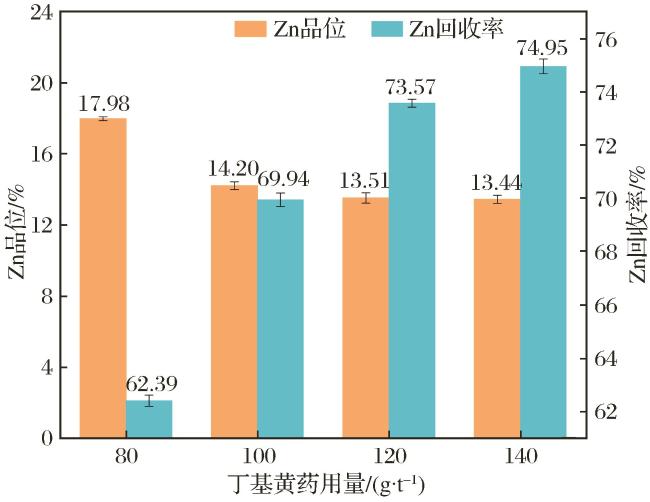
由图11可知,丁基黄药用量由80 g/t增加至140 g/t,锌品位从17.98%降低至13.44%,锌回收率从62.39%提高至74.95%。综合考虑产品指标和药剂用量,确定后续试验的丁基黄药用量为120 g/t。
3.7 浮选闭路试验
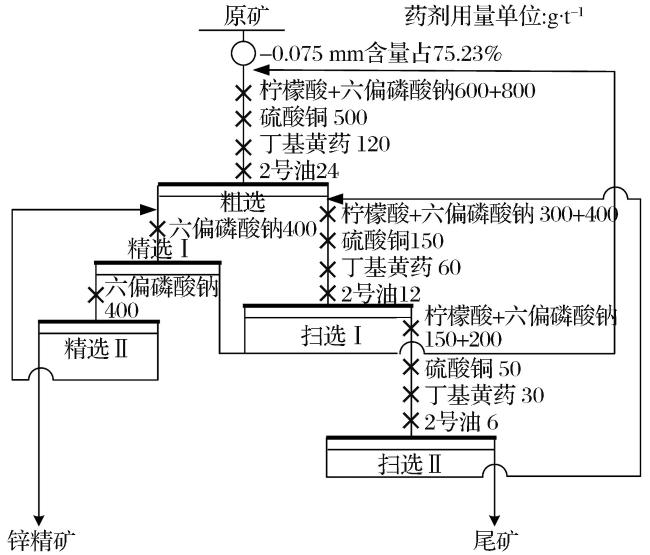
表5 闭路浮选锌镉试验结果Table 5 Test results of closed circuit flotation zinc-cadmium |
| 产品 名称 | 产率/% | 品位/% | 回收率/% | ||||
|---|---|---|---|---|---|---|---|
| Zn | Cd | MgO | Zn | Cd | MgO | ||
| 锌精矿 | 2.89 | 48.52 | 1 400 | 1.92 | 89.47 | 84.20 | 0.16 |
| 尾矿 | 97.11 | 0.17 | 7.82 | 35.47 | 10.53 | 15.80 | 99.84 |
| 原矿 | 100.00 | 1.57 | 48.00 | 34.50 | 100.00 | 100.00 | 100.00 |
|
由表5可知,浮选闭路试验获得的锌精矿中锌、镉和氧化镁含量分别为48.52%、1 400×10-6和1.92%,回收率分别为89.47%、84.20%和0.16%,锌精矿指标良好,说明柠檬酸+六偏磷酸钠协同降镁效果明显。与谢海云等(2021)对云南兰坪某高镁锌矿的研究相比,本浮选工艺在原矿氧化镁含量高出18.36个百分点和磨矿细度较粗的情况下,取得了相当的锌精矿指标。
3.8 FTIR分析结果
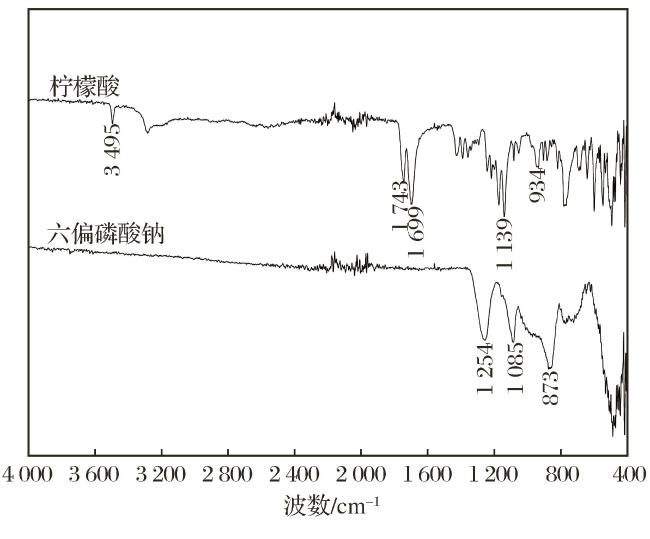
由图13可知,柠檬酸红外光谱在3 495 cm-1、1 743 cm-1、1 699 cm-1、1 139 cm-1和934 cm-1处出现5个特征峰,分别对应-OH伸缩振动峰、C=O伸缩振动峰、C=O伸缩振动峰、CH2的面外摇摆振动峰以及OH···O=的面外变形振动峰(Liu et al,2021a;董留洋,2022);在六偏磷酸钠红外光谱中,1 254 cm-1处为六偏磷酸钠分子中的P=O伸缩振动峰,1 085 cm-1处为P-O伸缩振动峰,873 cm-1处为P-O-P伸缩振动峰(薛斐嘉等,2024)。
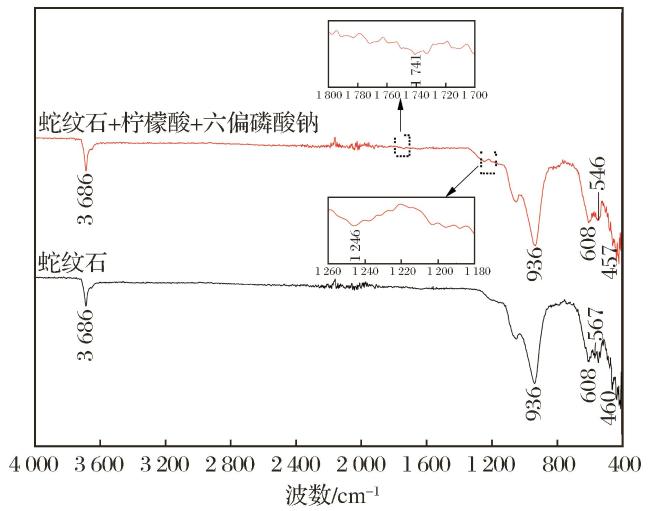
由图14可知,蛇纹石在3 686 cm-1、936 cm-1、608 cm-1、567 cm-1和460 cm-1处出现5个特征峰,分别对应-OH伸缩振动峰、Si-O伸缩振动峰、-OH弯曲振动峰、Mg-O面外振动峰和Si-O弯曲振动峰(李治杭等,2024;薛姗娜,2023)。当蛇纹石与柠檬酸+六偏磷酸钠作用时,红外光谱在1 741 cm-1和1 246 cm-1处出现了2处新峰,前者与柠檬酸中C=O伸缩振动峰相近,后者与六偏磷酸钠中P=O伸缩振动峰相近,这说明柠檬酸和六偏磷酸钠均在蛇纹石上发生了吸附;与蛇纹石的红外光谱相比,药剂作用时Mg-O面外振动峰由567 cm-1偏移至546 cm-1,这可能是由于蛇纹石表面的Mg2+与六偏磷酸钠的多磷酸根阴离子产生络合作用(李小黎等,2021),或是其与柠檬酸的羧基产生螯合作用引起的(Liu et al,2021a)。
六偏磷酸钠是直链多聚偏磷酸盐,化合物的链长达20~100个PO ,分子式一般认为是(NaPO3)6,pH值为5.5~6.4,水溶液中的多磷酸根阴离子是能够与Ca2+、Mg2+等络合的优势组分。六偏磷酸钠在水溶液中按式(1)~式(5) 水解(曹锡章等,2013)。
(NaPO3)6+6H2O⇌6NaOH+6HPO3
HPO3+H2O⇌H3PO4
H3PO4⇌H++H2PO
H2PO⇌H++H2PO
H2PO⇌H++PO
3.9 SEM-EDS分析
表6 抑制剂处理前后铁闪锌矿表面元素含量Table 6 Elements content of the marmatite surface before and after inhibitor treatment |
| 样品名称 | 相对含量/% | ||||||
|---|---|---|---|---|---|---|---|
| Zn | S | Fe | O | Mg | Si | Mn | |
| 无抑制剂样品 | 38.96 | 27.38 | 8.08 | 6.40 | 1.88 | 0.99 | |
| 添加抑制剂样品 | 49.15 | 28.20 | 7.92 | 0.78 | |||
4 结论
(1)在磨矿细度(-0.075 mm含量)为75.23%、柠檬酸用量为600 g/t、六偏磷酸钠用量为800 g/t、CuSO4用量为500 g/t、丁基黄药用量为120 g/t和2号油用量为24 g/t的条件下,采用“一粗二扫二精、中矿顺序返回”的浮选闭路流程,获得的锌精矿含锌48.52%、镉1 400×10-6和氧化镁1.92%,回收率分别为89.47%、84.20%和0.16%。
(2)柠檬酸和六偏磷酸钠能够通过络合作用吸附在蛇纹石表面,柠檬酸提供的H+能够提高六偏磷酸钠水解的优势络合组分含量,有效地改善蛇纹石与铁闪锌矿的异相凝聚。
(3)在丁基黄药浮选体系下,柠檬酸+六偏磷酸钠能够对蛇纹石产生协同抑制作用,实现铁闪锌矿与蛇纹石的高效浮选分离,对高镁低品位铁闪锌矿的降镁除杂具有一定的借鉴意义。

 甘公网安备 62010202000672号


