

铅锌是关键的大宗有色金属,在全球工业化进程和经济发展中发挥着不可替代的作用,广泛应用于机械、电气、军事、新能源、化工和冶金等工业领域(杨荣林,2018;李鑫等,2024)。其中,铅的主要用途是制造铅蓄电池,占总消耗量的70%以上;锌的应用需求仅排在铜和铝之后,主要应用于钢材防腐蚀镀层、合金制造、化工和医药业等领域(赵青,2020)。我国拥有十分丰富的铅锌资源,为铅锌冶炼产业的蓬勃发展提供了坚实基础,且该行业产量持续增长。进入21世纪后,我国精炼铅、锌的消费量呈不断增长趋势,至2010年我国铅、锌消费量分别占全球总消费量的45.1%和42.9%(代涛等,2013)。随着工业化进程的不断深入,铅锌矿产资源的需求依然保持旺盛状态,尽管我国铅锌产量在不断增加,但远达不到自产自销的供需平衡,我国对国外铅锌资源的依存度依然较高(孙传尧等,2019)。因此,在当前形势下,加大对我国铅锌矿资源的勘探开发力度,对保障我国铅锌矿产业的持续健康发展至关重要。
在矿产资源综合开发利用中,需通过研究矿石的工艺矿物学和选冶技术性能,为其可行性评价提供关键依据。工艺矿物学是矿物学的一个分支,是一门以研究矿物处理和矿物原料加工过程为主要内容的学科。在选矿方面,工艺矿物学主要研究矿石的化学成分、矿物组成、矿石结构构造、目的矿物的嵌布特征及其物化性质,以及矿物在选矿过程的行为,为诠释选矿机理、制定选矿工艺方案和实现选矿过程优化提供了矿物学依据(曾令明等,2018;傅开彬等,2020;李莎莎,2021;吕超等,2021;龚傲等,2022)。根据矿产勘查矿石加工选冶技术性能试验研究程度的要求,矿石加工选冶试验研究过程可细分为以下5类:初步评估的可选性试验、推荐工艺流程的实验室流程试验、利用扩大试验设备的实验室扩大连续试验、利用专门试验车间的半工业化试验和利用现有生产车间的工业试验(全国自然资源与国土空间规划标准化技术委员会,2020)。
广东某铅锌矿石处于开发利用阶段,为初步判断该矿石的可选性和主要有用组分的可利用性,本文在工艺矿物学研究的基础上,利用实验室的规模、设备和常规浮选药剂,采用可工业化应用的浮选工艺流程进行了矿石可选性试验。
1 试验内容
1.1 试验样品与药剂
表1 原矿化学多元素分析结果Table 1 Chemical multi-element analysis results of raw ore(%) |
| 组分 | 含量 | 组分 | 含量 |
|---|---|---|---|
| Pb | 2.72 | SiO2 | 59.37 |
| Zn | 2.28 | Al2O3 | 12.25 |
| Cu | 0.021 | CaO | 1.38 |
| Cd | 0.013 | MgO | 0.18 |
| TFe | 5.35 | MnO | 1.07 |
| As | 0.023 | Na2O | 2.62 |
| S | 2.51 | K2O | 3.86 |
| P | 0.021 | Ag | 65.00 |
|
1.2 试验方法
(1)工艺矿物学研究。为了查明原矿的矿石类型、矿物组成及含量,铅锌银等主要矿物的产出形式及其嵌布特性,主要有价金属元素和有害元素的赋存状态,以及银在原矿中的赋存状态及走向等特征,从而为选矿工艺研究和确定产品方案提供矿物学依据,选取代表性样品(包括原矿、块矿和原矿的分级产品),采用光学显微镜、X射线衍射分析(XRD)、扫描电镜分析(SEM)、能谱微区成分分析、多元素化学分析、元素化学物相分析和MLA(矿物参数自动分析系统)测定等分析手段开展了详细的工艺矿物学研究。
(2)浮选试验。利用吉林省探矿机械厂生产的XFD系列单孔浮选机进行实验室浮选试验,搅拌速度为1 992 r/min。根据物料重量或矿浆浓度选择浮选槽的大小,粗选和扫选一般选择3 L浮选槽,精选一般选择0.75 L或0.50 L浮选槽。浮选试验步骤如下:①将待选试料与自来水混合搅拌1 min,得到质量浓度为28%~35%的均匀矿浆;②向矿浆中依次加入所需量的调整剂、抑制剂、捕收剂和起泡剂,每种药剂搅拌1~3 min,使其与矿物充分作用;③充气刮取泡沫产品;④若进行扫选作业,则对粗选后浮选槽内的矿浆重复②、③步骤;⑤若进行精选作业,则对粗选泡沫产品重复①~③步骤,精选的矿浆质量浓度一般为10%~25%;⑥对浮选试验获得的精矿、中矿和尾矿等产品分别进行干燥、称重和有价金属元素含量的检测,计算回收率。
2 工艺矿物学研究
2.1 化学物相分析
表2 铅、锌、银的化学物相分析结果Table 2 Chemical phase analysis results of lead,zinc and silver(%) |
| 元素 | 物相 | 含量 | 分布率 |
|---|---|---|---|
| Pb | 硫化铅 | 2.43 | 89.34 |
| 硫酸铅 | 0.21 | 1.10 | |
| 碳酸铅 | 0.03 | 7.72 | |
| 铅铁矾 | 0.05 | 1.84 | |
| 合计 | 2.72 | 100.00 | |
| Zn | 硫化锌 | 2.18 | 95.61 |
| 碳酸锌 | 0.05 | 2.19 | |
| 硫酸锌 | 0.01 | 0.44 | |
| 锌铁尖晶石 | 0.04 | 1.76 | |
| 合计 | 2.28 | 100.00 | |
| Ag | 自然银 | 7.35 | 11.31 |
| 硫化银 | 42.69 | 65.68 | |
| 氯化银 | 0.78 | 1.20 | |
| 硫化物中银 | 12.21 | 18.78 | |
| 脉石中银 | 1.97 | 3.03 | |
| 合计 | 65.00 | 100.00 |
|
2.2 矿物组成及含量
矿块新鲜面在肉眼下显灰黑色,可见金属硫化物呈浸染状不均匀分布,部分块矿因金属硫化物含量较高而具有结构较致密的块状构造。采用MLA对主要矿物的含量进行统计,结果见表3。结合镜下鉴定和XRD分析可知,矿石中矿物种类多样且复杂,方铅矿、闪锌矿和黄铁矿是主要的金属矿物,含量分别为2.75%、3.39%和2.48%,其他矿物有铅矾、白铅矿、铅铁矾、砷铝铅矾、毒砂、黄铜矿、赤铁矿和褐铁矿,银矿物仅见辉银矿。脉石矿物以长石(钾长石和斜长石,36.15%)、石英(34.79%)和绿泥石(10.60%)为主,其次为云母(绢云母和黑云母)、菱锰矿和萤石,微量矿物有方解石、磷灰石和高岭石等。
表3 原矿矿物组成及含量分析结果Table 3 Analysis results of mineral composition and content of raw ore(%) |
| 矿物 | 含量 | 矿物 | 含量 |
|---|---|---|---|
| 方铅矿 | 2.75 | 斜长石 | 16.35 |
| 铅矾 | 0.13 | 绢云母、黑云母 | 3.41 |
| 白铅矿 | 0.02 | 阳起石、透辉石 | 0.06 |
| 砷铝铅矾 | 0.01 | 方解石 | 0.41 |
| 闪锌矿 | 3.39 | 菱锰矿 | 2.84 |
| 银矿物 | 0.01 | 萤 石 | 1.2 |
| 黄铁矿 | 2.48 | 高岭石 | 0.12 |
| 毒砂 | 0.05 | 磷灰石 | 0.14 |
| 赤铁矿、褐铁矿 | 1.03 | 绿泥石 | 10.6 |
| 石英 | 34.79 | 其他 | 0.41 |
| 钾长石 | 19.8 |
2.3 主要矿物的产出形式
(1)铅矿物。方铅矿在反射光下呈白色,均质体,具典型的三角形凹陷。SEM能谱微区成分分析结果显示,Pb平均含量为86.54%。根据方铅矿的形态特征、粒度大小及其与其他矿物嵌连关系的密切程度,可将矿石中方铅矿的产出形式划分为3种。一是以不规则团块状或粗粒状嵌布在脉石中,其中部分以脉状、团块状形式充填交代于闪锌矿、黄铁矿等其他金属硫化物的粒间、边缘或裂隙,但是这种形式的方铅矿内部包含少量细小的闪锌矿、黄铁矿或脉石残余,而使其实际粒度发生不同程度的细化[图1(a)~1(d)];二是呈粒度大小不一的不规则粒状、短脉状和蠕虫状等多种形态以浸染状的形式嵌布在脉石基底中,多见于团块状方铅矿的边部或相邻部位,部分沿脉石粒间充填者则构成似网格状交生关系,局部因粒度过于细小而表现出云雾状结构特征[图1(e)、1(f)];三是呈微细的粒状或细脉状、微脉状、网脉状沿粒间、孔洞和裂隙充填交代闪锌矿或黄铁矿,相互之间常构成穿插或包裹镶嵌等较为复杂的交生类型[图1(c)~1(e)]。
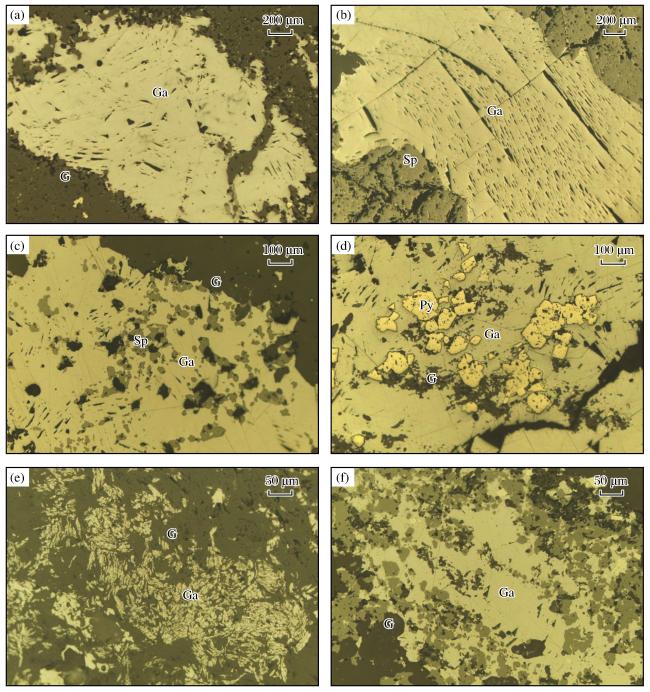
根据镜下粗略统计,上述3种产出形式的方铅矿矿物含量比例大致为50∶30∶20。显然,第3种形式的方铅矿与其他金属硫化物的镶嵌关系较为复杂,即使通过细磨也难以使部分微细嵌布的方铅矿单体解离,从而影响铅的回收率。
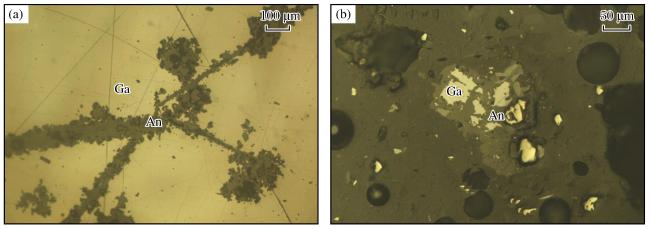
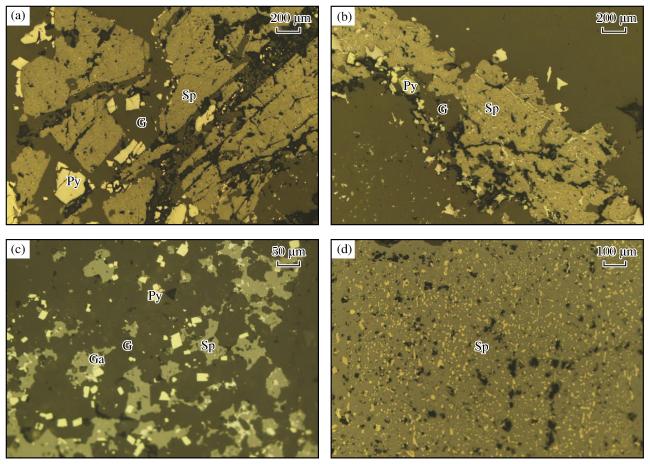
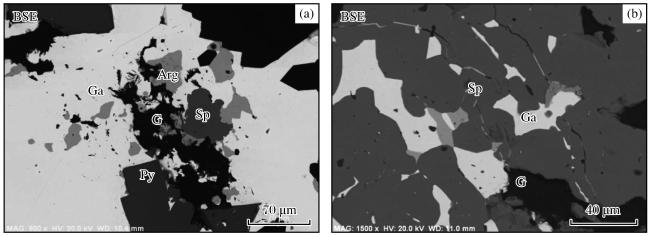
(2)闪锌矿。闪锌矿是锌在矿石中的主要存在形式。在透射光下呈现透明度低的红褐至黑褐色,并在反射光下展现出深红褐色的内反射色,这是由于闪锌矿广泛存在的类质同像置换现象而富含Fe元素,属于铁闪锌矿的范畴,且包含一定量的镉,但不含银(极个别晶粒除外),平均Zn含量为57.31%,Fe含量为9.39%,Cd含量为0.41%。70%左右的闪锌矿呈粒状或团块状以浸染状形式嵌布在脉石中,其中部分因包含十分微细的方铅矿不仅使相互之间的镶嵌关系趋于复杂,而且也使其粒度发生不同程度的细化[图1(b),图3(a)~3(c)];30%左右的闪锌矿呈不规则粒状、细脉状和网脉状与方铅矿紧密镶嵌,相互之间的接触界线通常为不规则的锯齿状或港湾状,以致构成极为复杂的镶嵌关系,粒度相对较为细小[图1(c)、1(f)]。需要指出的是,在部分闪锌矿晶粒的核心区域,明显包含有通过固熔体分离作用而析出的乳滴状黄铜矿和微细的磁黄铁矿,其粒度多数在0.01 mm以下[图3(d)]。无论是哪种形式的闪锌矿,均与方铅矿有着较为复杂的交生关系,特别是部分闪锌矿内部常包含粒度十分微细的方铅矿,这种镶嵌关系将直接导致锌精矿中铅含量偏高,同时也会影响锌的回收率。
2.4 影响选矿效果的主要矿物学因素分析
(1)矿石中方铅矿和闪锌矿的粒度普遍较粗,具中粗粒—中粒嵌布的特点,但二者之间常因交代作用而具有较为复杂的镶嵌关系,说明在较粗的磨矿细度条件下,通过选矿容易获得铅锌的混合粗精矿,但要获得独立的高品位铅精矿或锌精矿还需通过磨矿细度试验来确定。
(2)矿石中方铅矿的产出形式较为复杂,除少数因氧化形成铅矾之外,常呈微细的粒状包裹在闪锌矿中,即使通过细磨,部分方铅矿仍以连生体形式与闪锌矿镶嵌。由此推断,铅精矿中Zn元素含量将偏高或锌精矿中Pb元素含量将偏高。
(3)矿石中闪锌矿属于锌含量偏低的铁闪锌矿,内部除含有因固溶体分离作用形成的乳滴状黄铜矿以外,还普遍含有微细的磁黄铁矿,即使采用细磨也很难使这些包裹体得到解离,从而影响锌精矿的品位。
(4)与辉银矿镶嵌关系最密切的矿物是方铅矿,其次为闪锌矿。虽然通过选矿可使辉银矿在铅精矿中得到较大程度的富集,但仍有部分辉银矿将随同闪锌矿一起进入锌精矿。
3 可选性试验研究
3.1 试验方案的确定
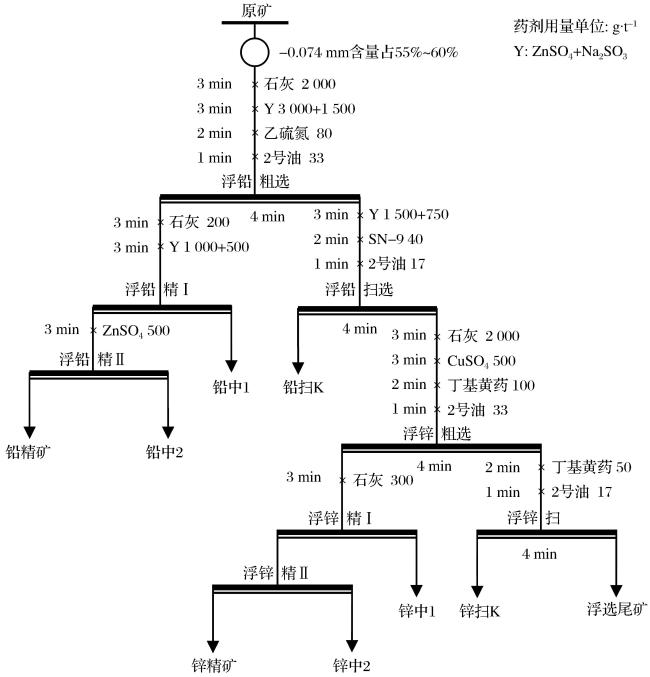
矿石中铅、锌和银分别主要以硫化铅(方铅矿)、硫化锌(闪锌矿)和硫化银(辉银矿)的形式存在,其占比依次为89.34%、95.61%和65.68%,属于含银的原生铅锌硫化矿矿石,需要排除的其他金属矿物主要是黄铁矿。浮选是铅锌多金属硫化矿分选中最常用的方法,而方铅矿、闪锌矿与黄铁矿之间存在明显的可浮性差异(Chen et al,2022;Zou et al,2022,2023; Kong et al,2024),可采用优先浮选工艺流程进行回收。窦源东等(2023)以河北某铅锌矿为例,在工艺矿物学的基础上采用浮铅—浮锌的优先浮选流程,闭路试验获得Pb品位为58.63%、Pb回收率为78.36%的铅精矿(其中Zn含量为5.92%),以及Zn品位为52.34%、Zn回收率72.15%的锌精矿(其中Pb含量为1.28%)。李希掌等(2021)以湖南某铅锌矿为例,采用浮铅—浮锌的优先浮选流程,常规高碱工艺和绿色无碱工艺均获得满意的浮选指标。众所周知,石灰是黄铁矿的常用抑制剂,ZnSO4+Na2SO3是闪锌矿的常用组合抑制剂,乙硫氮是方铅矿的常用捕收剂,CuSO4和丁基黄药分别是闪锌矿常用的活化剂和捕收剂(孙体昌等,2002;邱廷省等,2016;刘洋等,2022;Pan et al,2022;李强等,2024;周立波等,2024;Liu et al,2025)。为初步确定该矿石的可选性,选择这些常规浮选药剂,采用石灰抑硫、ZnSO4+Na2SO3抑锌优先浮铅,再用CuSO4活化浮锌的优先浮选工艺流程,进行磨矿细度、铅浮选条件(如抑制剂和捕收剂用量)和锌浮选条件(如抑制剂、活化剂和捕收剂用量)等优化试验,获得整个浮选工艺流程的药剂制度,如图5所示。
3.2 浮选开路试验
表4 浮选开路试验结果Table 4 Results of the flotation open-circuit test |
| 产品名称 | 产率/% | 品位/% | 回收率/% | ||
|---|---|---|---|---|---|
| Pb | Zn | Pb | Zn | ||
| 合计 | 100.00 | 2.72 | 2.21 | 100.00 | 100.00 |
| 铅精矿 | 2.74 | 67.40 | 3.03 | 67.87 | 3.75 |
| 铅中2 | 1.03 | 35.27 | 8.53 | 13.35 | 3.97 |
| 铅中1 | 1.94 | 8.24 | 5.30 | 5.87 | 4.64 |
| 铅扫K | 1.53 | 13.10 | 4.92 | 7.37 | 3.40 |
| 锌精矿 | 3.25 | 1.41 | 46.61 | 1.68 | 68.42 |
| 锌中2 | 0.30 | 1.12 | 12.82 | 0.12 | 1.74 |
| 锌中1 | 1.91 | 0.73 | 3.90 | 0.51 | 3.36 |
| 锌扫K | 1.19 | 0.86 | 10.54 | 0.38 | 5.66 |
| 浮选尾矿 | 86.11 | 0.09 | 0.13 | 2.85 | 5.06 |
3.3 浮选闭路试验
表5 浮选闭路试验结果Table 5 Results of the flotation closed-circuit test |
| 产品名称 | 产率 /% | 品位/% | 回收率/% | ||||
|---|---|---|---|---|---|---|---|
| Pb | Zn | Ag | Pb | Zn | Ag | ||
| 合计 | 100.00 | 2.80 | 2.22 | 65.62 | 100.00 | 100.00 | 100.00 |
| 铅精矿 | 3.93 | 65.08 | 3.03 | 1 323.80 | 91.32 | 5.37 | 79.28 |
| 锌精矿 | 4.57 | 2.92 | 41.70 | 183.65 | 4.76 | 85.96 | 12.79 |
| 浮选尾矿 | 91.50 | 0.12 | 0.21 | 5.69 | 3.92 | 8.67 | 7.93 |
|
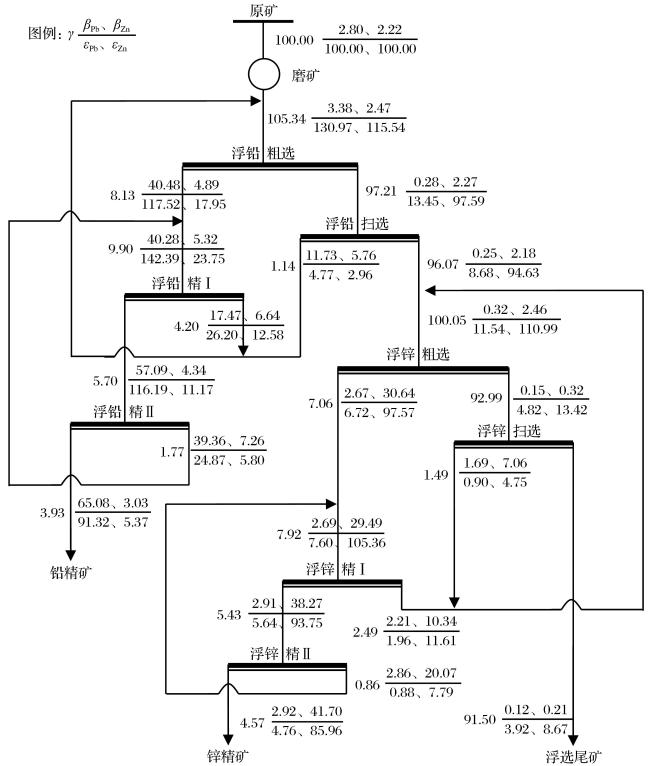
由表5可知,浮选闭路试验最终获得铅精矿Pb品位为65.08%、Pb回收率为91.32%,其中Zn含量为3.03%;锌精矿Zn品位为41.70%、Zn回收率为85.96%,其中Pb含量为2.92%。铅精矿Pb品位和杂质Zn含量均达到一级品质量标准(YS/T319-2013铅精矿一级品标准:Pb品位大于等于65%,Zn含量小于等于4.0%),Pb回收率高达91.32%,但剩余的铅(8.68%)中有一半以上损失于锌精矿,且锌精矿中Zn品位仅为41.70%,而Pb含量达2.92%,相对于锌精矿质量标准是偏高的(YS/T320-2014锌精矿四级品标准:锌精矿Zn品位大于等于40%,Pb含量小于等于2.5%),这与第2.4小节中影响选矿效果的主要矿物学因素第(2)、(3)条相吻合。Ag主要富集在铅精矿中,其含量为1 323.80×10⁻⁶,回收率为79.28%,另有12.79%的Ag富集在锌精矿中,这与工艺矿物学中Ag的产出形式保持一致。由表4和表5可知,随着闭路试验的进行,中矿中有用矿物铅锌矿得到有效分选,即Pb富集在铅精矿中,Zn富集在锌精矿中,说明所拟定的浮选流程是合适的。全流程数质量流程如图6所示。
4 结论
(1)原矿属于含银的原生铅锌硫化矿矿石。硫化铅是矿石中铅的主要存在形式,其次为硫酸铅,所占比例分别为89.34%和7.72%;锌的赋存状态相对单一,主要以硫化锌(闪锌矿)形式存在,占比为95.61%;银主要以硫化银形式存在。矿石中金属矿物主要有闪锌矿、方铅矿和黄铁矿,脉石矿物以长石、石英和绿泥石为主,其次为绢云母、黑云母、菱锰矿和萤石。
(2)根据矿石特性,采用优先浮铅—活化浮锌的工艺流程进行可选性试验研究,获得了稳定的试验指标。闭路试验获得Pb品位为65.08%、Pb回收率为91.32%的铅精矿(其中含锌3.03%)以及Zn品位为41.70%、Zn回收率为85.96%的锌精矿(其中含铅2.92%)。有价金属银在铅精矿产品中得到明显富集,含量为1 323.80 g/t,回收率为79.28%。锌精矿中Pb的高含量和银的富集走向与工艺矿物学研究结果呈现出高度的一致性和对应性。
(3)可选性试验研究表明,该矿石具有一定的可选性和回收利用价值。建议开展系统的流程试验或扩大连续试验研究,进一步提高锌精矿的质量,为下一步工业化应用提供技术依据。

 甘公网安备 62010202000672号


