

随着矿山开采不断向深部发展,井巷作为连接地表与地下矿体的重要通道,其稳定性遇到诸多挑战。井巷围岩不仅承受高地应力的作用,而且受到围岩蠕变和采区扰动等长期因素,以及开挖卸荷和爆破振动等短期因素的共同影响(王旭锋等,2023),进而发生破裂和变形等破坏状况(康红普等,2015;谢和平等,2015;孙朝燚等,2024)。井巷失稳不仅影响矿山正常生产,还会威胁作业人员的安全。因此,对井巷变形进行准确预测并提前识别围岩破裂风险,对于矿山安全生产至关重要(芦楠楠等,2019)。
近年来,随着计算机和人工智能技术的发展,众多学者使用机器学习模型对井巷位移进行预测。其中,一维卷积神经网络(1DCNN)、门控循环单元(GRU)、长短期记忆网络(LSTM)及其改进模型在井巷和隧道位移预测中得到广泛应用(赵楠等,2021;He et al,2023;崔靖奇等,2024;刘辉等,2025)。此外,结合模拟退火算法的自适应神经模糊网络(SA-ANFIS)、基于鲸鱼优化算法的BP神经网络(WOA-BP)和采用粒子群优化算法的长短期记忆网络(PSO-LSTM)等方法,通过对神经网络模型的参数优化,在提升井巷位移的预测精度中也展现出优势(Xie et al,2021;Du et al,2022;吴泽鑫等,2024)。上述研究证实了使用神经网络模型对井巷位移进行预测能够取得较好的预测效果。然而,现有研究采用单一神经网络模型的方法存在一定局限性。具体表现为BP神经网络易陷入局部极值,卷积神经网络在全局特征提取方面存在局限,循环神经网络易受梯度消失和爆炸问题困扰(郭风景等,2023;翟小伟等,2025)。此外,仅采用单一模型存在难以协同解析井巷位移中短期扰动响应与长期演化趋势的多时间尺度耦合特征的缺点。因此,构建具备多尺度特征解耦能力的预测模型,对于进一步提升井巷预测精度和增强模型泛化性能具有重要意义。
针对上述问题,本研究提出了一种融合加性注意力机制的时间卷积网络和长短期记忆网络(TCN-LSTM)模型。该模型结合时间卷积网络(TCN)与长短期记忆网络(LSTM)的优势,通过TCN提取时序数据的局部突变特征,利用LSTM捕捉长期依赖关系,引入加性注意力机制动态分配TCN和LSTM的输出贡献,通过多尺度特征解耦机制实现局部特征与全局记忆的优势互补,从而为复杂时序数据的精确预测提供新路径。
1 研究方法
1.1 时间卷积网络
时间卷积网络(TCN)是一种基于深度卷积神经网络的时序建模方法,能够通过层次化的时序特征提取机制和严格的因果约束,实现对时间序列数据的高效建模(周小燕等,2025)。TCN网络的核心结构主要由扩张卷积、膨胀卷积和残差连接3个部分组成(图1)。因果卷积采用一维卷积核将数据沿时间轴滑动计算,并通过左填充的方式,使卷积核仅覆盖历史时间步,确保当前时刻的输出仅依赖于历史及当前时刻的输入,能够有效避免未来信息泄露。膨胀卷积通过指数级增长的膨胀因子控制采样间隔,能够在不增加参数量的前提下扩大其感受野,且通过浅层小膨胀因子能够有效捕捉局部突变特征。残差连接模块包含卷积层、激活函数、归一化层和跳跃连接,通过跳跃连接融合浅层细节特征和深层抽象表征,能够在缓解梯度消失和加速模型收敛的同时,增强模型对于复杂时序特征的表征能力。
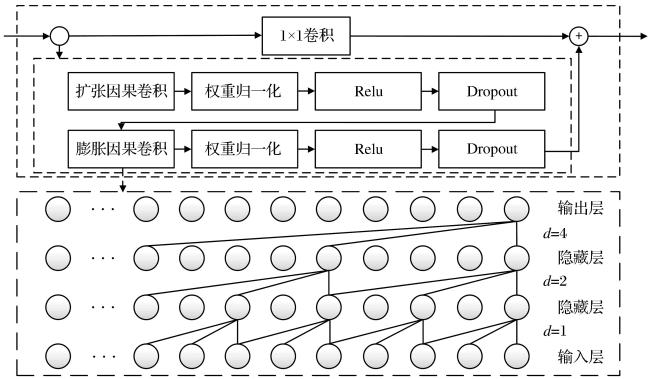
膨胀因果卷积和残差连接的计算公式如下:
式中: 为时间步t的输出; 为卷积核的第i个权重参数; 为输出序列中时间步 的值; 为膨胀率,用来控制卷积核的间隔采样;k为卷积核大小,决定覆盖时间步数量;F(x)为经过卷积层和激活函数后的特征; 为1×1卷积调整通道数,使残差与主路径维度相匹配。
1.2 长短期记忆网络
长短期记忆网络(LSTM)作为循环神经网络的重要改进架构,通过门控机制有效解决了传统RNN存在的梯度消失和梯度爆炸问题(荣光旭等,2023)。其核心优势体现在对时间序列数据长期依赖关系的建模能力,通过改进梯度反向传播过程中的信息传递效率,显著提升了对时间序列数据的处理性能。LSTM单元的核心在于构建了由遗忘门、输入门和输出门3种门控机制和具有长期记忆功能的细胞状态(图2)。其中,输入门依据当前输入向量与前一时刻状态,采用Sigmoid激活函数动态调节当前输入信息向细胞状态的传递强度;遗忘门通过Sigmoid函数计算遗忘概率,及时剔除失效信息以维持记忆系统的有效性;输出门通过Sigmoid函数和tanh双重激活机制,从更新后的细胞状态中提取与当前任务相关的特征表示。在各种机制的协同作用下,LSTM能够有效地记住对模型重要的信息,同时摒弃冗余干扰信息,在长序列数据处理任务中具有显著优势。
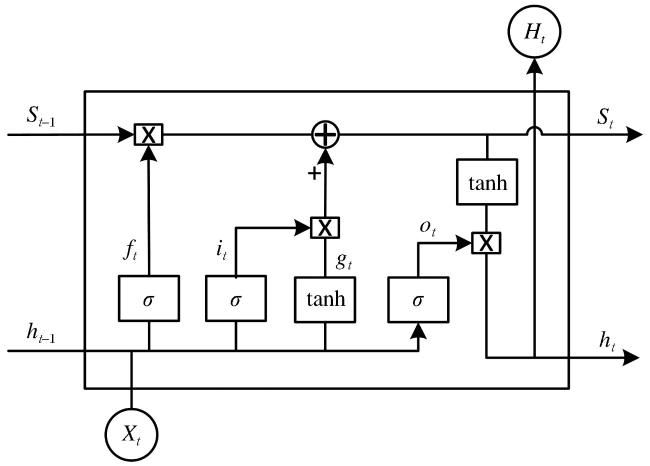
LSTM单元计算过程如下
式中: 、 、 、 、 和 分别为t时刻遗忘门、输入门、输入节点、输出门、中间输出和状态单元的状态; 为上一时刻的中间输出; 、 、 和 分别为遗忘门、输入门、输入节点和输出门与当前时刻的输入x相乘的权重矩阵; 、 、 和 分别为遗忘门、输入门、输入节点和输出门与上一时刻t-1的中间输出 相乘的权重矩阵; 、 、 和 分别为遗忘门、输入门、输入节点和输出门的偏置项; 表示向量中的元素按位相乘; 表示Sigmoid激活函数, 为tanh激活函数。
1.3 加性注意力机制
加性注意力是一种重要的注意力机制。在对时序数据进行分析时,引入加性注意力机制能够显著增强对时间序列内关键信息的捕捉能力,提高信息的利用率(Wu et al,2021;胡倩伟等,2024)。在加性注意力运行过程中,将输入数据送入线性变换层通过权重矩阵转换为全局查询向量 ,该过程能够高效地从输入中提取后续注意力计算需要的关键特征表示;再将查询向量和键向量 分别通过各自线性变换矩阵进行线性变换得到中间向量,随后通过可学习的参数向量,将中间特征映射为标量相似度评分,随后使用Softmax函数对评分进行归一化,生成注意力权重分布,最终依据权重对值向量 进行加权求和得到输出。
注意力权重计算公式为
式中: 为第 个键向量 与查询向量 之间的相似度评分; 为可学习的线性变换矩阵,对查询向量 进行线性变换,映射至合适的特征空间; 为可学习的线性变换矩阵,对键向量 进行线性变换,使键向量 映射至与查询向量 变换后的相同特征空间, 为可学习参数向量,将高维特征向量压缩为标量;N为查询矩阵 Q 的序列长度;tanh为双曲正切函数; 为第 个键向量 所对应的注意力权重。
1.4 融合加性注意力机制的TCN-LSTM模型
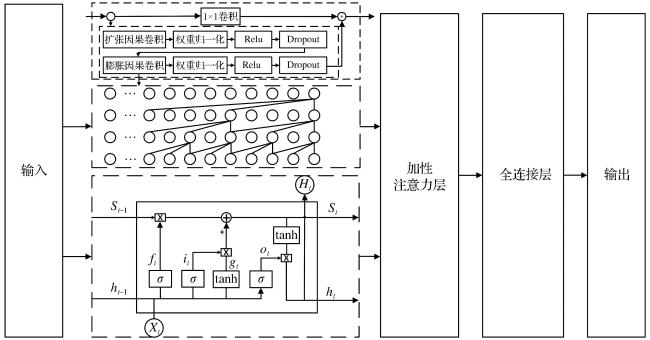
综合上述方法,本研究构建了融合TCN、LSTM和加性注意力机制的巷道变形预测组合模型(图3)。该模型采用并联设计:时序数据同步输入TCN和LSTM双通道,其中TCN通过膨胀因果卷积提取序列的局部突变特征,LSTM通过门控机制捕捉长期演化趋势;随后,加性注意力机制对双通道输出特征进行动态权重分配,自适应调整TCN局部感知和LSTM全局记忆的贡献度;最后通过全连接层实现多尺度信息的整合。
2 工程应用
2.1 工程概况
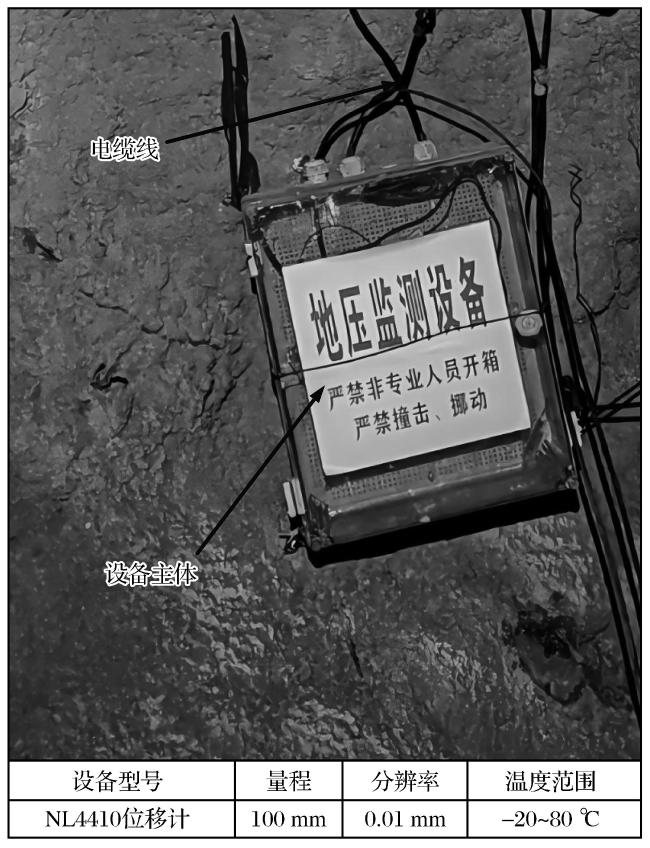
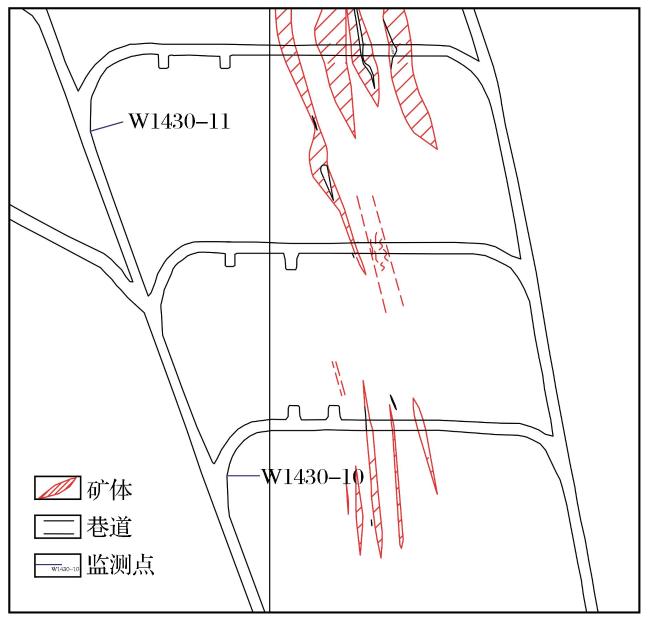
自走铁矿位于云南省玉溪市新平县城120°方向,直线距离为29 km。矿区地处川滇SN向构造带南段,位于青杨断裂与通海山字型构造前缘石屏弧西翼的复合部位,处于断裂带区域,节理裂隙较为发育。区内岩体主要为沉积—变质的碳酸盐类岩石,揭露岩石以灰岩为主。矿床为以溶蚀裂隙为主的岩溶充水矿床,最低开采标高高于最低侵蚀基准面,地下水补给条件差,巷道围岩含水情况较好,对围岩稳定性无较大影响。矿山开拓方式为平硐开拓,目前1 430 m中段为主生产中段。为掌握次生应力随着采空区范围扩大和时间推移所发生的变化情况,从而判断围岩和间柱的稳定性,以便及时采取有效的处理与防范措施来确保生产安全,目前自走铁矿使用NL4410位移计等地压监测设备开展地压监测工作(图4)。位移计量程为100 mm,分辨率为0.01 mm,数据可自动进行采集,采集到的数据通过各中段基站箱发送至服务器主机。
2.2 监测数据处理
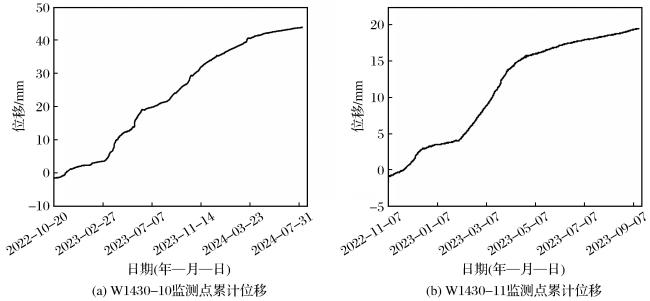
本研究选取W1430中段的W1430-10和W1430-11监测点的位移数据进行分析(图5)。W1430-10监测点数据采集时段为2022年10月20日至2024年8月9日,共获取3 310组数据;W1430-11监测点数据采集时间为2022年11月7日至2023年9月13日,共获取1 555组数据。采集频率均为每天5组。
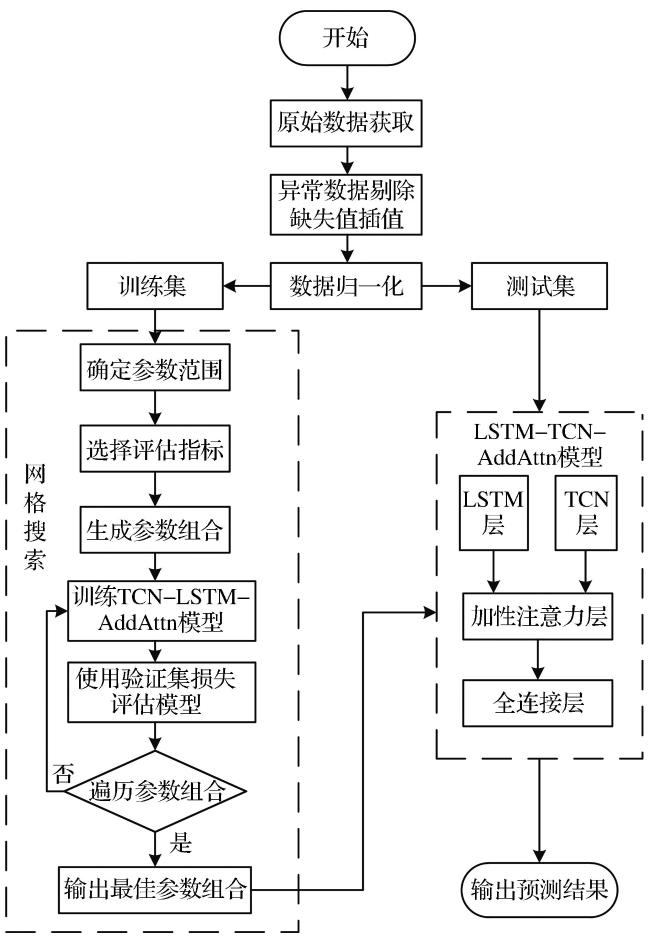
由于受施工扰动、环境噪声和设备异常等因素的影响,监测数据存在缺失值和异常值现象。由于时间序列分析需要保证数据点的等时间间隔特性,本研究在分析前对原始数据进行预处理,具体处理内容包括异常值剔除、缺失值插补和数据归一化,以确保时序数据的完整性和可靠性。
在数据处理阶段,首先对原始数据的异常值进行剔除。本试验使用Hampel滤波器对异常值进行筛选(王文强等,2024),其核心原理是通过滑动窗口内的中位数和中位数绝对偏差(MAD)识别异常点。当时间窗口为k时,对于时间序列中的每个点 ,选取其前后共2k+1个点组成窗口序列 ,每个窗口序列的中值和MAD的计算公式为
式中: 为窗口序列 的中值; 为每个 对应窗口 的中位数绝对偏差;常量1.4826为该偏移量在数据呈正态分布时等于标准偏移量的情况;本次时间窗口大小为5。
异常值判定公式为
式中: 通常取3。如式(13) 成立,则认为 为异常点并将其剔除。
对于剔除异常值后的时间序列,使用3次样条插值法对缺失处进行插值,3次样条插值法通过构造分段3次多项式 来拟合给定数据点 ,其中(x 0<x 1<⋯<xn ),且保证函数 及其一阶和二阶导数在节点数连续,其数学表达式为
式中: 为区间步长; 为节点处的二阶导数,对于自然样条,边界条件为 。若已知端点一阶导数 和 ,采用固定边界条件,固定边界形式可表示为
随后对处理后的数据进行归一化操作。归一化处理公式为
式中: 为原始输入数据; 为经过归一化处理后的数据; 和 分别为训练样本的最大值和最小值。
经过归一化处理后,将数据按照8∶1∶1的比例划分为训练集、验证集和测试集,输入到融合加性注意力机制的TCN-LSTM模型进行训练(模型巷道变形预测流程图见图7)。
2.3 模型参数设置
模型具体参数配置如下:输入时间窗口步长设置为35,TCN模块由单个残差单元构成,采用大小为3的一维因果卷积核,并在层间设置0.1的Dropout率防止过拟合;LSTM模块采用双层堆叠;加性注意力机制通过32维隐藏层动态融合TCN提取的局部特征和LSTM生成的全局时序状态,强化关键信息的表征能力。训练过程采用Adam优化器进行200轮迭代,以均方误差(MSE)作为损失函数,并应用阈值为0.5梯度裁剪以稳定训练过程。为提升模型泛化能力,设置早停机制,在验证集损失连续30轮未下降时终止训练。通过网格搜索对模型学习率、LSTM隐藏层维度、TCN通道数和批量大小等超参数进行优化,其中学习率的取值范围为[0.0001,0.0005,0.001,0.005,0.01],LSTM隐藏层大小取值范围为[32,64,128],TCN卷积通道数取值范围为[16,32,64],批量大小取值范围为[16,32,64]。确定最优参数组合如下:学习率为0.001,LSTM隐藏层维度为64,TCN卷积通道数为32,批量大小为32。
2.4 模型权重可视化
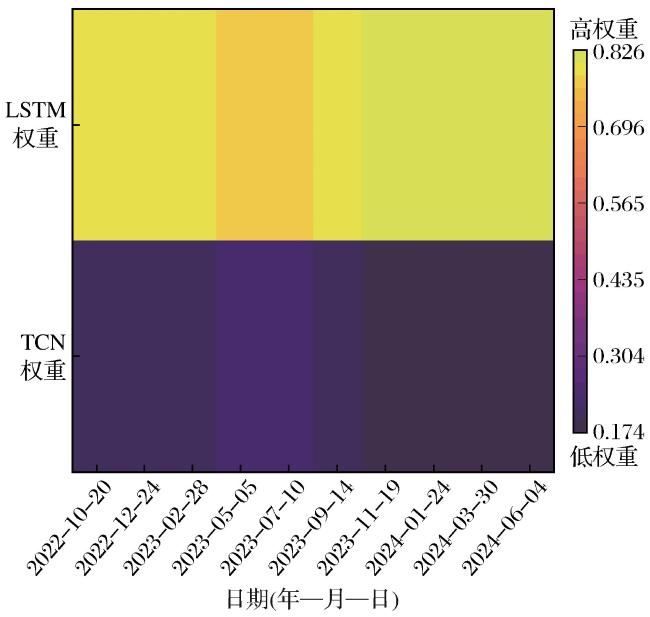
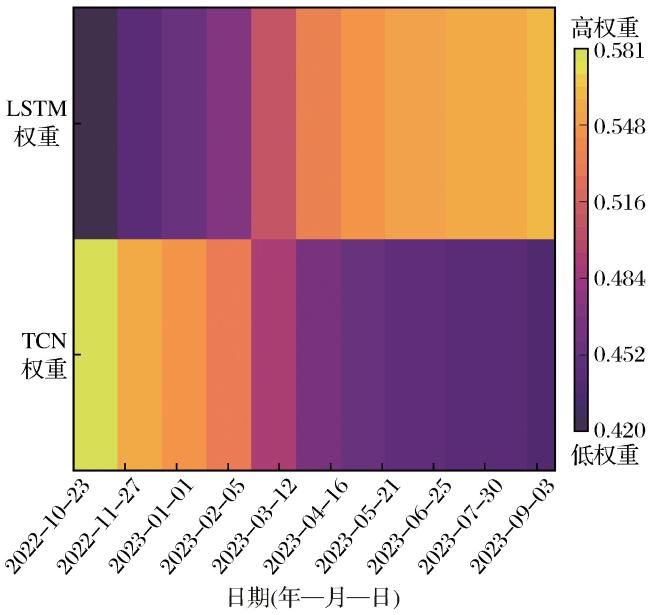
在对W1430-11监测点进行预测的过程中,TCN和LSTM模块的权重贡献呈现出动态博弈的差异化特征。在监测序列初始阶段,TCN网络凭借其膨胀因果卷积结构的优势,精准捕捉到位移数据中的局部突变特征,在模型输出中占据主导;随着时间的推移,LSTM模块的权重贡献开始逐步攀升,表明巷道变形后期逐渐回归到以岩体蠕变为主导,系统的长期记忆效应在变形预测中的控制作用显著提升。这种动态权重分配机制验证了融合模型架构在协同捕捉短期事件响应和长期趋势演化方面具有优越性。
3 预测结果分析
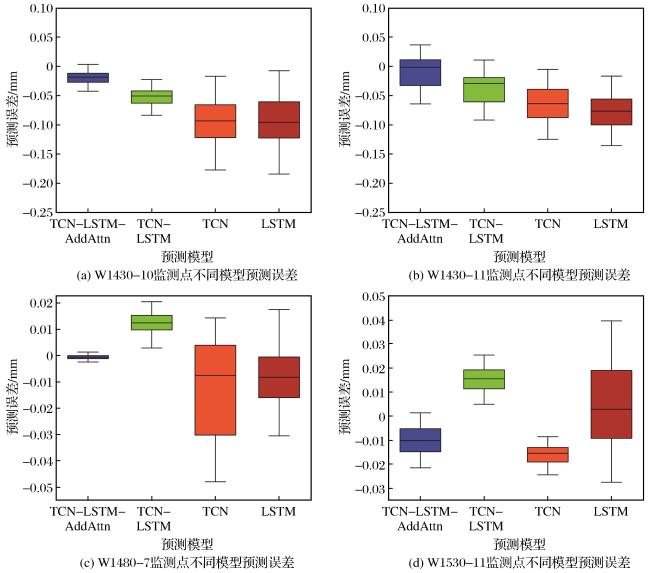
为验证融合加性注意力机制的TCN-LSTM模型的预测稳定性和泛化性能,基于不同中段的W1430-10、W1430-11、W1480-7和W1530-11监测点数据,将测试集的预测结果与TCN、LSTM和TCN-LSTM模型的预测误差和评价指标进行对比分析。
3.1 预测误差对比
不同模型的预测误差分析结果如图10所示。通过预测误差对比,得出如下结论:在不同中段4个监测点的预测任务中,单一LSTM和TCN模型的预测误差中位数较高且箱线波动范围较大,说明二者对于复杂时序特征的捕捉能力有限;TCN-LSTM模型通过结合TCN模型的局部特征提取能力和LSTM模型的长期依赖能力,降低了预测的误差中位数,同时减小了波动范围;融合加性注意力机制的TCN-LSTM模型(TCN-LSTM-AddAttn)的预测误差中位数最低,且箱体波动范围更小,说明加性注意力机制通过动态分配特征权重,增强了模型对于关键时序特征的敏感性,且强化了模型的泛化能力和稳定性。
3.2 预测评价指标
本研究采用平均绝对误差(MAE)、均方根误差(RMSE)、校正决定系数(R 2 adj)和对称平均绝对百分比误差(SMAPE)4项指标对模型性能进行评价。
R2 adj 通过引入自由度惩罚项,能够在一定程度上缓解模型因复杂度增加导致的传统R 2虚高的问题,从而更合理地平衡模型复杂度与拟合能力的关系(Akossou et al,2013;Chicco et al,2021)。
SMAPE通过修正传统平均绝对百分比误差(MAPE)的分母不对称性,解决了后者因预测值小于真实值时导致误差被过度放大造成的评估偏差问题,确保误差评估的公平性和方向无关性(Ribeiro et al,2023)。
MAE、RMSE、R2 adj和SMAPE指标的计算公式分别表示为
式中: 为模型预测值; 为实际值; 为样本数量; 为样本特征数量。
性能评价指标见表1。MAE、RMSE和SMAPE指标越小,表明建立的神经网络模型对数据的预测精度越高;R 2 adj越接近1,说明模型对数据的拟合效果越好。
表1 各模型性能评价指标对比Table 1 Comparison of performance evaluation indexes of each model |
| 监测点 | 预测模型 | MAE | RMSE | SMAPE | R2 adj |
|---|---|---|---|---|---|
| W1430-10 | TCN-LSTM-AddAttn | 0.0292 | 0.0396 | 0.0337 | 0.9861 |
| TCN-LSTM | 0.0561 | 0.0632 | 0.0647 | 0.9646 | |
| TCN | 0.0915 | 0.0990 | 0.1057 | 0.9131 | |
| LSTM | 0.0927 | 0.1021 | 0.1069 | 0.9077 | |
| W1430-11 | TCN-LSTM-AddAttn | 0.0282 | 0.0366 | 0.0738 | 0.9799 |
| TCN-LSTM | 0.0396 | 0.0505 | 0.1035 | 0.9616 | |
| TCN | 0.0627 | 0.0736 | 0.1636 | 0.9186 | |
| LSTM | 0.0737 | 0.0837 | 0.1924 | 0.8947 | |
| W1480-7 | TCN-LSTM-AddAttn | 0.0057 | 0.0082 | 0.0049 | 0.9805 |
| TCN-LSTM | 0.0122 | 0.0133 | 0.0105 | 0.9487 | |
| TCN | 0.0151 | 0.0212 | 0.0130 | 0.8689 | |
| LSTM | 0.0134 | 0.0166 | 0.0115 | 0.9201 | |
| W1530-11 | TCN-LSTM-AddAttn | 0.0100 | 0.0111 | 0.0340 | 0.9808 |
| TCN-LSTM | 0.0154 | 0.0159 | 0.0523 | 0.9604 | |
| TCN | 0.0186 | 0.0220 | 0.0628 | 0.9246 | |
| LSTM | 0.0254 | 0.0309 | 0.0862 | 0.8518 |
通过对表1中的4项指标(MAE、RMSE、SMAPE和R 2 adj)进行分析可知:融合加性注意力机制的TCN-LSTM模型,即TCN-LSTM-AddAttn模型在各项指标上均优于其他模型。
在W1430-10监测点数据集上,相较于TCN-LSTM、TCN和LSTM模型,TCN-LSTM-AddAttn模型的MAE分别降低了47.95%、68.09%和68.50%,RMSE分别降低了37.34%、60.00%和61.21%,SMAPE分别降低了47.91%、68.12%和68.48%;在W1430-11监测点数据集上,TCN-LSTM-AddAttn模型的MAE分别降低了28.79%、55.02%和61.71%,RMSE分别降低27.52%、50.27%和56.27%,SMAPE分别降低28.70%、54.89%和61.64%;在W1480-7监测点数据集上,TCN-LSTM-AddAttn模型的MAE分别降低53.28%、62.25%和57.46%,RMSE分别降低38.35%、61.32%和50.60%,SMAPE分别降低53.33%、62.31%和57.39%;在W1530-11监测点数据集上,相较于TCN-LSTM、TCN和LSTM模型,TCN-LSTM-AddAttn模型的MAE分别降低了35.06%、46.24%和60.63%,RMSE分别降低了30.19%、49.55%和64.08%,SMAPE分别降低了34.99%、45.86%和60.56%,并且TCN-LSTM-AddAttn模型在4个数据集上的R 2 adj最接近1,充分表明融合加性注意力机制的TCN-LSTM模型预测精度最高、误差分布最集中,同时具有最强的数据解释能力和泛化能力。
4 结论
本研究构建了融合加性注意力机制的TCN-LSTM模型,使用自走铁矿不同中段的监测点位移监测数据进行预测,通过预测误差分析和4项评价指标对比,得出如下结论:
(1)融合加性注意力机制的TCN-LSTM模型通过并联架构集成TCN的局部特征提取能力和LSTM的长期依赖建模优势,并结合加性注意力机制动态优化特征权重分配,显著提升了复杂时序数据的预测精度。在不同中段4个监测点的预测任务中,该模型的MAE、RMSE和SMAPE较TCN-LSTM模型分别降低了28.79%~53.28%、27.52%~38.35%和28.70%~53.33%,且R 2 adj均达到0.97以上,验证了模型具有优异的非线性拟合能力和泛化能力。
(2)针对W1430-10、W1430-11、W1480-7和W1530-11监测点预测任务中,融合加性注意力机制的TCN-LSTM模型预测结果与巷道位移监测值高度同步,预测误差波动范围在0.1 mm以内,证明模型能够精准捕捉围岩变形的局部突变特征和长期演化趋势。
(3)通过使用融合加性注意力机制的TCN-LSTM模型对未来变形量进行精准预测,结合变形速率分析,有望提前识别潜在高风险变形区域,引导施工人员进行超前支护,从而为矿山巷道稳定性维护和安全预警提供技术支持。

 甘公网安备 62010202000672号


