


爆破参数的选择与优化是爆破工程领域的核心技术难题,其决策过程受多重复杂因素的耦合影响,包括岩石的物理力学性质、具体地质构造条件、炸药的爆轰性能以及爆破作业的外部环境约束等,这些因素的关联使得爆破参数的精准匹配难度显著增加(艾欣等,2023;张曌等,2025)。因此,围绕爆破参数优化这一关键问题,国内外学者开展了长期且系统的研究,形成了多种技术路径和研究方法。
现行的爆破参数优化方法主要为经验公式法、模拟法和机器学习法。研究人员根据矿山地质特点和环境条件,采用经验公式进行爆破参数设置,优化爆破参数,用于降低露天矿高台阶爆破大块率和飞石距离等(赵文奎等,2021;甘杰,2025)。部分学者以利文顿爆破漏斗理论为依据,在现场开展了爆破试验,获得适用于试验矿山矿岩条件的爆破参数(陈能革,2016;文兴等,2021)。国内学者根据现场条件,通过围岩节理扫描分析,改进爆破参数,确定孔位及爆破药量,提高了炮孔利用率,降低了单耗(张云鹏等,2014;郭学庭等,2021)。随着爆破参数优化技术朝着高效化、精准化的方向发展,优化方案的可行性和有效性需通过严格验证方可落地工程实践。然而,传统工业试验成本投入高,难以大规模开展。在此背景下,兼具高效性与低成本优势的计算机数值模拟技术,逐渐成为爆破领域研究者的优选工具,其在爆破方案优化设计与参数合理性验证中的应用也日益广泛,为工程实践提供了可靠的技术支撑(过江等,2016;李波等,2024)。如采用AUTOCAD与ANSYS/LS-DYNA联合建模技术构建了精细化双排扇形孔三维数值模型,结合矿石爆破块度空间分布形态,确定了最优爆破参数(龚永超等,2020);采用LS-DYNA数值模拟软件,针对巷道掘进掏槽爆破过程开展模拟分析,基于模拟结果,通过优化炮孔布置方案,同时配套采取增加炮孔深度和炮孔堵塞长度等针对性技术措施,有效延长了爆炸能量的作用时长,显著提升了爆破效率(汪海波等,2018)。近年来,以神经网络为核心的机器学习算法在工程领域的应用愈发深入且广泛。神经网络具备强非线性拟合能力、复杂数据挖掘潜力及自适应优化等特性,为爆破参数优化这一多目标、多约束的复杂工程问题提供了全新的解决思路。因此,越来越多的学者和工程技术人员开始将神经网络、遗传算法和粒子群优化等各类智能算法引入爆破参数优化研究中,通过算法与工程实际的深度融合,实现爆破参数的精准优化与爆破效果的显著提升(王帅,2022)。如采用Floyd算法构建中深孔爆破扇形炮孔排面模型,有效解决了预设特定炮孔参数条件下的布孔优化设计问题(刘益超等,2021);采用人工神经网络(ANN)模型作为帝国竞争算法(ICA)的目标函数,通过参数优化使爆破振动峰值速度(PPV)降低了59%(Rezaeineshat et al,2020)。
经验公式法高度依赖现场工程经验,主观性强且对复杂地质条件的适应性差,难以应对多因素耦合下的参数精准匹配需求;数值模拟法虽能实现爆破过程的可视化分析,但建模流程复杂、计算耗时较长,对网格划分精度与边界条件设置要求严苛,且难以完全复现现场岩体非均质性、节理发育等真实工况;传统机器学习方法在处理爆破参数优化等多约束、强非线性问题时,常存在收敛速度慢、易陷入局部最优解的缺陷,导致模型泛化能力与预测精度难以满足工程实际对参数精准度的要求。针对爆破参数难以确定的问题,本文提出了一种改进蜣螂优化算法(Dung Beetle Optimizer,DBO)(Xue et al,2023)优化极限学习机(ELM)的回归预测模型,对孔距、排距和炸药单耗进行预测优化。NDBO算法优化输入层到隐含层权值、隐含层阈值和输出层权值3个核心参数,极大地提高了ELM性能,采用粒子群算法(Particle Swarm Optimization, PSO)(朱尚军等,2020)—最小二乘支持向量机(Least Squares Support Vector Machine, LSSVM)(马宁等,2024)、PSO-ELM、NDBO-LSSVM模型与NDBO-ELM模型进行对比分析,得出NDBO-ELM模型具有更优性能,预测精度最高,具有良好的工程实际意义,为爆破参数设置提供了新的参考方案。
1 NDBO-ELM回归预测模型
1.1 NDBO算法
蜣螂优化算法是一种新型群体智能优化算法,其灵感来自于蜣螂的生物行为。在该算法中,滚球蜣螂、育雏球、小蜣螂和小偷蜣螂群体行为代表着不同的算子运行规律。NDBO引用了NOA(王馨楠,2024)优化算法的觅食和储存阶段策略,改进策略为
(1)在滚球蜣螂阶段,更换位置更新方式表示为
式中:xi (t+1)为第t+1次迭代时第i个蜣螂的位置;xi (t)为第t次迭代时第i个蜣螂的位置;u为基于正态分布、飞行函数和0~1随机数之间随机生成的数字;xA (t)为第t次迭代时第A个蜣螂的位置;xB (t)为第t次迭代时第B个蜣螂的位置,且A与B互不相等。
(2)在偷窃蜣螂阶段,加入位置更新方式表示为
式中:x best(t)为第t次迭代时最好蜣螂的位置;l为从1衰减至0的衰减因子;r、r 1为0~1之间的随机数。
1.2 NDBO性能测试
采用DBO、BWO(Zhong et al,2022)、GA(Punia et al,2024)、NGO(何虎等,2024)、GWO(Mirjalili et al,2014)、PSO、WOA(Mirjalili et al,2016)和HHO(Heidari et al,2019)8种高引算法和NDBO算法进行对比测试。单峰函数在函数边界内具有一个全局最优解,用于检测算法的寻优速度,多峰函数在函数边界内具有多个局部最优解,用于检测算法寻优精度。单峰测试函数选取Schwefel’s Problem(2.22、1.20、2.21)函数,多峰测试函数选取Ackley’s Function、Generalized Penalized Function(1、2)函数,共6个测试函数,迭代次数为1 000,维度为30,种群数为30,运行20次取平均收敛曲线如图1所示。
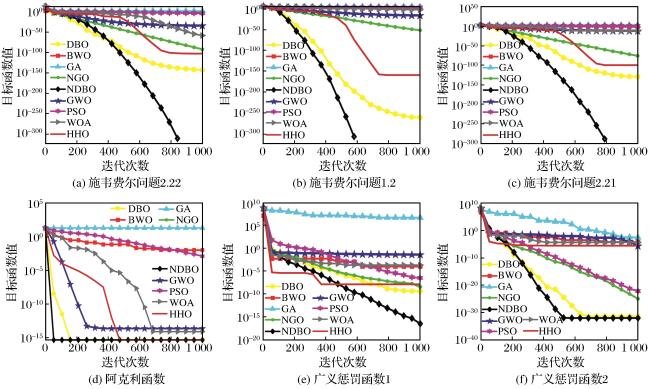
在单峰算法测试中,NDBO、DBO和HHO具有良好的寻优精度,且NDBO算法收敛相比其他算法速度更快;在多峰函数测试中,由于改进的收敛机制,使得NDBO具备优秀的收敛精度,提高了算法跳出局部最优解的能力,为后续ELM超参数算法优化提供有力支持。
1.3 ELM算法
ELM是一种单隐层前馈神经网络,它通过求解线性方程组快速完成训练,增强了泛化能力,在训练速度和泛化能力上显著优于传统神经网络。
式中:wi 为输入权值;bi 为隐含层偏差值; i 为输出权值; X i 为输入向量; Y i 为输出向量;g为激活函数;l为隐含层神经元数量。
NDBO-ELM具体工作流程如下:NDBO算法初始化种群,以最小均方根误差作为目标函数值(参数包含ELM输入层到隐含层权值、隐含层阈值和输出层权值)开始迭代,计算初始适应度值,开始迭代达到最大迭代次数,算法返回最优函数值时的参数组合,ELM将算法返回的参数组合训练,输出得到爆破参数。
2 工程实例
2.1 数据收集及处理
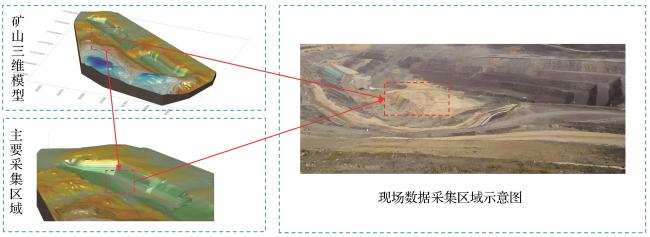
本次试验数据来自云南某露天金属矿,该矿目前开采阶段为910~1 340 m。研究团队于2023年11月至2024年7月共参与了71次爆破计划,共收集到有效数据61组。爆破作业穿孔设备由DI500(Ф152 mm)和L8-D65(Ф178 mm)潜孔钻机组成;炸药为2#岩石乳化炸药;雷管为数码电子雷管;采用逐孔起爆,数据采集区域如图2所示。
块度分布占比数据来自爆破结束后,拍摄爆堆图像块度并识别得到。具体划分为运输初期爆堆块度图像、运输中期爆堆块度图像和运输后期爆堆块度图像3个阶段,然后由WipFrag软件完成块度识别,取前中后期爆堆块度平均值。块度分析和统计结果如图3所示。
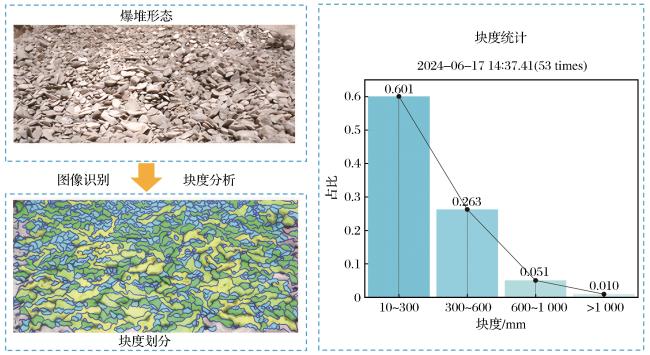
表1 爆破参数收集Table 1 Blasting parameter collection |
| 序号 | 台阶高度/m | 普氏系数 | 抵抗线/m | 前冲距离/m | 侧冲距离/m | 块度分布 (10~600 mm) | 根底率 | 孔距/m | 排距/m | 炸药单耗 /(kg·t-1) |
|---|---|---|---|---|---|---|---|---|---|---|
| 1 | 10 | 9 | 4.0 | 5 | 4 | 0.914 | 0 | 7.0 | 4.0 | 0.39 |
| 2 | 10 | 9 | 4.5 | 5 | 4 | 0.916 | 0 | 7.0 | 4.0 | 0.39 |
| 3 | 10 | 9 | 4.5 | 5 | 3 | 0.905 | 1 | 7.5 | 4.5 | 0.39 |
| 4 | 10 | 10 | 4.5 | 6 | 5 | 0.924 | 0 | 7.0 | 4.0 | 0.41 |
| 5 | 10 | 10 | 4.0 | 5 | 5 | 0.921 | 0 | 6.8 | 4.0 | 0.39 |
| 6 | 10 | 11 | 4.0 | 8 | 5 | 0.928 | 0 | 7.0 | 3.5 | 0.44 |
| 7 | 15 | 9 | 4.5 | 5 | 5 | 0.897 | 1 | 8.0 | 3.5 | 0.38 |
| 8 | 15 | 9 | 4.5 | 7 | 3 | 0.926 | 0 | 7.0 | 4.0 | 0.41 |
| 9 | 15 | 9 | 4.5 | 5 | 5 | 0.935 | 0 | 7.0 | 3.5 | 0.42 |
| 10 | 15 | 9 | 4.0 | 5 | 3 | 0.885 | 1 | 7.5 | 4.5 | 0.39 |
| 11 | 15 | 9 | 4.5 | 6 | 4 | 0.948 | 0 | 7.0 | 3.5 | 0.42 |
| 12 | 10 | 9 | 4.5 | 5 | 3 | 0.897 | 1 | 8.0 | 4.5 | 0.37 |
| 13 | 10 | 9 | 4.0 | 5 | 3 | 0.902 | 1 | 7.0 | 3.5 | 0.39 |
| 14 | 10 | 9 | 4.5 | 5 | 4 | 0.922 | 0 | 7.0 | 4.0 | 0.41 |
| 15 | 10 | 9 | 4.5 | 6 | 5 | 0.927 | 0 | 6.8 | 3.5 | 0.41 |
| 16 | 10 | 9 | 4.5 | 6 | 4 | 0.932 | 0 | 7.0 | 4.0 | 0.42 |
| 17 | 10 | 9 | 4.5 | 6 | 5 | 0.920 | 0 | 7.0 | 4.0 | 0.40 |
| 18 | 15 | 9 | 4.0 | 6 | 3 | 0.906 | 1 | 8.0 | 4.5 | 0.40 |
| 19 | 15 | 11 | 4.0 | 6 | 5 | 0.897 | 1 | 7.5 | 4.0 | 0.42 |
| 20 | 15 | 9 | 4.5 | 6 | 4 | 0.924 | 0 | 7.0 | 3.5 | 0.41 |
| 21 | 15 | 9 | 4.0 | 5 | 5 | 0.907 | 1 | 7.2 | 4.0 | 0.38 |
| 22 | 15 | 9 | 4.5 | 5 | 4 | 0.926 | 0 | 7.0 | 4.0 | 0.40 |
| 23 | 15 | 9 | 4.0 | 5 | 4 | 0.915 | 0 | 7.0 | 4.0 | 0.41 |
| 24 | 15 | 11 | 4.5 | 9 | 5 | 0.901 | 1 | 7.2 | 4.5 | 0.43 |
| 25 | 15 | 11 | 4.5 | 7 | 6 | 0.926 | 0 | 7.0 | 4.0 | 0.44 |
| 26 | 15 | 11 | 4.0 | 6 | 3 | 0.910 | 1 | 6.5 | 4.0 | 0.43 |
| 27 | 15 | 11 | 4.0 | 8 | 5 | 0.927 | 0 | 7.0 | 4.5 | 0.42 |
| 28 | 15 | 11 | 4.5 | 6 | 3 | 0.922 | 0 | 7.5 | 4.0 | 0.40 |
| 29 | 15 | 11 | 4.5 | 6 | 5 | 0.894 | 1 | 7.0 | 3.5 | 0.39 |
| 30 | 15 | 9 | 4.5 | 5 | 4 | 0.924 | 0 | 7.0 | 4.0 | 0.4 |
| 31 | 15 | 9 | 4.0 | 6 | 4 | 0.901 | 1 | 7.0 | 3.5 | 0.38 |
| 32 | 15 | 9 | 4.0 | 6 | 5 | 0.907 | 1 | 7.0 | 4.0 | 0.37 |
| 33 | 10 | 11 | 4.5 | 6 | 3 | 0.925 | 0 | 7.0 | 4.0 | 0.42 |
| 34 | 10 | 11 | 4.5 | 6 | 3 | 0.926 | 0 | 7.0 | 3.5 | 0.42 |
| 35 | 10 | 9 | 4.5 | 5 | 4 | 0.910 | 0 | 7.3 | 4.5 | 0.39 |
| 36 | 10 | 9 | 4.5 | 5 | 4 | 0.919 | 0 | 7.0 | 4.0 | 0.40 |
| 37 | 10 | 11 | 4.5 | 6 | 5 | 0.916 | 0 | 7.0 | 3.5 | 0.40 |
| 38 | 15 | 10 | 4.5 | 5 | 4 | 0.912 | 0 | 7.5 | 4.5 | 0.4 |
| 39 | 15 | 10 | 4.5 | 5 | 5 | 0.886 | 1 | 7.5 | 3.8 | 0.37 |
| 40 | 15 | 11 | 4.5 | 5 | 3 | 0.872 | 1 | 7.0 | 4.0 | 0.39 |
| 41 | 15 | 11 | 4.0 | 6 | 3 | 0.901 | 1 | 8.0 | 4.5 | 0.43 |
| 42 | 15 | 11 | 4.0 | 7 | 5 | 0.926 | 0 | 7.0 | 4.0 | 0.43 |
| 43 | 15 | 9 | 4.5 | 6 | 3 | 0.910 | 1 | 7.5 | 4.0 | 0.4 |
| 44 | 15 | 9 | 4.0 | 6 | 4 | 0.919 | 0 | 7.0 | 3.5 | 0.42 |
| 45 | 15 | 10 | 4.5 | 6 | 3 | 0.885 | 1 | 8.0 | 4.5 | 0.37 |
| 46 | 15 | 11 | 4.0 | 7 | 3 | 0.948 | 0 | 6.5 | 4.0 | 0.42 |
| 47 | 15 | 11 | 4.0 | 5 | 4 | 0.872 | 1 | 7.0 | 4.0 | 0.39 |
| 48 | 15 | 11 | 4.5 | 6 | 3 | 0.926 | 0 | 7.3 | 4.0 | 0.38 |
| 49 | 15 | 9 | 4.5 | 7 | 3 | 0.928 | 0 | 7.0 | 4.0 | 0.42 |
| 50 | 15 | 9 | 4.5 | 5 | 3 | 0.940 | 0 | 7.0 | 4.0 | 0.43 |
| 51 | 15 | 9 | 4.0 | 5 | 3 | 0.891 | 1 | 7.5 | 4.8 | 0.39 |
| 52 | 15 | 9 | 4.5 | 6 | 4 | 0.930 | 0 | 7.0 | 3.5 | 0.42 |
| 53 | 10 | 9 | 4.5 | 5 | 3 | 0.899 | 1 | 8.0 | 4.5 | 0.37 |
| 54 | 10 | 9 | 4.0 | 5 | 3 | 0.903 | 1 | 7.0 | 3.5 | 0.39 |
| 55 | 10 | 9 | 4.5 | 5 | 4 | 0.920 | 0 | 7.0 | 4.0 | 0.41 |
| 56 | 10 | 9 | 4.5 | 6 | 4 | 0.930 | 0 | 7.5 | 4.5 | 0.41 |
| 57 | 10 | 9 | 4.5 | 6 | 4 | 0.935 | 0 | 7.0 | 4.0 | 0.42 |
| 58 | 10 | 10 | 4.5 | 6 | 5 | 0.920 | 0 | 7.0 | 3.5 | 0.40 |
| 59 | 15 | 9 | 4.0 | 5 | 3 | 0.903 | 1 | 8.0 | 4.0 | 0.40 |
| 60 | 15 | 11 | 4.0 | 6 | 5 | 0.899 | 1 | 7.5 | 4.5 | 0.42 |
| 61 | 15 | 9 | 4.5 | 5 | 4 | 0.912 | 0 | 7.0 | 3.5 | 0.41 |
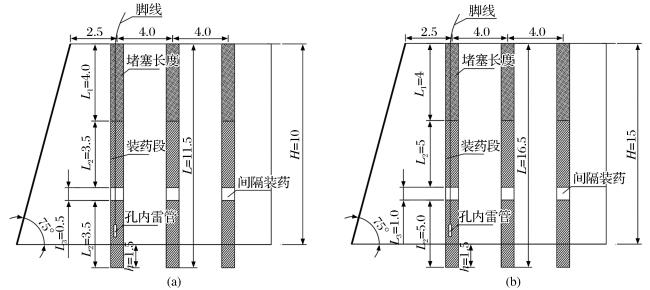
2.2 爆破数据相关性分析
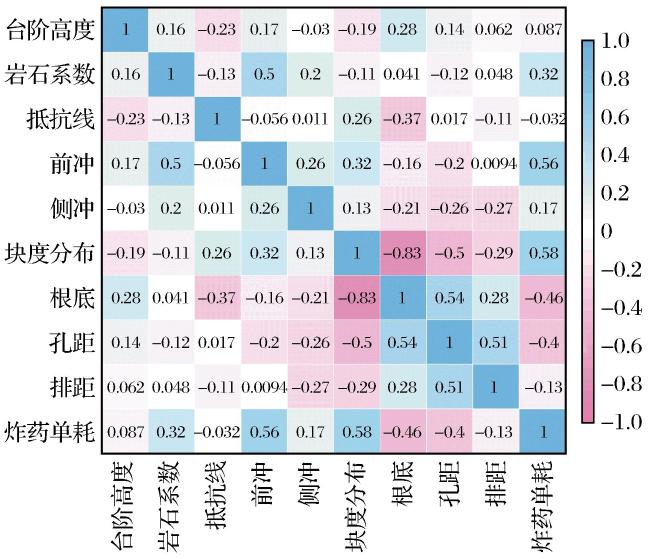
对爆破参数进行优化,选取了3个重要指标进行预测,即孔距、排距和炸药单耗。孔距和排距的选择有助于控制爆破时产生的裂隙传播,确保矿石的合理破碎。孔距和排距过小可能会导致过度破碎,造成附加能量消耗;孔距和排距过大则可能导致爆破效果不理想,矿石难以有效破碎。炸药单耗决定了爆破时产生的能量大小,确保岩石在爆破后的破碎程度和块度满足开采的需求。若炸药使用过少,岩石破碎不彻底;若炸药使用过多,可能会造成过度破碎和浪费。
2.3 回归预测模型对比分析
本次预测模型选取LSSVM和ELM这2种回归模型,并选择PSO和NDBO这2种优化算法进行对比,共4种模型进行对比研究。优化算法均以最小均方根误差为目标函数优化模型,LSSVM优化正则化系数和核函数,ELM优化输入层到隐含层权值、隐含层阈值和输出层权值。选取数据最后12个数据作为测试集,预测结果如图5所示。
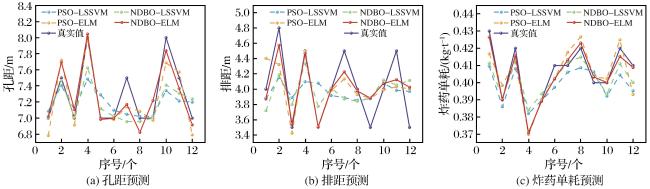
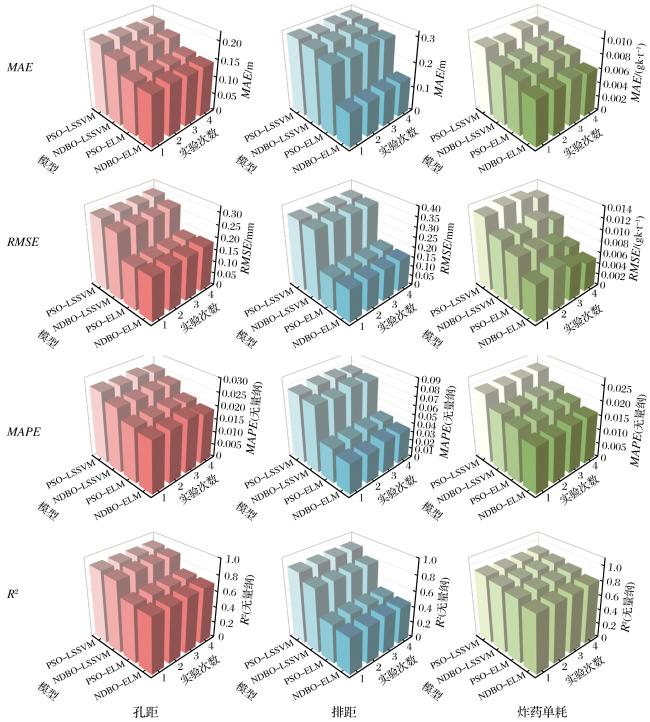
由表2和表3可知,相较于LSSVM模型,ELM模型的预测精度提升显著:在排距预测方面,ELM模型表现出更高的敏感性,性能提升幅度可达47%;在炸药单耗预测方面,2种模型均具有良好的预测能力,R²均可达0.8以上。在优化算法层面,NDBO算法的模型性能较PSO算法更优,其中对炸药单耗预测的提升幅度最大,孔距最小,但2种优化算法下的模型对孔距的预测结果均较为理想,R²最低值为0.71。综合上述分析,NDBO-ELM模型为最优模型,适用于爆破优化参数的预测。该模型各指标的预测结果如下:对于孔距预测,MAE、RMSE、MAPE和R²分别为0.14、0.18、0.02和0.91;对于排距预测,4个指标分别为0.14、0.16、0.03和0.94;对于炸药单耗预测,4个指标分别为0.006、0.007、0.01和0.93。
表2 NDBO性能提升统计Table 3 Statistics of performance improvement of NDBO |
| 参数 | MAE(-) | RMSE(-) | MAPE(-) | R 2(+) |
|---|---|---|---|---|
| 孔距 | 3.04%~9.41% | 2.02%~7.22% | 12.90%~15.48% | 1.78%~2.02% |
| 排距 | 21.06%~25.98% | 1.87%~1.88% | 2.46%~4.91% | 4.65%~12.32% |
| 炸药单耗 | 13.33%~14.74% | 18.46%~19.14% | 12.9%~15.48% | 6.94%~11.07% |
表3 ELM性能提升统计Table 4 Statistics on performance improvement of ELM |
| 参数 | MAE(-) | RMSE(-) | MAPE(-) | R 2(+) |
|---|---|---|---|---|
| 孔距 | 17.78%~27.78% | 33.31%~39.38% | 14.4%~25.0% | 18.92%~21.99% |
| 排距 | 6.97%~54.46% | 51.56%~53.37% | 47.94%~54.40% | 39.32%~47.93% |
| 炸药单耗 | 7.40%~31.57% | 11.32%~41.54% | 7.92%~32.20% | 4.07%~12.25% |
2.4 爆破参数优化系统
基于NDBO-ELM模型编制了一款针对于该矿山爆破部分的参数优化系统。系统搭建分为7个阶段。
(1)专用数字底座搭建,为优化模型与数据闭环提供物理载体:部署5G/F5G网络,实现矿区爆破作业区全覆盖;安装高清摄像头和振动传感器等,实时采集爆前、爆中和爆后多源数据;搭建混合云,承载海量时序数据与模型的高性能计算。
(2)数据中台与AI平台建设,汇集数据、训练模型并提供智能服务:构建数据仓库,汇聚地质、穿孔、爆破和效果等全流程数据;利用Spark进行数据清洗和特征工程;搭建PyTorch算法平台,部署并持续优化NDBO-ELM模型及其他AI模型,将模型以API服务形式发布。
(3)后端服务平台开发,构建稳定、可扩展的业务服务与API:采用Node.js技术栈开发微服务;使用MySQL+TDengine进行数据库设计;开发RESTful/WebSocket API,其中核心接口将调用第二阶段发布的NDBO-ELM模型服务,实现参数智能推荐。
(4)前端与三维可视化应用开发,打造直观、易用的交互界面:基于Vue3+TypeScript开发Web管理后台;利用uni-app开发移动端APP,用于现场数据采集和任务执行。
(5)智能生产执行子系统开发,将优化结果落地生产并形成管控闭环:智能爆破设计子系统调用优化API自动生成爆破方案;生产调度与执行子系统据此向智能钻机、装药车下发任务并跟踪执行;设备与安全监控子系统则集成设备状态、人员定位和环境数据以保障施工安全,并实现数据反哺模型。
(6)系统集成与全方位测试,确保系统集成可靠、安全、高性能:通过API网关集成所有微服务;实现OAuth 2.0统一认证与精细权限(RBAC)控制;使用Postman,JMeter,SonarQube进行接口、压力、安全测试。
(7)云原生部署与持续运维,保障系统高可用、可扩展、易维护:采用Kubernetes进行容器化编排与部署;建立CI/CD流水线,实现自动发布;配置Prometheus+Grafana监控告警;制定异地备份与灾备策略。
该系统包含爆破数据收集和参数优化2个子系统,具体见图8。
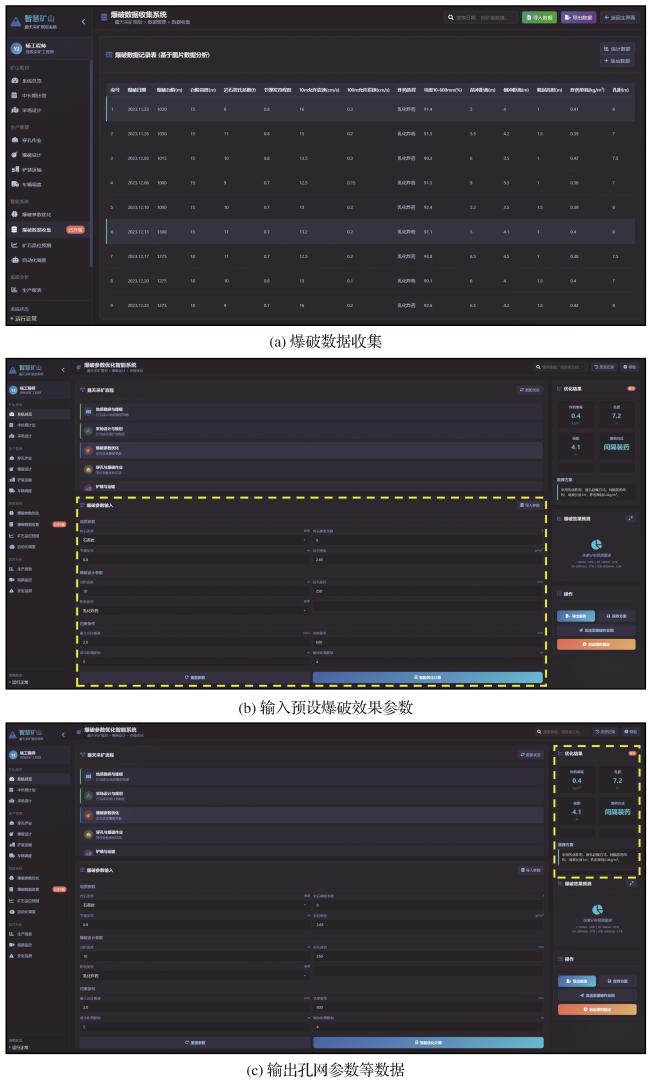
图8所示为该系统爆破部分参数优化以及收集的工作流程,具体阶段阐述如下:
A阶段(a-b):构建爆破数据收集库,用于收集历史爆破数据,为NDBO-ELM模型提供数据基础。
B阶段(b-c):算法将历史爆破数据库进行深度学习,在下一次爆破作业时,人工输入地质工程数据和预设爆破效果数据,NDBO-ELM模型根据历史数据拟合出适合的孔网参数等数据。
C阶段(c-a):将输出的爆破参数通过系统发送至爆破作业组进行爆破,爆破结束后再收集爆破效果数据输入爆破数据库。随着爆破数据库样本量的增加,所输出参数更准确。
3 结论
(1)提出的改进蜣螂优化算法(NDBO)通过引入新的位置更新策略,在收敛精度和速度方面均优于原DBO算法。对6个测试函数的仿真验证结果表明,NDBO具有更强的全局寻优能力和稳定性,为爆破参数优化提供了可靠的算法基础。
(2)构建的NDBO-ELM预测模型在爆破参数优化中表现出色。该模型在孔距、排距和炸药单耗3个关键参数的预测中,各项指标均优于对比模型(PSO-LSSVM、PSO-ELM和NDBO-LSSVM)。具体而言,孔距预测的MAE、RMSE、MAPE和R²分别达到0.14、0.18、0.02和0.91;排距预测相应指标为0.14、0.16、0.03和0.94;炸药单耗预测则为0.006、0.007、0.01和0.93,显示出较高的预测精度和泛化能力。
(3)基于NDBO-ELM模型开发的爆破参数优化系统,实现了爆破数据收集与参数智能推荐的有机整合。系统通过历史数据训练模型,能够根据实时输入的地质条件和预期爆破效果,智能输出孔距、排距和炸药单耗等关键参数,并将爆破后的实际效果数据反馈至数据库,形成持续优化的闭环管理机制。

 甘公网安备 62010202000672号


