ISSN 1005-2518
CN 62-1112/TF
Mineral Exploration and Resource Evaluation

Geochemical Characteristics of Dikes and Metallogenic Geological Setting of the Xiejiagou Gold Deposit

  • Kun LIU , 1 ,
  • Xiaofeng YAO 2 ,
  • Dianzhe MA 1 ,
  • Zezhong DU 2 ,
  • Xiao LIANG 1 ,
  • Qian LIU 1 ,
  • Pengcheng GE 1 ,
  • Xiaoxu LI 1
Expand
  • 1. Shandong Land and Mining Group, Jinan 250013, Shandong, China
  • 2. Development and Research Center, China Geological Survey/Technical Guidance Center for Mineral Resources Exploration, Ministry of Natural Resources, Beijing 100037, China

Received date: 2025-12-05

  Revised date: 2026-03-25

  Online published: 2026-07-10

Copyright

© Editorial Department of Gold Science and Technology (CC BY-NC-ND)

Abstract

The Xiejiagou gold deposit is situated to the west of the Zhaoping fault zone within the Jiaoxibei region. It represents a prototypical example of an altered-rock-type gold deposit, predominantly influenced by a NNE-oriented ductile shear zone. The deposit exhibits a significant temporal and spatial association with Mesozoic magmatic events. A diverse array of dikes is extensively distributed throughout the mining area. This study seeks to elucidate the magmatic context as evidenced by these dikes and to investigate their genetic linkage to gold mineralization. We conducted comprehensive petrogeochemical analyses on various dike types, including pre-mineralization fine-grained granite and altered rock(initially diorite), as well as post-mineralization quartz diorite porphyry and granodiorite. The findings reveal a broad range in SiO2 content among these dikes, spanning from 56.70% to 76.07%. Collectively,these rocks are classified within the high-K calc-alkaline to shoshonite series. Their A/CNK ratios suggest that they are metaluminous to weakly peraluminous I-type granites. The samples are characterized by elevated K₂O/Na₂O ratios and an enrichment in large ion lithophile elements(LILE) such as Rb, Ba, and K, while exhibiting a depletion in high field strength elements(HFSE) like Nb and Ta. These geochemical signaturesare indicative of formation in an island-arc or active continental margin setting associated with subduction processes. The samples display high strontium(Sr) concentrations, ranging from 329×10-6 to 937×10-6. Their rare earth element(REE) patterns are right-inclined, demonstrating moderate differentiation between light and heavy rare earth elements(LREE/HREE), with ratios spanning from 3.36 to 7.87. The LaN/YbN ratios range from 6.92 to 27.64, and the absence of significant negative europium(Eu) anomalies, is reflected in δEu values between 0.77 and 1.38. Thesegeochemical characteristics suggest the presence of garnet as a residual phase in the magma source region and indicate substantial crust-mantle interaction. Furthermore, the post-mineralization dikes exhibit typical adakitic geochemical features, including high Sr,low Y and Yb,and elevated La/Yb ratios. Basic magmas, enriched in volatiles and ore-forming elements, are inferred to have been generated through partial melting of the mantle wedge. Acidic magmas wereproduced through the partial melting of the thickened lower crust. These two magma types subsequently mixed in varying proportions within the deep crust. This process of crust-mantle magma mixing is responsible for the formation of the two compositionally distinct dike groups observed in the mining region. The findings of this study enhance our comprehension of the metallogenic system associated with the Xiejiagou gold deposit and offer novel petrogeochemical indicators for gold exploration in the Jiaoxibei area.

Cite this article

Kun LIU , Xiaofeng YAO , Dianzhe MA , Zezhong DU , Xiao LIANG , Qian LIU , Pengcheng GE , Xiaoxu LI . Geochemical Characteristics of Dikes and Metallogenic Geological Setting of the Xiejiagou Gold Deposit[J]. Gold Science and Technology, 2026 , 34(3) : 583 -596 . DOI: 10.11872/j.issn.1005-2518.2026.03.361

胶东地区是我国最重要的金资源基地,累计探获金资源储量超过5 000 t(宋明春,2015杨立强等,20142024黄鑫,2021于晓卫等,2023张泽涛等,2025)。胶西北地区位于胶东半岛西北部,区域内分布有3条近平行分布的NNE-NE向断裂带,自西向东依次为三山岛、焦家和招平断裂(肖风利等,2018),随着深部找矿工作的持续推进,该地区已成为找矿突破的重要区域,金资源储量占胶东地区已探明金矿床的90%(宋明春等,2011朱平平等,2023冯雅杰等,2025)。
谢家沟金矿位于招远市西南部,产于招平断裂带以西5 km的下盘次级谢家沟断裂带上,严格受控于NNE向韧性剪切带,属于同韧性剪切带蚀变岩型矿化类型(辛洪波等,2007姚晓峰等,2020),区域内大面积出露花岗岩,脉岩多呈近SN向分布。前人在谢家沟金矿开展了控矿构造、矿床地质特征和成矿时代等大量工作(田锋,2005张群喜等,2007辛洪波等,20062007姚晓峰等,2020王文钰等,2021鲍兴隆等,2024),但对成矿前后岩脉的地球化学研究相对较少,导致对末期岩浆活动的性质认识不足。为此,通过对谢家沟金矿的两套岩脉开展系统的地球化学研究,并结合现有研究成果,探讨了岩脉与金矿化的潜在关系,进一步明确了谢家沟金矿的成矿地质背景,为认识胶西北金成矿作用和下一步找矿勘查提供理论依据。

1 矿床地质特征

矿区内地层仅见第四系,主要为残积物、残坡积物和冲积物,其中残积物和残坡积物主要分布在低山丘陵地段,冲积物主要分布在山间河流地带(丁东胜,2019王文钰等,2021)。
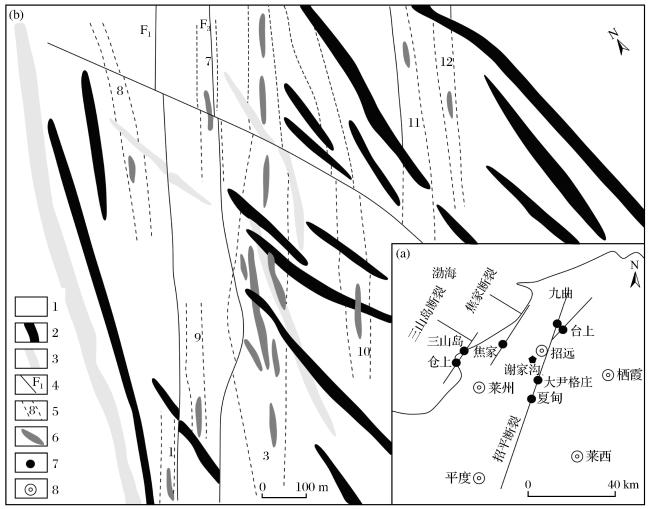
矿区内构造较为发育,主要为NNE和NNW向断裂(图1)。其中,NNE向断裂为矿区内主要断裂,发育规模较大,具有多期活动特征,早期韧性剪切带内可见S-C组构和定向排列现象,与矿床空间展布形态一致,晚期韧性变形带破坏矿体,可见断层泥和碎裂岩等;NNW向断裂规模较小,带内可见断层泥和角砾岩(姚晓峰等,2020鲍兴隆等,2024)。
图1 谢家沟金矿床地质图(修改自王建国等,2009姚晓峰等,2020

(a)区域位置示意图;(b)矿区地质简图;1.玲珑花岗岩;2.中基性脉岩;3.硫铁矿带;4.断层及编号;5.蚀变带及编号;6.金矿体;7.金矿床;8.城市

Fig. 1 Geological map of the Xiejiagou gold deposit(modified after Wang et al,2009;Yao et al,2020)

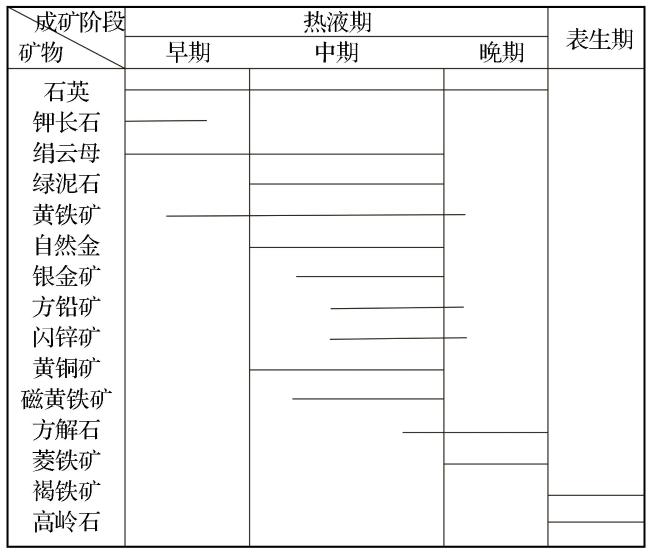
矿区内发育玲珑花岗岩,主要岩性为片麻状黑云母花岗岩,主要矿物成分为钾长石、斜长石、石英和黑云母等(胡文萱等,2024),还发育有大量的燕山期岩脉,主要有煌斑岩、辉石闪长岩、闪长玢岩、石英闪长玢岩和花岗闪长岩等,大部分岩脉呈NW和NNW向展布。围岩蚀变主要有钾长石化、绢云母化、硅化和黄铁矿化等。矿体沿NE向展布,倾向SE,倾角为70°~80°,严格受控于韧性剪切带,具有尖灭再现特征。矿石类型主要为黄铁矿(黄铜矿)绢英岩化和石英硫化物脉型(辛洪波等,2006),其中前者品位较高但空间连续性较差,后者叠加于绢英岩化矿体之上,矿化较为均匀但品位相对较低。矿石矿物主要有黄铁矿、黄铜矿、方铅矿、闪锌矿、自然金和银金矿,还有少量的碲银矿和辉银矿,脉石矿物主要有石英、绢云母、钾长石、碳酸盐矿物和萤石(杜泽忠等,2020姚晓峰等,2020Du et al,2023鲍兴隆等,2024)。结合矿物共生组合和穿插关系,建立谢家沟金矿的矿物生成顺序如图2所示。
图2 谢家沟金矿矿物生成顺序(底图据Chai et al,2019

Fig. 2 Paragenetic sequence of minerals in the Xiejiagou gold deposit(base map according to Chai et al,2019

2 侵入岩特征

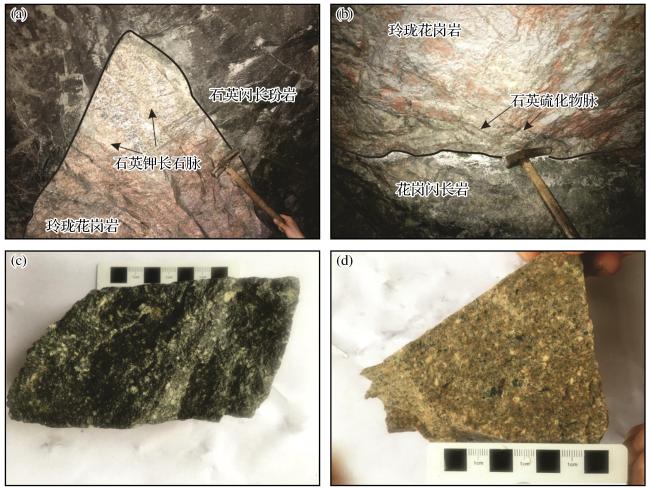
矿区主要脉岩类型有闪长玢岩、花岗闪长斑岩、闪长岩、石英闪长玢岩、辉石闪长岩、辉绿岩和煌斑岩等(图3)(张群喜等,2007)。目前对于成矿前脉岩缺乏直接同位素测年研究,但韦延光(2005)通过单矿物及全岩K-Ar法测年,获得谢家沟金矿的主成矿年龄为115~125 Ma,据此推断成矿前脉岩形成时代应早于125 Ma,成矿后脉岩形成时代约为118 Ma(姚晓峰等,2020)。本研究的成矿前蚀变岩(原岩为闪长岩)具有半自形粒状结构,主要矿物为斜长石(50%~55%)、角闪石(20%~25%)、黑云母(5%~10%)和少量石英(5%)。成矿前细粒花岗岩具有细晶结构,块状构造,主要矿物为钾长石(40%~45%)、石英(30%~35%)和斜长石(15%~20%)。成矿后石英闪长玢岩具有斑状结构,斑晶含量为20%~25%,主要为斜长石(10%~15%)、角闪石(5%~8%)和石英(3%~5%),基质具有显微晶质结构,由长石和石英微晶组成。成矿后花岗闪长岩具有中—细粒花岗结构,主要矿物为斜长石(35%~40%)、钾长石(15%~20%)、石英(20%~25%)、角闪石(10%~15%)和黑云母(3%~5%)。
图3 石英闪长玢岩和花岗闪长岩切割矿化蚀变带现象

(a)石英闪长玢岩侵入玲珑花岗岩,接触带切割第一阶段石英钾长石脉体;(b)花岗闪长岩侵入玲珑花岗岩,接触带切割第一阶段钾化和第三阶段石英硫化物脉体;(c)石英闪长玢岩标本照片;(d)花岗闪长岩标本照片

Fig. 3 Phenomena of quartz diorite porphyry and granodiorite cutting mineralized alteration zones

3 采样及分析测试

3.1 采样位置

选取坑道内两类岩脉进行取样,分别为成矿前细粒花岗岩、蚀变岩和成矿后石英闪长玢岩、花岗闪长岩,采集无蚀变及脉体穿插的新鲜样品,用纯化水冲洗干净,烘干并粉碎至200目以备测试使用。

3.2 测试方法

样品分析测试工作由北京燕都中实测试技术有限公司完成,主量元素采用XRF测试,微量元素采用ICP-MS测试。
主量元素测试:首先将样品研磨至200目以下,称量后加入Li2B4O7(1∶8)助熔剂混合,放置于融样机中加热至1 150 ℃,使其在金铂坩埚中熔融成均一玻璃片体,后使用XRF(Zetium,PANalytical)测试。测试结果保证数据误差小于1%。
微量元素测试:首先将粉末样品称量后放入聚四氟乙烯溶样罐内,加入HF+HNO3,将高压消解罐放置于干燥箱中,温度控制在190 ℃,72 h后取出,经过赶酸并将溶液稀释后上机测试。测试使用ICP-MS(M90,analytikjena)完成,所测数据根据监控标样GSR-2显示误差小于5%,部分挥发性元素和极低含量元素的分析误差小于10%。

4 测试数据

4.1 主量元素特征

主量元素测试分析结果见表1。测试结果显示,样品烧失量变化范围为2.14%~4.97%,差异性较小。烧失量校正后样品氧化物含量变化如下:
表1 谢家沟金矿岩脉样品主量元素测试分析结果

Table 1 Test analysis results of main elements in dyke samples of the Xiejiagou gold deposit

成矿期次 岩性 样品编号 含量/% 烧失量/%
SiO2 Al2O3 TFe MgO CaO Na2O K2O MnO TiO2 P2O5
成矿前 细粒花岗岩 YM-4-3 73.06 14.18 2.85 0.32 1.52 4.07 3.76 0.04 0.16 0.04 2.81
YM-4-4 74.03 13.75 2.44 0.29 1.93 4.07 3.24 0.05 0.16 0.04 2.79
YM-4-5 76.07 11.93 2.30 0.23 2.37 4.04 2.84 0.06 0.12 0.03 2.91
YM-4-6 75.58 13.25 1.61 0.16 1.37 4.40 3.45 0.03 0.11 0.03 2.14
蚀变岩 YM-3-1 57.78 14.42 7.32 5.91 6.41 3.06 3.92 0.20 0.74 0.24 4.55
YM-3-2 56.70 15.26 8.07 6.45 5.21 3.04 4.07 0.18 0.77 0.26 3.56
YM-3-4 62.70 11.27 8.45 4.60 5.80 1.94 4.25 0.15 0.62 0.22 4.01
成矿后 石英闪长玢岩 YM-2-4 66.25 15.95 4.29 1.99 3.59 4.13 3.10 0.08 0.46 0.15 2.81
YM-2-5 65.78 16.21 4.32 2.02 3.84 3.93 3.20 0.08 0.47 0.16 2.93
YM-2-6 63.12 16.52 5.40 2.63 4.32 4.01 3.14 0.10 0.56 0.20 4.59
YM-2-7 63.26 16.70 4.80 2.60 4.76 3.77 3.23 0.10 0.58 0.19 4.97
花岗闪长岩 YM-1-3 66.31 15.79 4.21 2.16 3.72 3.81 3.23 0.08 0.52 0.17 2.60
YM-1-4 66.98 15.85 3.81 2.00 3.00 4.22 3.46 0.08 0.46 0.14 2.76
YM-1-5 66.86 15.80 3.76 1.89 3.37 4.60 3.07 0.09 0.43 0.14 3.45
YM-1-6 66.24 15.96 4.41 1.99 3.38 4.13 3.19 0.09 0.45 0.15 2.28

注:表中SiO2、Al2O3、TFe、MgO、CaO、Na2O、K2O、MnO、TiO2和P2O5含量数据均为去除烧失量的标准化数据

成矿前,细粒花岗岩和蚀变岩主要氧化物含量变化较大。细粒花岗岩SiO2含量为73.06%~76.07%,平均值为74.68%;Al2O3含量为11.93%~14.18%,平均值为13.28%;MgO含量为0.16%~0.32%,平均值为0.25%;CaO含量为1.37%~2.37%,平均值为1.80%,全碱含量为6.89%~7.86%,平均值为7.47%。蚀变岩SiO2含量为56.70%~62.70%,平均值为59.06%;Al2O3含量为11.27%~15.26%,平均值为13.65%;MgO含量为4.60%~6.45%,平均值为5.65%;CaO含量为5.21%~6.41%,平均值为5.81%;全碱含量为6.19%~7.11%,平均值为6.76%。
成矿后,石英闪长玢岩和花岗闪长岩中主要氧化物含量变化较为稳定。石英闪长玢岩SiO2含量为63.12%~66.25%,平均值为64.60%;Al2O3含量为15.95%~16.70%,平均值为16.35%;MgO含量为1.99%~2.63%,平均值为2.31%;CaO含量为3.59%~4.76%,平均值为4.13%;全碱含量为7.00%~7.23%,平均值为7.13%。花岗闪长岩SiO2含量为66.24%~66.98%,平均值为66.60%;Al2O3含量为15.79%~15.96%,平均值为15.85%;MgO含量为1.89%~2.16%,平均值为2.01%;CaO含量为3.00%~3.72%,平均值为3.37%;全碱含量为7.04%~7.68%,平均值为7.43%。
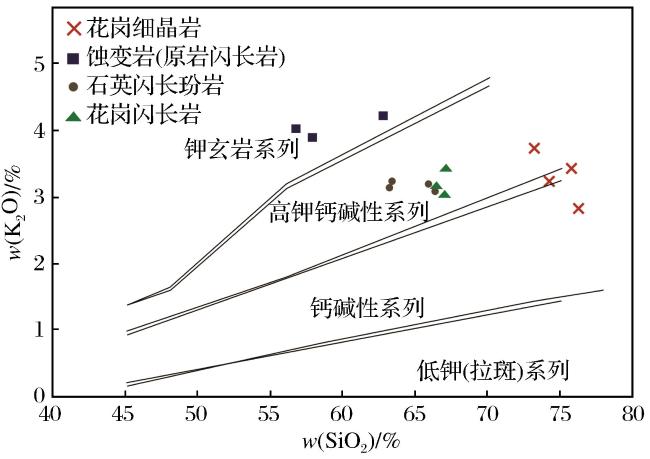
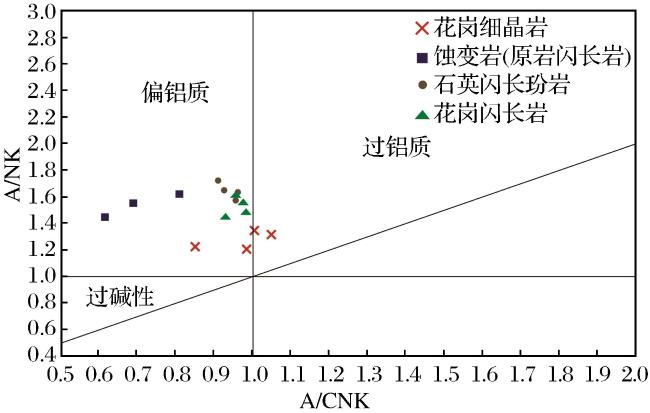
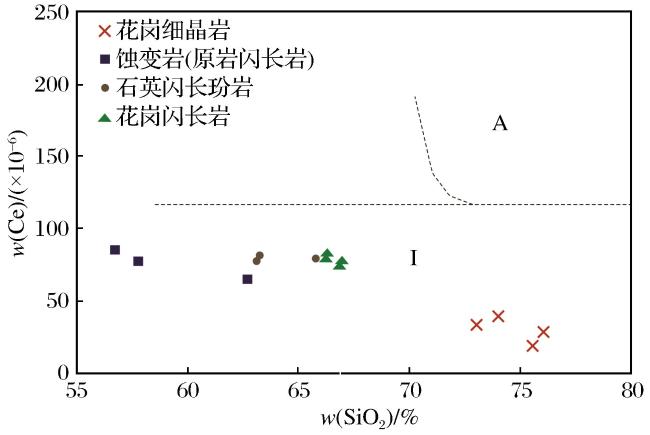
图4可知,成矿前,细粒花岗岩位于钙碱性和高钾钙碱性系列,蚀变岩全部位于钾玄岩系列,谢家沟金矿蚀变地球化学研究表明,钾长石化是该矿床早期重要的蚀变类型,K元素发生明显迁入(丁东胜等,2017杜泽忠等,2020);成矿后,石英闪长玢岩和花岗闪长岩全部位于高钾钙碱性系列。在A/NK-A/CNK图解(图5)中,样品基本全部落入偏铝质岩石区域,仅部分成矿前的细粒花岗岩位于过铝质区域,属于准铝质钙碱性花岗岩类,为I型花岗岩(图6)。
图4 w(K2O)-w(SiO2)图解(底图据Rollinson,1993

Fig. 4 w(K2O)-w(SiO2)diagram(base map according to Rollinson,1993

图5 A/NK-A/CNK图解(底图据Maniar et al,1989

Fig. 5 A/NK-A/CNK diagram(base map according to Maniar et al,1989

图6 w(Ce)-w(SiO2)图解(底图据Collins et al,1982

Fig. 6 w(Ce)-w(SiO2) diagram(base map according to Collins et al,1982

4.2 稀土、微量元素分析特征

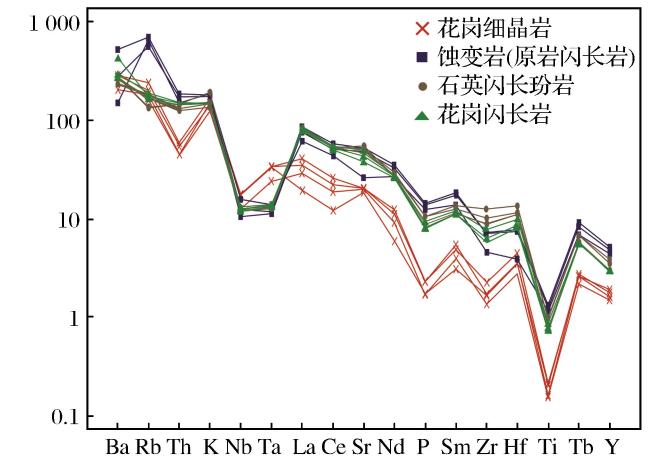
图7表2可知,成矿前后岩脉微量元素配分模式表现为高度一致性变化,所有样品均表现出明显的Nb和Ta亏损,指示在俯冲背景下,富集Nb、Ta的矿物可能在源区发生残留或在地幔楔受到俯冲流体交代,同时,成矿后岩脉Zr/Hf比值介于成矿前两岩脉之间,且均低于球粒陨石值(约为36.3),可能指示其发生岩浆混合作用,并形成于高压环境。
图7 原始地幔微量元素标准化蛛网图(底图据Thompson,1982

diagram(base map according to Thompson,1982

Fig. 7 Primitive mantle normalized trace elements spider

表2 谢家沟金矿岩脉样品微量元素测试结果

Table 2 Test results of trace elements in dyke samples of the Xiejiagou gold deposit(×10-6

成矿期次 岩性 样品编号 Ba Rb Tu K Nb Ta La Ce Sr
成矿前 细粒花岗岩 YM-4-3 1 546 118.00 3.98 31 225.56 10.80 1.15 20.20 33.80 365
YM-4-4 1 509 101.00 3.74 26 926.43 10.30 1.14 23.70 39.50 360
YM-4-5 1 485 79.60 3.07 23 603.49 7.70 0.82 17.10 28.80 356
YM-4-6 1 124 90.20 3.16 28 640.31 10.50 1.13 11.50 19.10 329
蚀变岩 YM-3-1 1 503 271.00 11.30 32 559.45 6.31 0.40 43.40 77.90 806
YM-3-2 2 768 334.00 12.20 33 766.55 8.07 0.41 46.80 85.40 876
YM-3-4 828 315.00 9.90 35 235.31 9.41 0.48 35.30 65.00 460
成矿后 花岗闪长玢岩 YM-2-4 1 489 66.80 9.84 25 719.90 7.41 0.48 46.20 79.20 848
YM-2-5 1 531 68.10 9.62 26 524.99 7.22 0.47 46.80 79.40 937
YM-2-6 1 442 83.80 8.37 26 043.27 7.12 0.45 45.30 78.00 803
YM-2-7 1 264 90.80 8.75 26 839.81 7.36 0.45 47.20 81.60 838
花岗闪长岩 YM-1-3 1 516 80.60 9.98 26 767.61 7.98 0.49 49.20 82.90 833
YM-1-4 1 566 93.60 10.00 28 692.27 7.55 0.47 46.00 77.90 747
YM-1-5 2 284 87.00 9.84 25 459.93 7.21 0.46 44.20 74.40 658
YM-1-6 1 637 93.00 9.74 26 509.96 7.54 0.50 47.10 79.20 884
成矿期次 岩性 样品编号 Nd P Sm Zr Hf Ti Tb Y
成矿前 细粒花岗岩 YM-4-3 13.00 189.06 1.90 22.70 1.21 259.81 0.25 7.83
YM-4-4 14.40 184.41 2.11 17.50 0.98 253.42 0.26 7.32
YM-4-5 10.70 140.00 1.55 14.10 0.76 192.39 0.21 6.22
YM-4-6 7.05 147.57 1.22 16.80 0.96 202.79 0.25 6.67
蚀变岩 YM-3-1 37.30 1 058.17 6.58 68.60 1.98 1 454.13 0.78 19.00
YM-3-2 39.60 1 119.53 6.89 71.40 2.09 1 538.45 0.85 20.70
YM-3-4 30.50 965.73 5.23 44.80 1.07 1 327.10 0.65 17.70
成矿后 花岗闪长玢岩 YM-2-4 30.80 669.92 4.44 87.10 2.97 920.61 0.56 12.10
YM-2-5 31.00 693.35 4.51 83.30 2.86 952.79 0.55 12.20
YM-2-6 31.50 852.46 4.74 97.70 3.03 1 171.44 0.62 14.30
YM-2-7 33.20 828.04 5.14 120.00 3.54 1 137.88 0.64 15.50
花岗闪长岩 YM-1-3 31.20 740.12 4.58 75.50 2.61 1 017.06 0.55 12.40
YM-1-4 30.00 629.06 4.27 60.30 2.30 864.45 0.52 11.90
YM-1-5 29.30 620.04 4.33 55.90 2.16 852.06 0.54 11.70
YM-1-6 30.60 661.69 4.40 83.70 2.88 909.29 0.55 12.30
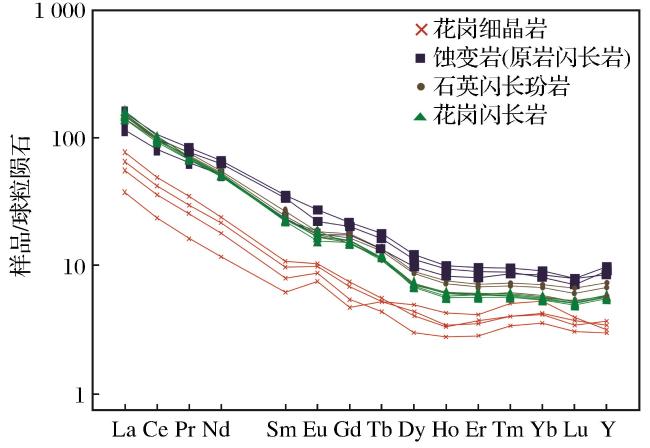
表3图8可知,成矿前后岩脉稀土元素均呈右倾模式,富集轻稀土(LREE)元素,亏损重稀土(HREE)元素,稀土元素配分曲线较为平滑,δEu值为0.77~1.38,多数样品无显著Eu异常,说明斜长石分离结晶不强烈或源区压力较高,δCe值为0.88~0.91,所以样品均显示无Ce异常或异常极弱,表明岩浆体系处于还原环境。成矿前岩脉稀土元素含量变化较大,总量为53.79×10⁻⁶~227.16×10⁻⁶,LREE含量为41.44×10⁻⁶~190.80×10⁻⁶,HREE含量为10.58×10⁻⁶~36.36×10⁻⁶,LREE/HREE比值为3.36~6.52,除细粒花岗岩的一个样品LaN/YbN值较低之外,其余样品比值范围为13.30~17.95。其中,蚀变岩稀土元素总量较高,为175.47×10-6~276.95×10-6,LREE含量为145.00×10-6~190.80×10-6,HREE含量为30.47×10-6~36.36×10-6;细粒花岗岩含量较低,为53.79×10-6~97.74×10-6,LREE含量为41.44×10-6~84.73×10-6,HREE含量为10.58×10-6~13.39×10-6。成矿后岩脉稀土元素含量变化较为稳定,总量为183.18×10-6~205.46×10-6,LREE含量为161.84×10-6~177.85×10-6,HREE含量为21.34×10-6~27.73×10-6,LREE/HREE比值较高(6.41~7.87),LaN/YbN比值范围为21.21~27.64。
表3 谢家沟金矿岩脉稀土元素测试分析结果

Table 3 Test analysis results of rare earth elements in dyke samples of the Xiejiagou gold deposit(×10-6

成矿期次 岩性 样品编号 La Ce Pr Nd Sm Eu Gd Tb Dy Ho Er
成矿前 细粒花岗岩 YM-4-3 20.20 33.80 3.62 13.00 1.90 0.73 1.78 0.25 1.42 0.25 0.75
YM-4-4 23.70 39.50 4.26 14.40 2.11 0.76 1.93 0.26 1.32 0.24 0.79
YM-4-5 17.10 28.80 3.11 10.70 1.55 0.64 1.42 0.21 0.97 0.20 0.60
YM-4-6 11.50 19.10 2.01 7.05 1.22 0.56 1.23 0.25 1.60 0.31 0.87
蚀变岩 YM-3-1 43.40 77.90 9.41 37.30 6.58 1.63 5.26 0.78 3.60 0.68 1.89
YM-3-2 46.80 85.40 10.1 39.60 6.89 2.01 5.65 0.85 3.94 0.72 2.03
YM-3-4 35.30 65.00 7.73 30.50 5.23 1.24 4.36 0.65 3.14 0.60 1.69
成矿后 石英闪长玢岩 YM-2-4 46.20 79.20 8.68 30.80 4.44 1.25 4.09 0.56 2.33 0.44 1.26
YM-2-5 46.80 79.40 8.77 31.00 4.51 1.24 3.92 0.55 2.30 0.44 1.26
YM-2-6 45.30 78.00 8.52 31.50 4.74 1.31 4.26 0.62 2.81 0.52 1.44
YM-2-7 47.20 81.60 9.24 33.20 5.14 1.35 4.66 0.64 2.92 0.55 1.50
花岗闪长岩 YM-1-3 49.20 82.90 8.76 31.20 4.58 1.21 4.02 0.55 2.34 0.44 1.28
YM-1-4 46.00 77.90 8.40 30.00 4.27 1.16 3.90 0.52 2.21 0.42 1.24
YM-1-5 44.20 74.40 8.23 29.30 4.33 1.38 3.89 0.54 2.19 0.40 1.19
YM-1-6 47.10 79.20 8.51 30.60 4.40 1.28 4.09 0.55 2.35 0.44 1.24
成矿期次 岩性 样品编号 Tm Yb Lu Y ∑REE/(×10-6 ∑LREE/(×10-6 ∑HREE/(×10-6 LREE/HREE LaN/YbN δEu δCe
成矿前 细粒花岗岩 YM-4-3 0.13 0.87 0.11 7.83 86.63 73.25 13.39 5.47 15.64 1.19 0.88
YM-4-4 0.13 0.89 0.12 7.32 97.74 84.73 13.00 6.52 17.95 1.14 0.88
YM-4-5 0.11 0.75 0.10 6.22 72.48 61.90 10.58 5.85 15.29 1.30 0.88
YM-4-6 0.17 1.12 0.13 6.67 53.79 41.44 12.35 3.36 6.92 1.38 0.88
蚀变岩 YM-3-1 0.29 1.70 0.23 19.00 209.65 176.22 33.43 5.27 17.21 0.82 0.89
YM-3-2 0.31 1.90 0.26 20.70 227.16 190.80 36.36 5.25 16.61 0.96 0.90
YM-3-4 0.28 1.79 0.26 17.70 175.47 145.00 30.47 4.76 13.30 0.77 0.91
成矿后 石英闪长玢岩 YM-2-4 0.19 1.17 0.17 12.10 192.88 170.57 22.31 7.65 26.62 0.88 0.89
YM-2-5 0.20 1.21 0.17 12.20 193.96 171.72 22.24 7.72 26.08 0.88 0.88
YM-2-6 0.23 1.42 0.20 14.30 195.16 169.37 25.79 6.57 21.51 0.87 0.89
YM-2-7 0.24 1.50 0.22 15.50 205.46 177.73 27.73 6.41 21.21 0.83 0.89
花岗闪长岩 YM-1-3 0.20 1.20 0.17 12.40 200.44 177.85 22.59 7.87 27.64 0.84 0.89
YM-1-4 0.19 1.14 0.16 11.90 189.41 167.73 21.68 7.74 27.20 0.85 0.89
YM-1-5 0.18 1.09 0.16 11.70 183.18 161.84 21.34 7.58 27.34 1.01 0.88
YM-1-6 0.19 1.17 0.17 12.30 193.58 171.09 22.49 7.61 27.14 0.91 0.88

注: δEu=2×EuN/(SmN+GdN

图8 球粒陨石标准化稀土元素配分模式图

(底图据Boynton,1984

Fig. 8 Chondrite-normalized REE pattern diagram(base map according to Boynton,1984

5 讨论

5.1 谢家沟金矿成矿地质背景

太平洋板块俯冲是胶东地区构造作用及岩浆活动的主要源动力,构造体制转换为成矿提供了有利的地质条件(韦延光,2005)。早白垩纪早期太平洋板块发生近EW向俯冲,至123~119 Ma,区域应力场向NW-SE向转换,含金流体从深部地幔经拆离断层快速上升;到早白垩纪后期,EW-SE向伸展持续,热液系统进入脆性主导阶段,促使金在浅部地壳大规模沉淀(Ni et al,2025)。
通过典型金矿对比,有助于理解不同类型金矿对同一区域构造背景的响应差异。胶西北金矿集区位于华北克拉通东南缘,是我国最大的金矿集区,包含三山岛、焦家和玲珑等大型—超大型金矿,成矿时代主要集中在(120±10)Ma(尹业长,2020),与胶东地区大规模金成矿事件高峰期高度一致(韦延光,2005辛洪波,2005)。谢家沟金矿与焦家金矿、玲珑金矿的成矿时代相近,与古太平洋板块俯冲方向转换时期吻合,均受到区域断裂系统控制,与中生代岩浆活动密切相关,成矿流体均显示壳幔混合特征,反映了幔源物质的参与,但谢家沟金矿严格受控于韧性剪切带,其矿石与围岩来源差异明显,成矿物质可能具有复杂的来源,成矿压力约为2 200×105 Pa,远高于焦家金矿的成矿压力,反映其形成深度更大(辛洪波,2005)。
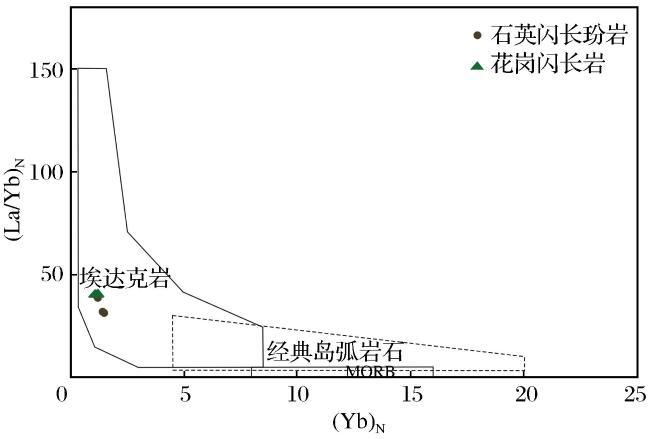
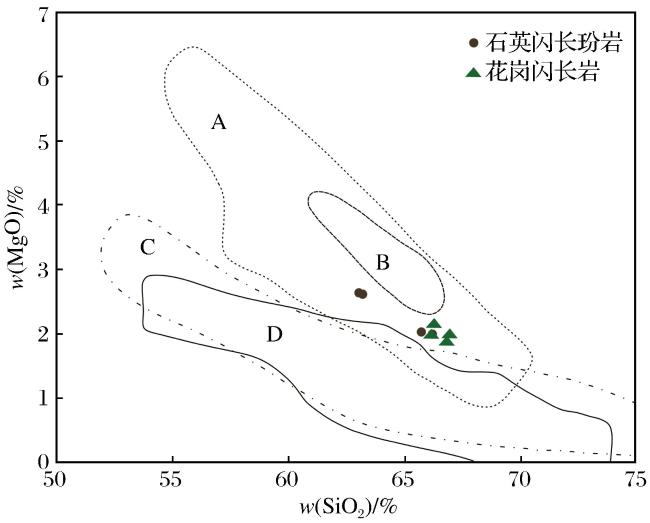
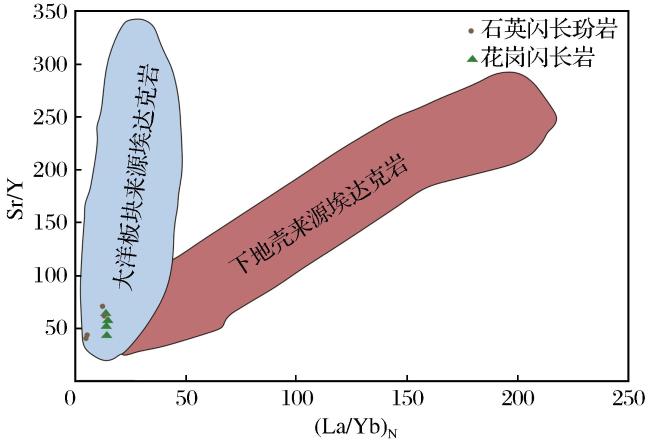
成矿后岩脉具有高Sr(658×10-6~937×10-6)、低Y(11.7×10⁻⁶~15.5×10⁻⁶)和低Yb(1.09×10⁻⁶~1.50×10⁻⁶)特征,(La/Yb)N为21.21~27.64(20)、Eu无明显负异常,表现出极为明显的埃达克岩特征(图9)。俯冲洋壳部分熔融形成的埃达克岩需要高压条件(深度大于50 km),下地壳部分熔融形成的埃达克岩则要求源区残留相中有斜长石存在,因此形成深度相对较浅(Sun et al,2012)。其高Sr低Y、(La/Yb)N明显高于典型岛弧岩浆岩以及强烈的轻重稀土分馏特征指示源区残留相中有石榴子石存在,石榴子石是高压条件下的特征残留矿物(Atherton et al,1993Rapp et al,1995;张旗等,2001a,2001b)。在SiO2-MgO图解(图10)和Sr/Y-(La/Yb)N图解(图11)中,成矿后岩脉样品投点均落入下地壳与大洋板块重叠部位,但趋势偏向大洋板块部分。这一分布特征可能是岩浆混合作用和后期流体微弱改造作用的结果,成矿流体中CO2与金的正相关关系间接指示流体对微量元素存在改造能力(韦延光,2005),岩石中Sr可能发生迁移或再分配,导致Sr/Y比值变化。谢家沟成矿后岩脉具有相对较高的MgO含量(1.89%~2.63%)和Mg#值(42~49),实验岩石学研究表明,单纯的下地壳部分熔融形成的熔体Mg#值通常较低(小于40),较高的Mg#值指示熔体在上升过程中可能与地幔橄榄岩发生相互作用(Xie et al,2012),这种相互作用也是俯冲洋壳熔融型埃达克岩的典型特征。
图9 (Yb)N/(La/Yb)N图解(底图据Martin,1986

Fig. 9 (Yb)N/(La/Yb)N diagram(base map according to Martin,1986

图10 w(SiO2)-w(MgO)图解(底图据Wang et al,2006

A-俯冲洋壳起源的埃达克岩;B-与橄榄岩混合的变玄武岩和榴辉岩的实验熔体;C-变玄武岩和榴辉岩的实验熔体(1.0~4.0 GPa);D-加厚下地壳部分熔融起源的埃达克岩

Fig. 10 w(SiO2)-w(MgO) diagram(base map according to Wang et al,2006

图11 Sr/Y-(La/Yb)N图解(底图据Xie et al,2012

Fig. 11 Sr/Y-(La/Yb)N diagram(base map according to Xie et al,2012

5.2 岩脉与岩浆演化的关系

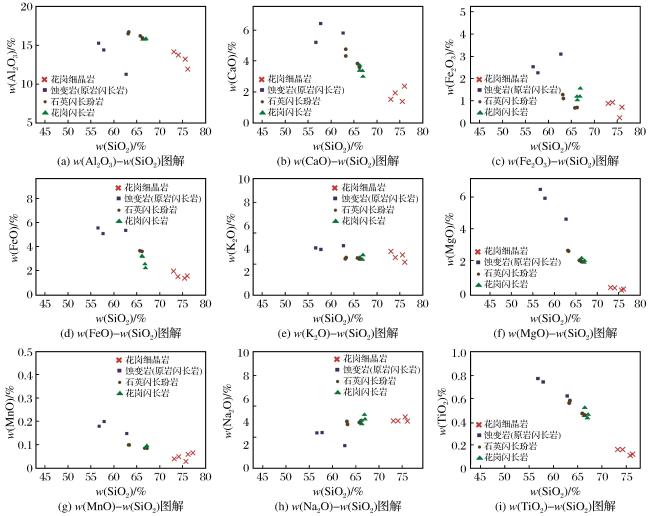
区域研究表明,壳幔岩浆的混合反应和演化是胶东地区巨量金质来源的主要形成机制(田瑞聪等,2022)。成矿前蚀变岩的SiO2含量(56.70%~62.70%)较低,MgO含量(4.60%~6.45%)很高,全铁含量为7.32%~8.45%,指示其来源于未经充分分异演化的岩浆。成矿前细粒花岗岩SiO2含量为73.06%~76.07%,MgO含量(0.16%~0.32%)很低,全铁含量仅为1.61%~2.85%,与下地壳部分熔融产生的酸性岩浆成分相符。成矿后的石英闪长玢岩和花岗闪长岩成分位于2个端元中间,在哈克图解(图12)上表现出良好的线性关系,反映了2种不同成分岩浆的混合过程,如果是单一岩浆通过分离结晶作用演化,其元素变化趋势通常呈曲线而非直线(韦延光,2005),指示谢家沟地区在白垩纪发生岩浆混合作用。轻重稀土分馏程度(LaN/YbN比值)在成矿后岩石中更高(21.21~27.64),高于蚀变岩(13.30~17.95)和细粒花岗岩(6.92~17.95),这表明混合后的岩浆可能又经历了进一步的演化,或者混合过程中源区的残留矿物组合发生了变化。
图12 主量元素哈克图解

Fig. 12 Harker diagrams of major elements

起源于交代岩石圈地幔的岩浆中富含水、硫和碳等挥发分,硫在热液迁移中能够与金形成络合物,因此基性岩浆上侵的过程中,不断地演化和分异使得岩浆中Au元素含量不断升高,在与酸性岩浆发生混合作用后,迅速改变混合体系的物理化学条件,运移至地壳浅部有利构造部位后沉淀成矿。谢家沟金矿主成矿阶段成矿流体的均一温度主要集中在260~340 ℃。韦延光(2005)提出更详细的阶段划分数据,第一阶段流体包裹体均一温度为320~350 ℃,第二阶段为270~330 ℃。第三阶段为250~290 ℃。
流体包裹体的气相成分分析揭示了成矿流体的挥发分组成。谢家沟金矿流体包裹体的气相成分主要为H2O和CO2,从主成矿阶段至成矿晚期,流体中H2O含量逐渐增加,而CO2含量逐渐减少。值得注意的是,流体中CO2的含量与矿石的金品位之间存在一定的正相关关系,表明CO₂在Au元素的运移和沉淀过程中可能扮演了重要角色(韦延光,2005孙莉,2006)。丁东胜等(2017)研究进一步明确了流体体系的类型,成矿早期流体属于H2O-CO2-NaCl体系,主成矿期流体属于H2O-CO2-NaCl±CH₄体系。H、O同位素组成是示踪成矿流体来源的有效工具。孙莉(2006)对谢家沟金矿的石英样品进行了H、O同位素分析,研究结果显示,在Ⅰ~Ⅲ主成矿阶段,石英的δ 18O平均值为10.98‰,与含矿黑云母花岗岩和郭家岭花岗岩的δ 18O值相当,相应的成矿流体的δ 18 O H 2 O平均值为4.15‰,δD H 2 O平均值为-86.68‰,成矿晚阶段形成的萤石流体包裹体的δD H 2 O值为-122.71‰,这一数值接近中生代大气降水的值。

5.3 区域脉岩对比及其对成矿背景的指示

关于脉岩与金矿的成因联系,区域研究提出了胶东群的两阶段部分熔融模式(杨冀,2010)。该模式认为,早期(第一阶段)部分熔融产生中酸性岩浆,此时温度较低,金不易活化迁移,从而在胶东群残留体中富集。后期(第二阶段)在燕山运动强烈的构造—热事件影响下,胶东群再次部分熔融产生中基性岩浆,此时金达到活化迁移的条件,并在幔源流体的参与下进入岩浆系统,含矿岩浆在上升过程中,成矿流体与中基性岩浆发生分离,最终在构造有利部位充填或交代形成金矿床,中基性岩浆则在矿体附近的构造薄弱带侵位,形成各种脉岩。
招平断裂带是胶西北地区重要的控矿构造带。该断裂带及其次级断裂(如谢家沟断裂)在中生代发育大量脉岩。区域研究表明,招平断裂带内的脉岩类型复杂,主要划分为基性、中性和酸性岩类。在时间上,这些脉岩呈现“脉动式”活动特征,在金成矿前、成矿期和成矿后均有发育(杨冀,2010);在空间上,除部分脉岩本身构成矿体之外,大多数脉岩与金矿体相伴生,并且均受到断裂带的严格控制(王建国等,2008)。谢家沟金矿成矿后石英闪长玢岩和花岗闪长岩的U-Pb年龄分别为(118.0±1.1)Ma和(118.4±0.9)Ma(姚晓峰等,2020),与区域上招平断裂带中基性脉岩的主要活动时代(130~110 Ma)和胶西北地区金成矿高峰期(120 Ma左右)高度吻合(王建国等,2008杨冀,2010)。这种时间上的相近性表明,脉岩活动与金成矿作用处于同一构造—岩浆事件框架内。

6 结论

(1)成矿前后岩脉均显示为高钾钙碱性、准铝质的I型花岗岩,具有富集LREE和LILE、亏损HREE和HFSE的特征,弱的负Eu异常和负Ce异常,表明来源于壳幔混合源区;成矿前岩浆活动复杂,有显著的幔源物质注入和强烈的壳幔相互作用,成矿后岩脉具有高度演化、成分均一的深部岩浆房末期特征。
(2)成矿后岩脉具有高Sr、低Y和无负Eu异常等埃达克岩特征,暗示其形成于洋壳俯冲背景下的高压环境,与古太平洋板块俯冲引发的壳幔作用密切相关。
(3)古太平洋板块俯冲导致地幔楔部分熔融,产生基性岩浆并向上运移,底侵古老下地壳产生酸性岩浆,两类成分差距较大的岩浆以不同比例发生岩浆混合作用,在成矿前产出中性蚀变岩和酸性细粒花岗岩。在主成矿期,充分混合的岩浆分异出含矿热液,在有利部位成矿,最终充分混合后形成成分均一的中酸性岩浆,在主成矿期后形成石英闪长玢岩和花岗闪长岩。
(4)起源于交代岩石圈地幔的基性岩浆富含水、硫和碳等挥发分,伴随着岩浆上侵演化过程,流体中Au元素逐渐富集,经历了与酸性岩浆的混合作用,物理化学条件发生改变而导致金在地壳浅部析出成矿。

http://www.goldsci.ac.cn/CN/10.11872/j.issn.1005-2518.2026.03.361

Atherton M P Petford N1993.Generation of sodium-rich magmas from newly underplated basaltic crust[J].Nature362(6416):144-146.

Boynton W V1984.Cosmochemistry of the rare earth elements:meteorite studies[M]//Rare Earth Element Geochemistry.Amsterdam:Elsevier.

Chai P Hou Z Q Zhang H R,et al,2019.Geology,fluid inclusion,and H-O-S-Pb isotope constraints on the mineralization of the Xiejiagou gold deposit in the Jiaodong peninsula[J].Geofluids,(1):3726465.

Collins W J Beams S D White A J R,et al,1982.Nature and origin of A-type granites with particular reference to Southeastern Australia[J].Contributions to Mineralogy and Petrology80(2):189-200.

Du Z Z Cheng Z Z Yao X F,et al,2023.Two-stage superimposed gold mineralization in the Xiejiagou gold deposit,Shandong Province:insights from fluid inclusions,H-O-S isotopes,and trace elements[J].Minerals13(9):1210.

Maniar P D Piccoli P M1989.Tectonic discrimination of granitoids[J].Geological Society of America Bulletin101(5):635-643.

Martin H1986.Effect of steeper Archean geothermal gradient on geochemistry of subduction-zone magmas[J].Geology14(9):753.

Ni J L Liu J L Wang Y R,et al,2025.Control of the shift in subduction direction on upper plate tectonic extension and gold mineralization:a case study from the Early Cretaceous Jiaodong Peninsula,Eastern China[J].Tectonics44(3):e2024TC008585.

Rapp R P Watson E B1995.Dehydration melting of metabasalt at 8-32 kbar:implications for continental growth and crust-mantle recycling[J].Journal of Petrology36(4):891-931.

Rollinson H R1993.Using geochemical data[M].Harlow,Essex,England:Longman Scientific Technical.

Sun W D Ling M X Chung S L,et al,2012. Geochemical constraints on adakites of different origins and their mineralization potential. In:Advances in Adakite Research[C]// Geological Society of London Special Publications,367:175-192.

Thompson R N1982.Magmatism of the British tertiary volcanic province[J].Scottish Journal of Geology18(1):49-107.

Wang Q Xu J F Jian P,et al,2006.Petrogenesis of adakitic porphyries in an extensional tectonic setting,Dexing,South China:implications for the genesis of porphyry copper mineralization[J].Journal of Petrology47(1):119-144.

Xie J C Yang X Y Sun W D,et al,2012.Early Cretaceous dioritic rocks in the Tongling region,Eastern China:implications for the tectonic settings[J].Lithos,150:49-61.

鲍兴隆,钱建平,孙俊磊,等,2024.胶西北地区谢家沟金矿床构造控矿规律及找矿方向[J].地质通报43(5):680-691.

Bao Xinglong Qian Jianping Sun Junlei,et al,2024.Ore-controlling structure and exploration target of Xiejiagou gold deposit in northwest Jiaodong area[J].Geological Bulletin of China43(5):680-691.

丁东胜,陈蕾,巩恩普,等,2017.山东谢家沟金矿床流体包裹体研究及成矿机制的探讨[J].矿床地质36(2):345-363.

Ding Dongsheng Chen Lei Gong Enpu,et al,2017.Fluid inclusion study and metallogenic mechanism of Xiejiagou gold deposit in Shandong Province[J].Mineral Deposits36(2):345-363.

丁东胜,2019.胶东谢家沟金矿成岩—成矿机理研究[D].沈阳:东北大学.Ding Dongsheng,2019.Research on petrogenetic-metallogenic mechanism of the Xiejiagou gold deposit,Jiaodong Peninsula[D].Shenyang:Northeastern University.

杜泽忠,程志中,姚晓峰,等,2020.胶东谢家沟金矿热液蚀变作用过程的元素迁移规律[J].地质通报39(8):1137-1152.

Du Zezhong Cheng Zhizhong Yao Xiaofeng,et al,2020.Element migration regularity during hydrothermal alteration in the Xiejiagou gold deposit,Eastern Shandong Province[J].Geological Bulletin of China39(8):1137-1152.

冯雅杰,王永志,丁正江,等,2025.胶西北金矿成矿模式及找矿技术方法演变[J].地学前缘32(4):165-181.

Feng Yajie Wang Yongzhi Ding Zhengjiang,et al,2025.The ore-forming model and evolution of prospecting techniques for gold deposits in Jiaoxibei[J].Earth Science Frontiers32(4):165-181.

胡文萱,宋明春,李杰,等,2024.胶东金矿成矿物质来源:来自与金成矿有关地质单元金含量的约束[J].黄金科学技术32(5):781-797.

Hu Wenxuan Song Mingchun Li Jie,et al,2024.Sources of ore-forming materials in the Jiaodong gold deposits:constraints on gold content from geological units related to gold mineralization[J].Gold Science and Technology32(5):781-797.

黄鑫,2021.胶东大柳行金矿矿床特征及成因探讨[J].西北地质54(4):129-141.

Huang Xin2021.Discussion on the characteristics and genesis of the Daliuhang gold deposit in Jiaodong[J].Northwestern Geology54(4):129-141.

宋明春,2015.胶东金矿深部找矿主要成果和关键理论技术进展[J].地质通报34(9):1758-1771.

Song Mingchun2015.The main achievements and key theory and methods of deep-seated prospecting in the Jiaodong gold concentration area,Shandong Province[J].Geological Bulletin of China34(9):1758-1771.

宋明春,崔书学,姜洪利,2011.山东胶西北矿集区和焦家金矿田成矿构造系统[J].地质通报30(4):573-578.

Song Mingchun Cui Shuxue Jiang Hongli2011.Metallogenic structural system for Jiaojia gold field and Jiaoxibei gold deposits concentrated areas in Shandong Province,China[J].Geological Bulletin of China30(4):573-578.

孙莉,2006.胶东谢家沟金矿床流体包裹体研究[D].北京:中国地质大学(北京). Sun Li,2006.Study on the fluid inclusions of Xiejiagou gold deposit[D].Beijing:China University of Geosciences.

田锋,2005.谢家沟金矿元素地球化学特征及原生叠加晕模型[D].北京:中国地质大学(北京). Tian Feng,2005.Elements’ geochemical features and model of primary superimposed halos of the Xiejiagou gold deposit[D].Beijing:China University of Geosciences.

田瑞聪,李大鹏,张文,等,2022.胶北隆起中生代壳幔岩浆的混合反应是巨量金质来源的关键[J].岩石学报38(1):23-40.

Tian Ruicong Li Dapeng Zhang Wen,et al,2022.The mixing of Mesozoic crust-mantle magma is the key to the source of large amounts of gold deposits in the Jiaobei uplift,China[J].Acta Petrologica Sinica38(1):23-40.

王建国,李秀臣,刘洪臣,2008.招平断裂带脉岩群对金成矿的约束[J].中国矿业17(12):64-70.

Wang Jianguo Li Xiuchen Liu Hongchen2008.Relationship of dike and gold mineralization in Zhao-Ping fault belt[J].China Mining Magazine17(12):64-70.

王建国,刘洪臣,邓军,等,2009.胶东谢家沟金矿稀土元素特征及其成矿意义[J].地质学报83(10):1497-1504.

Wang Jianguo Liu Hongchen Deng Jun,et al,2009.REE characteristics of the Xiejiagou gold deposit,eastern Shandong Province and its significance to mineralizations[J].Acta Geologica Sinica83(10):1497-1504.

王文钰,邢晓平,2021.胶东地区谢家沟金矿床地质特征及找矿标志[J].世界有色金属,(4):52-53.

Wang Wenyu Xing Xiaoping2021.Geological characteristics and prospecting criteria of Xiejiagou gold deposit in Jiaodong area[J].World Nonferrous Metals,(4):52-53.

韦延光,2005.山东招远市谢家沟—石城夼构造岩浆带金成矿系统研究[D].北京:中国地质大学(北京). Wei Yanguang,2005.Study on the gold mineralization system in Xie-jiagou-Shichengkuang structure-magma belt,Zhaoyuan,Shandong[D].Beijing:China University of Geosciences.

肖风利,曾庆栋,马凤山,等,2018.胶东西北部重要金成矿断裂带特征[J].黄金科学技术26(4):396-405.

Xiao Fengli Zeng Qingdong Ma Fengshan,et al,2018.Features of major gold metallogenic fracture belt in northwestern Jiaodong[J].Gold Science and Technology26(4):396-405.

辛洪波,2005.胶东谢家沟金矿与焦家金矿地质特征与成因对比[D].北京:中国地质大学(北京). Xin Hongbo,2005.The contrast of geological feature and genesis between Xiejiagou gold deposit and Jiaojia gold deposit in Jiaodong Area[D].Beijing:China University of Geosciences.

辛洪波,邓军,曲晓明,等,2006.胶东谢家沟金矿床地质特征与成矿时代研究[J].黄金科学技术14(3):1-6.

Xin Hongbo Deng Jun Qu Xiaoming,et al,2006.The research on the geological feature and mineralization age of Xiejiagou gold deposit in Jiaodong area[J].Gold Science and Technology14(3):1-6.

辛洪波,王建国,曲晓明,等,2007.胶东谢家沟金矿岩石地球化学及流体包裹体研究[J].地质与勘探43(5):61-67.

Xin Hongbo Wang Jianguo Qu Xiaoming,et al,2007.Geochemical characteristics and fluid inclusion in the Xiejiagou gold deposit,Jiaodong area[J].Geology and Prospecting43(5):61-67.

杨冀,2010.招平断裂带(招掖地区)脉岩与金成矿[D].北京:中国地质大学(北京). Yang Ji,2010.Dykes and gold mineralization in Zhaoping Fault Belt(Zhaoye Region)[D].Beijing:China University of Geosciences.

杨立强,邓军,王中亮,等,2014.胶东中生代金成矿系统[J].岩石学报30(9):2447-2467.

Yang Liqiang Deng Jun Wang Zhongliang,et al,2014.Mesozoic gold metallogenic system of the Jiaodong gold province,Eastern China[J].Acta Petrologica Sinica30(9):2447-2467.

杨立强,邓军,张良,等,2024.胶东型金矿[J].岩石学报40(6):1691-1711.

Yang Liqiang Deng Jun Zhang Liang,et al,2024.Jiaodong-type gold deposit[J].Acta Petrologica Sinica40(6):1691-1711.

姚晓峰,程志中,杜泽忠,等,2020.胶西北地区谢家沟金矿岩脉U-Pb年龄及其对成矿时限的制约[J].地质通报39(8):1153-1162.

Yao Xiaofeng Cheng Zhizhong Du Zezhong,et al,2020.U-Pb age of post-ore dykes in the Xiejiagou gold deposit and its constraints on ore-forming age,Northwest Jiaodong,China[J].Geological Bulletin of China39(8):1153-1162.

尹业长,2020.胶西北金矿集区金成矿作用与成矿模型[D].长春:吉林大学. Yin Yechang,2020.Gold mineralization and metallogenic model of the Jiaoxibei gold deposit concentrated area[D].Changchun:Jilin University.

于晓卫,王来明,刘汉栋,等,2023.胶东中生代花岗岩与金矿关系及成矿期划分[J].地质学报97(6):1848-1873.

Yu Xiaowei Wang Laiming Liu Handong,et al,2023.The relationship between Mesozoic granite,gold deposits and the division of metallogenic period in eastern Shandong[J].Acta Geologica Sinica97(6):1848-1873.

张旗,钱青,王二七,等 ,2001a.燕山中晚期的中国东部高原:埃达克岩的启示[J].地质科学36(2):248-255. ZhangQi,QianQing,WangErqi,et al,2001a.An East China plateau in mid-late Yanshanian period:implication from adakites[J].Chinese Journal of Geology (Scientia Geologica Sinica),36(2):248-255.

张旗,王焰,钱青,等 ,2001b.中国东部燕山期埃达克岩的特征及其构造—成矿意义[J].岩石学报17(2):236-244. ZhangQi,WangYan,QianQing,et al,2001b.The characteristics and tectonic-metallogenic significances of the adakites in Yanshan period from Eastern China[J].Acta Petrologica Sinica,17(2):236-244.

张群喜,王生龙,2007.山东谢家沟金矿脉岩特征及其与金矿成矿关系[J].安徽地质17(1):24-27,36.

Zhang Qunxi Wang Shenglong2007.Characteristics of vein rocks and their relationship with gold metallogenism in the Xiejiagou gold mine,Shandong Province[J].Geology of Anhui17(1):24-27,36.

张泽涛,段留安,石满乾,等,2025.胶西北滕家金矿基性脉岩锆石U-Pb年代学、地球化学及其地质意义[J].黄金科学技术33(6):1084-1102.

Zhang Zetao Duan Liu’an Shi Manqian,et al,2025.Zircon U-Pb geochronology,geochemistry of gold-bearing dike from the Tengjia gold deposit in the northwest Jiaodong and its geological significance[J].Gold Science and Technology33(6):1084-1102.

朱平平,刘岳,成秋明,2023.定量确定胶东毕郭地区勘查地球化学异常的分布方向及地质意义[J].地学前缘30(2):440-446.

Zhu Pingping Liu Yue Cheng Qiuming2023.Quantitative determinations of the dispersion pattern and geological significance of geochemical anomalies in Biguo area,Jiaodong Terrane[J].Earth Science Frontiers30(2):440-446.

Outlines

/