

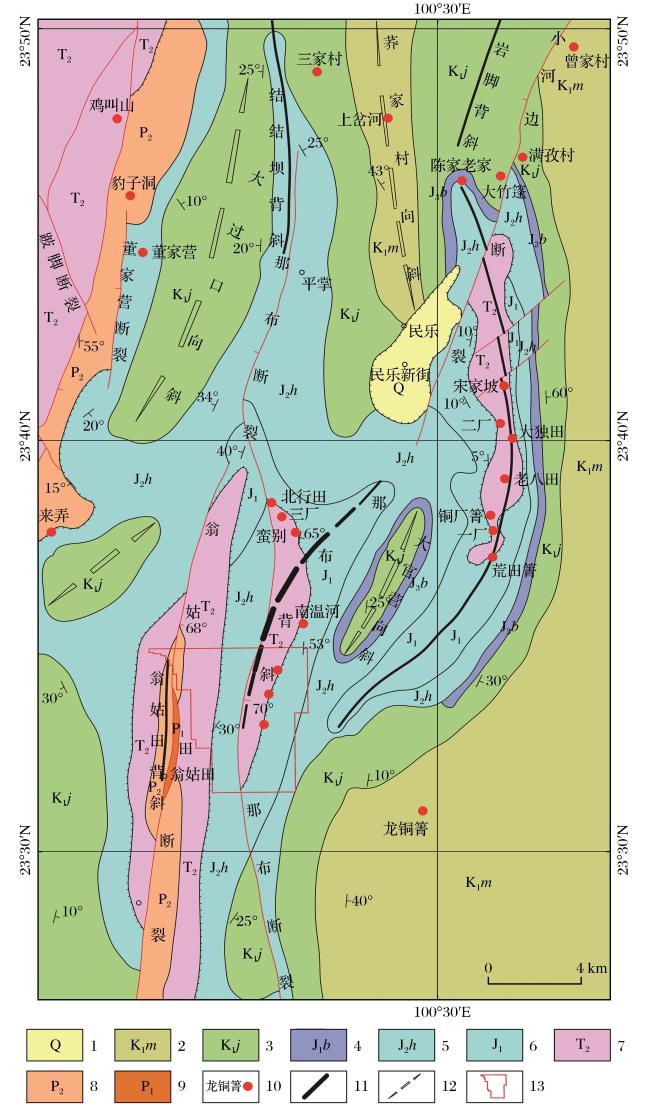
民乐铜矿集区位于澜沧江成矿带南段,近年来,随着曾家村、南温河和坝卡河等矿区取得找矿突破,该地区累计探明铜金属量超过80万t,是我国极具找矿潜力的铜多金属成矿远景区(杨昌华等,2024)。翁孔坝铜矿位于民乐铜矿集区的核心位置,具有优越的成矿地质条件。前期运用地质、地球物理和地球化学等勘查方法对该矿区花地矿段进行了系统勘探,对区内成矿规律和找矿预测取得了一定的认识和进展,探获了一小型铜矿,但矿床成矿的主控因素、矿床成因以及构造控岩控矿机制等问题尚未摸清(曾淑明等,2023)。以往研究认为,翁孔坝铜矿床成因类型属于火山热液型,区内安山岩和玄武岩带是该矿床的成矿岩体,分布受含矿火山岩相带的控制。目前,区内是否发育与南温河矿床相似的含矿火山岩相带,以及在成矿火成岩控矿因素之外,构造是否为另一主要控矿因素,是亟待解决的关键科学问题(吴子卓等,2023;田映天等,2023)。
构造地球化学是介于构造地质学与地球化学之间的交叉学科,是研究地质构造组成和地质化学元素活化迁移及其运动内在规律的一门科学(程志中等,2021;许杰等,2025)。近年来,随着构造地球化学勘查技术的不断发展,该方法通过系统分析断裂构造岩和蚀变岩等地质体,有效提取与盲矿体相关的成矿信息(鞠培姣,2021;李松涛等,2021;宋威方等,2022),在预测矿体产状和示踪成矿流体运移方向方面具有显著优势,已成为隐伏矿体定位预测的关键技术之一(王海丰等,2021;宋威方等,2022;田映天等,2023; Li et al,2023;徐永利等,2024)。程志中等(2021)对甘肃西河地区、江西岩背锡矿区外围进行构造地球化学研究,取得了良好的找矿效果(朱振东等,2023)。
为充分研究矿区的成矿规律,实现找矿突破,本次在翁孔坝铜矿区地表及花地矿段1 098 m中段矿(化)体分布区内开展构造地球化学研究,绘制构造地球化学异常图,分析地球化学场的空间变化特征,预测找矿靶区并进行验证。
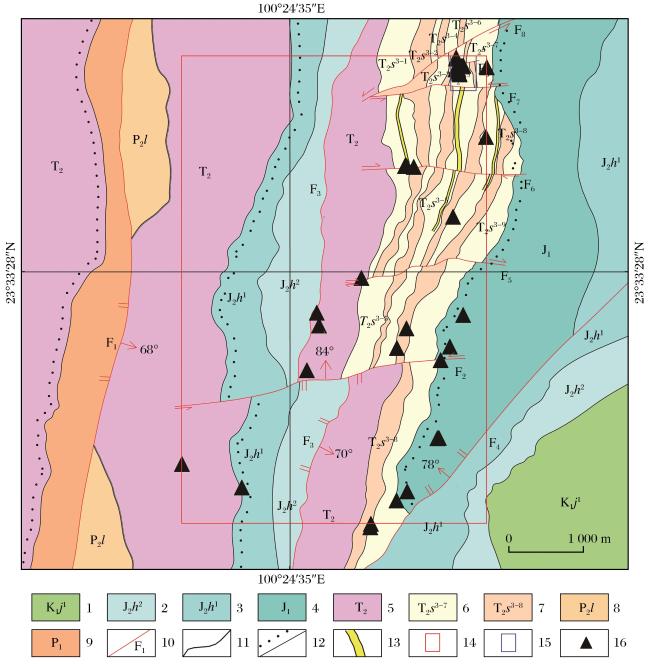
1 矿区地质概况
2 构造地球化学勘查
2.1 样品采集与分析测试
本次在矿区内不同断裂构造带及其上、下盘不同方向、不同性质断裂带采集代表性的构造岩样品,在构造不发育地段采集蚀变岩样品。样品均采自花地矿段1 098 m中段、地表及钻孔内,每件样品重量约为200 g,岩矿样测试分析及试验工作由有色金属西北矿产地质测试中心完成,样品全部磨至200目,缩分成测试样品,采用ICP-OES进行中高含量微量元素测定(包括Ag),采用ICP-MS进行中低含量微量元素测定(包括Ag);采用原子荧光法测定As、Sb、Bi和Hg,检出限为×10-6级,相对标准偏差(RSD)为1.8%,相对误差为2%,精密度和精确度均符合要求。在测试样品中增加5%的密码样,经具有CMA证书的实验室检测,合格率达100%。按照技术流程进行数据处理,先统一元素含量单位,并对数据进行对数标准化和正态分布处理,进一步开展聚类分析和因子分析,获取的元素组合符合地质实际情况,采集样品的经纬度清晰准确。
本次共采集坑道内构造地球化学样品66件、钻孔样品119件和地表构造岩样品33件。在符合统计学前提下,选择花地1 098 m中段56件构造岩样品绘制1 098 m中段构造地球化学图,选择地表、花地1 098 m中段及接近地表的钻孔构造岩样品共91件绘制翁孔坝铜矿区构造地球化学图。地表与坑道样品的挑选原则为选取断裂带内构造岩及断裂上下盘样品,对于一个断裂内采集的多个样品,通过控制其样品间的距离,挑选部分含矿品位高的样品即可。对于钻孔样品的挑选,考虑到地势高低不一致,选择接近地表50 m以内的样品。采样点分布位置如图2所示。
2.2 地表构造地球化学异常分析
(1)聚类分析及指示意义
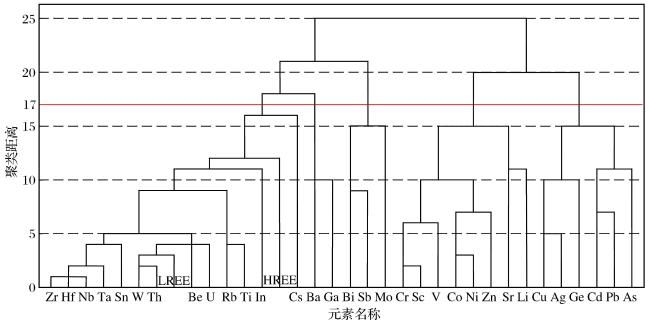
将测试数据换算并统一单位后进行对数处理,运用SPSS软件进行Kolmogorov-Smirnov检验,当P值大于0.05时,数据符合正态分布,当P值小于等于0.05时,数据不符合正态性要求。Ba、Sr、Cu、Zn、Cr、Co、Ni、V、Li、Be、Sc、Ga、Ge、Rb、Zr、Nb、Mo、Ag、Cd、In、Sn、Cs、Hf、Ta、W、Ti、Pb、Bi、Th、U、As和Sb这32种元素以及LREE和HREE的P值大于0.05,数据符合正态分布。
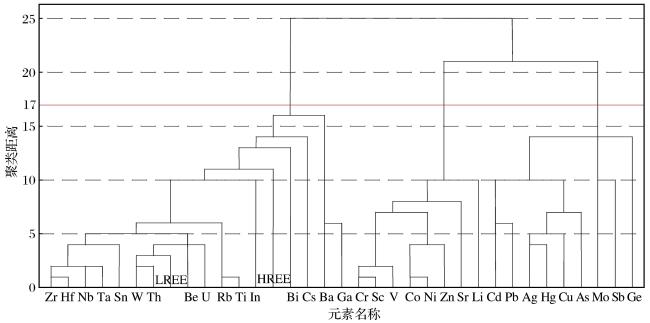
利用SPSS软件对上述元素进行聚类分析,按照安全距离系数连接和Euclidean相关系数,得到R型聚类分析谱系图。按照距离系数为17(图3),结合矿床地质特征,将32种元素及LREE和HREE划分为5组元素组合。其中,第一组为Zr、Hf、Nb、Ta、Sn、W、Th、LREE、Be、U、Rb、Ti、In、HREE、Cs、Ga、Bi和Sb,代表中基性火山岩成岩元素组合;第二组为Ba和Ga,代表造岩元素组合;第三组为Bi、Sb和Mo,代表前缘晕与尾晕元素组合;第四组为Cr、Sc、V、Co、Ni、Zn、Sr和Li,代表闪锌矿化和黄铁矿化元素组合;第五组为Cu、Ag、Ge、Cd、Pb和As,代表铜等成矿元素组合。
(2)因子分析及指示意义。在聚类分析的基础上,进行R型因子分析。按照累计方差贡献值达到76%取因子个数,得到6个主因子,依次是:F1:(-Cu)、Be、(-Ge)、Rb、Zr、Nb、(-Ag)、In、Sn、Hf、Ta、W、Ti、Th、U、LREE、HREE;F2:Zn、Cr、Co、Ni、V、Sc、In;F3:Cu、Zn、Co、Ag、Cd、Pb、As-(Sr)、Li、Bi、Sb;F4:Mo、Bi、As、Sb、(-Sr)、(-Zn)、(-HREE);F5:Be、Rb、Cs;F6:Ba、Ga、Rb、Ti、(-Sr)、(-Li)。
根据元素数据整理及因子得分值,运用Surfer软件绘制了翁孔坝铜矿区地表构造地球化学图(图4)。
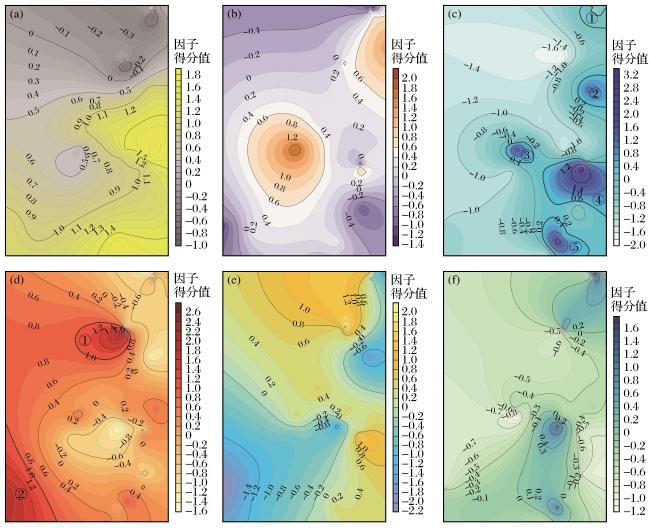
F1:(-Cu)、Be、(-Ge)、Rb、Zr、Nb、(-Ag)、In、Sn、Hf、Ta、W、Ti、Th、U、LREE和HREE元素组合[图4(a)]。大致划分为低异常区与高异常区2个部分,结合区域地质背景,推测高低异常区分布代表不同的岩浆岩,即岩浆岩在SN向上存在岩性差异,反映成矿流体的运移方向总体为NW-SN向。同时,在该火山喷发沉积—成岩成矿期,有Cu和Ag的初始富集(F1得分为负值),F1得分低异常区主要分布在F6断裂以北(尤其是花地矿段)和矿区西侧的中三叠统(T2)未分地层中。
F2:Zn、Cr、Co、Ni、V、Sc和In元素组合,其中Cr、V显示强亲氧性,主要形成氧化物与含氧酸盐的矿物结合;Co和Ni向地核集中,Cr、Co和Ni是典型的幔源型元素,对深部物质的活动性具有指示作用,也说明该区是火山沉积—成岩期形成的矿化元素组合,异常区指示流体的运移方向大致为NW-SN向[图4(b)]。
F3:Cu、Zn、Co、Ag、Cd、Pb、As-(Sr)、Li、Bi和Sb元素组合,As为半金属两性元素,Cu、Pb和Zn具强亲硫性,因此推测F3为改造期热液成矿的元素组合,如图4(c)所示。
F4:(-Sr)、(-Zn)、Mo、Bi、As、Sb、(-HΣREE)元素组合,Sr为造岩元素,Bi为成矿作用中的矿化剂,与成矿元素相伴生,Mo和Bi为高温元素组合,As和Sb集中到晚阶段的低温热液中,因此推测F4为前缘晕与尾晕的元素组合[图4(d)]。
F5:(-Sr)、(-Li)、Be、Rb和Cs元素组合,可能代表了深部叠加的富碱酸性岩浆岩的元素组合[图4(e)]。
F6:Ba、Ga、Rb和Ti元素组合,认为F5可能代表重晶石的元素组合[图4(f)]。
综上所述,F1、F2和F6因子指示早期为火山沉积成岩矿化初始富集期;F3、F4和F5因子指示晚期为构造改造成矿期,其中F4和F5因子可能为与构造改造同期的深部富碱酸性岩浆热液活动的叠加,因此矿区存在两期成矿特点(曾淑明等,2023)。
根据地表构造地球化学样品Cu分析数据,圈定F3因子元素组合(Cu-Ag-Cd-Pb-Zn-As)异常区5个,F4因子元素组合(Mo-Bi-As-Sb)异常区2个,且F3和F4元素组合异常区与Cu、Pb、Zn元素异常区分布基本一致。
2.3 花地矿段1 098 m中段构造地球化学异常分析
(1)聚类分析及指示意义
将样品的测试数据换算并统一单位后进行对数处理,运用SPSS软件进行Kolmogorov-Smirnov检验,当P值大于0.05时,数据符合正态分布,当P值小于等于0.05时,不符合正态性要求。其中,Zr、Hf、Nb、Ta、Nb、Ta、Sn、W、Th、Be、U、Rb、Ti、In、Bi、Cs、Ba、Ga、Cr、Sc、V、Co、Ni、Zn、Bi、Sb、Cu、Cd、As、Hg、Mo、Pb以及LREE和HREE的P值大于0.05,数据符合正态分布。
(2)因子分析及指示意义。在聚类分析的基础上,进行R型因子分析。按照累计方差贡献值达到72%取因子个数,得到4个主因子。F1因子:Be、Rb、Zr、Nb、In、Sn、Hf、Ta、W、Ti、、Th、U、LREE和(HREE);F2因子:Sr、Zn、Cr、Co、Ni、V、Li、Sc、(-Ge);F3因子:Cu、Mo、Ag、Cd、As、Sb、Hg、-(H∑REE);F4因子:Ba、Ga和Ti。根据元素数据整理及因子得分值,运用Surfer软件绘制了翁孔坝花地矿段1 098 m中段的构造地球化学图(图6)。
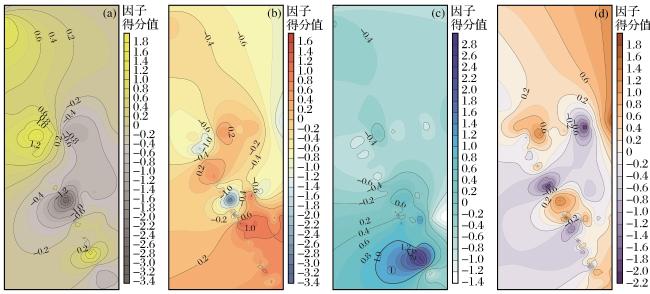
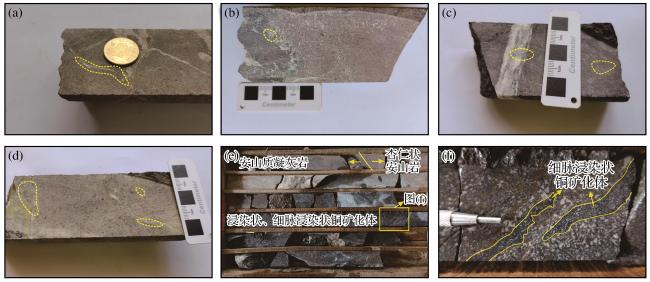
图7 火山—沉积热液期浸染状辉铜矿(a)ZK11-1-R29-3中玄武质安山岩,见绿泥石化、泥化和不规则状方解石—石英脉,浸染状辉铜矿沿方解石—石英脉发育;(b)ZK38-3-R83-3中凝灰岩,发育方解石脉,靠近浅色凝灰岩一侧发育浸染状辉铜矿;(c)ZK183-1-R88-1中玄武质安山岩互层内见方解石脉,脉内发育浸染状辉铜矿;(d)ZK11-1-R31-1中玄武质安山岩中发育不规则状绿泥石、绿帘石和石英—方解石脉,脉内发育浸染状辉铜矿;(e)ZK46-3中玄武质安山岩内发育细脉浸染状辉铜矿化,与围岩呈渐变过渡关系;(f)ZK46-3细脉浸染状铜矿化体 Fig. 7 Disseminated chalcocite in volcanic-sedimentary hydrothermal period |
F2因子由Sr、Zn、Cr、Co、Ni、V、Li、Sc和(-Ge)组成,构成火山沉积期的锌矿化和黄铁矿化元素组合[图6(b)]。
F3因子由Cu、Mo、Ag、Cd、As、Sb、Hg和(-HREE)组成,为改造期成矿元素组合,结合地质特征,在EW向构造最为发育的地段矿体最富。F3构造地球化学异常展布与已知矿体总体展布一致[图6(c)]。
F4因子由Ba、Ga和Ti元素组合组成,为火山喷发沉积成岩期形成的重晶石组合,如图6(d)所示。
3 找矿预测
3.1 预测标志
(1)铜矿化因子和Zn-Ag-Cd-Pb-As中低温元素组合因子的异常高值区分布特征,可以有效示踪并预测区内成矿流体的运移方向。
(2)多元素组合异常重叠和相邻区是主要的成矿地段,对深部找矿靶区圈定具有重要指示意义。
(3)区内构造地球化学异常受断裂控制,SN向断裂和岩性不整合界面为矿床的导矿构造,EW向断裂控制为该矿床的主要容矿构造。
3.2 靶区预测及验证效果
因子得分能够客观地反映对应样品中成矿元素组合的特征,其数值高低代表了取样点矿化作用强弱。通过分析因子得分的空间分布规律,能够揭示矿化的空间展布规律,进而利用因子得分等值线来描述矿床构造地球化学场特征。
通过对矿区地表样品、钻孔近地表样品和花地矿段1 098 m中段样品进行因子分析,选择F3(Bi、Sb和Mo)、F4(Cr、Sc、V、Co、Ni、Zn、Sr和Li)和F5(Cu、Ag、Ge、Cd、Pb和As)矿化因子绘制构造地球化学平面图,并结合找矿标志圈定了5处找矿靶区,如图8所示。
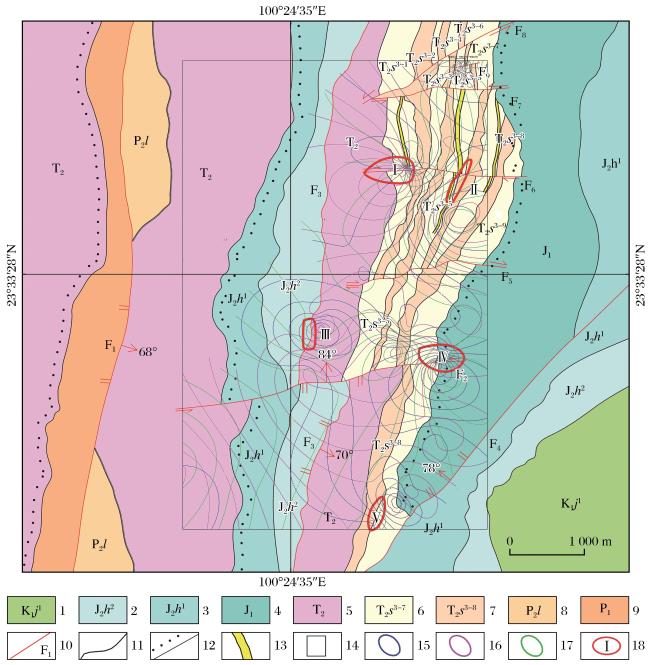
图8 翁孔坝铜矿区构造地球化学及靶区图1.景星组下段;2.和平乡组上段;3.和平乡组下段;4.下侏罗统;5.中三叠统未分组;6.宋家坡组上段奇数岩性段;7.宋家坡组上段偶数岩性段;8.上二叠统龙潭组;9.下二叠统;10.断层及编号;11.整合地质界线;12.不整合地质界线;13.矿(化)体;14.异常范围;15.F3因子得分异常等值线;16.F4因子得分异常等值线;17.F5因子得分异常等值线;18.靶区位置及编号 Fig. 8 Tectonic geochemistry and target area map of the Wengkongba copper mine |
根据ZK43-2和ZK107-1钻孔的施工情况,在Ⅱ号和Ⅲ号靶区揭露出多层铜铅矿体,可见蓝铜矿、辉铜矿和方铅矿呈细脉状和团块状沿碳酸盐脉不规则分布,且矿石品位可达工业要求。其余3处靶区尚未进行工程验证,显示区内仍具有较大的找矿潜力。
4 结论
(1)地表因子分析表明,矿区火山沉积成矿(F1、F2、F6)和构造改造(F3、F4)成矿作用同时存在,且F5因子暗示可能存在富碱酸性岩浆热液的叠加作用;F1因子表明中基性火山岩系具有明显的岩相分带,F6北侧及矿区西侧中三叠统(T2)未分地层中的火山岩岩相在火山沉积—成岩成矿期易于发生铜的富集矿化作用。
(2)矿区内构造控矿作用明显,矿化元素组合异常在SN向呈带状出现,反映SN向断裂、岩性不整合界面和岩性分界为矿区的导矿构造;成矿元素组合异常在近EW向呈相邻式分布,反映矿床受EW向断裂控制,为矿区的主要控矿构造。
(3)通过分析多元素组合异常发现,在岩性不整合面、岩性分界面和断裂交会部位因子得分多交叉和重叠,该重叠部位及其附近可作为找矿重点靶区。
(4)通过施工ZK43-2和ZK107-1钻孔对Ⅱ号和Ⅲ号靶区进行验证,揭露到多层铜铅(化)矿体,这不仅证实构造地球化学方法在指导翁孔坝铜矿找矿勘查中的有效性,也显示出该矿区具有广阔的资源前景。

 甘公网安备 62010202000672号


