

在金属矿床地下开采作业中,为提高岩体的长期稳定性,岩体节理发育等部位往往采用锚杆锚固。然而,由于受开采工艺流程的影响,锚固体将经历蠕变损伤和动态冲击等多种不同应变率的力学作用。认清锚固体在多应变率下的响应规律与锚固机理,准确把握锚固失效的时间效应,对于科学设计锚固支护方案和有效预防相关灾害至关重要。
岩石蠕变是岩体工程围岩变形失稳的主要原因之一,近年来研究人员围绕围岩劣化、支护优化及锚固耦合机制进行了大量研究,取得诸多成果。例如:围岩强度参数与刚度参数的劣化显著加剧了瞬时与蠕变变形,基于统一强度准则或非静水应力场模型的解析方法,能够更精准地预测变形趋势(Wang et al,2023;王俊杰等,2024)。支护时机对围岩的长期稳定性至关重要,围岩瞬时变形结束后及时施作二次衬砌能有效抑制蠕变发展,同时优化支护参数可协同控制各阶段变形(侯朝炯,2017;Yang et al,2023)。针对岩体蠕变与支护的相互作用,构建相关理论模型并通过Laplace变换及数值模拟验证,揭示了锚杆预应力随时间的动态衰减规律及其与岩体蠕变的协调变形机制(宋洋等,2021;Yang et al,2022)。锚固裂隙岩体蠕变试验研究表明,锚杆锚固可抑制微裂纹扩展并促使拉伸裂纹主导破坏模式(Yu et al,2023)。此外,在复杂荷载(如疲劳或地震)下,锚固岩体流变呈现衰减、稳态和加速三阶段特征,虽然疲劳加载会加剧蠕变,但这种效应随荷载等级提升呈线性抑制趋势(Song et al,2020;Li et al,2021)。
近年来,国内外学者在动载条件下围岩锚固系统的稳定性研究方面取得重要进展,主要集中在动态力学响应机制、结构参数优化及能量调控等方面。在动态力学响应方面,通过SHPB试验揭示了预应力端锚锚固体的应力波传播规律,发现应力波峰值应变随冲击气压呈指数衰减(常聚才等,2022)。进一步研究表明,全长锚固体系中锚杆、锚固剂与围岩的动态响应具有显著时序差异性(常聚才等,2023)。通过静—动载对比试验发现,锚杆可使煤样抗拉强度提升35%(静载)和24%~40%(动载),破坏模式由静载条件下的块状破裂转化为动载条件下的破碎(韦四江等,2023a,2023b)。针对锚固参数优化,基于3D打印试样的静—动耦合试验,证实锚固长度与静/动态强度均呈正相关关系(Wu et al,2024)。通过径向圆柱P波解析模型发现,岩石与锚固剂在瞬态入射条件下的动态应力分布呈反向特征(Xiang et al,2023),提出通过降低锚固剂刚度和厚度可有效抑制界面应力集中。在能量调控与工程应用层面,研究发现锚杆可显著提升岩体临界应变率并降低耗散能指数(Qiu et al,2022),据此提出基于能量阈值与应变率关联的抗动载支护设计方法。通过冲击试验,验证锚杆可减少围岩吸收能50%以上(Liu et al,2019),其能量耗散率与破碎程度呈正相关关系,表明锚杆通过能量重分布抑制围岩破坏扩展。
综上所述,现有研究多关注单一荷载(静载或动载)下锚杆的锚固效应,由于岩石蠕变和动态变形破坏是2个不同应变率的力学响应问题,为探究动态扰动对于锚固体蠕变特性的影响机制,需将二者结合起来,以揭示动态荷载对蠕变进程的加速效应。传统试验多采用应变片监测锚杆变形,存在仅能监测离散点和无法反映空间异质性的局限性。基于此,本文结合分布式光纤和声发射监测技术对节理试样和全长锚固节理试样开展了蠕变—冲击试验。其中,分布式光纤技术实时捕捉锚杆全程全长应变分布特征,揭示局部应力集中与变形演化规律,声发射技术通过峰值频率和能量释放特征,解析破裂演化与裂纹类型,二者联用实现“锚杆空间连续变形+岩体损伤破裂演化”的同步动态监测,揭示蠕变—冲击作用下节理试样的锚固力学效应,研究锚杆锚固对节理试样的控制机理,为深部复杂动载环境下的锚杆支护安全提供理论支撑。
1 试验方案
1.1 试样制作
本试验中的试样制作方法参考相关文献(占赛等,2024),其中容重相似常数为1∶1、几何(应力)相似常数为5∶1,将节理试样设计为长方体,尺寸为75 mm(长度)×40 mm(厚度)×150 mm(高度),与钢材加工厂家定制好浇筑模具,其中模型试样的节理尺寸设计为37.5 mm(长度)×2.0 mm(开度),模型试样的锚杆孔直径为6 mm,节理与锚杆呈固定角度60°,镁锰合金制作的相似锚杆尺寸为100 mm(长度)×4 mm(直径)。全长锚固节理试样的制作过程划分为以下步骤:(1)配置好所需相似材料配比及重量;(2)采用搅拌机进行搅拌;(3)将搅拌好的物料倒入模具中静置1~2天,试样形成一定强度;(4)进行脱模处理(锚杆孔与节理在此步骤形成);(5)养护1个月左右使试样达试验所需强度;(6)进行相似锚杆安装,节理试样的制作过程及几何参数见图1。
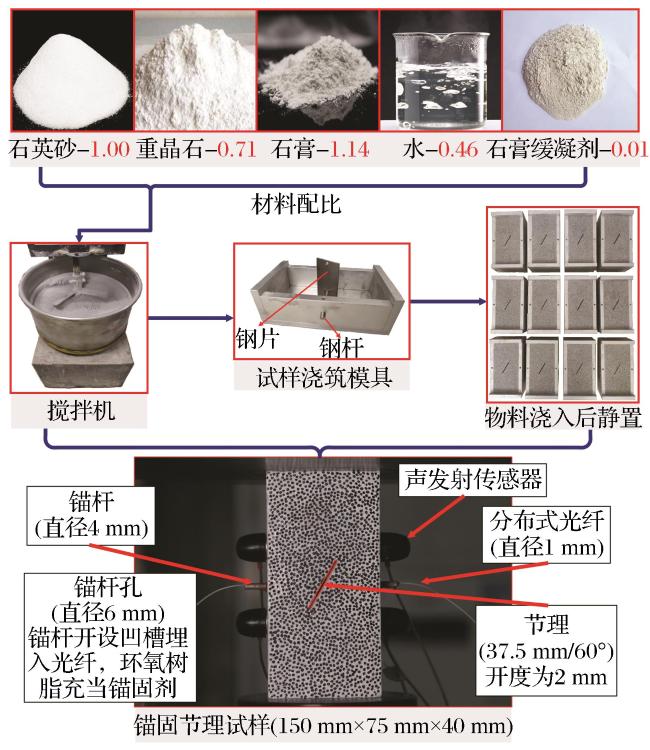
以往研究发现,当锚固角度约为60°时,锚杆对节理的锚固止裂效果显著(Spang et al,1990;Barton et al,2021)。采用单一节理试样(倾角为60°、开度为2 mm)开展物理试验,虽然未考虑实际岩体中多组节理交叉和不同倾角等复杂地质条件的影响,但通过单一变量,有利于基于多源监测数据揭示锚固锚杆与节理的相互作用过程,为蠕变—冲击耦合作用下锚固止裂机理的精细化研究提供可行路径。同时,为多物理场耦合作用下含复杂节理锚固岩体破裂失稳研究提供了技术手段。
在进行锚杆安装的过程中,由于锚孔壁与锚杆之间的孔隙内径为1 mm,先用棉签蘸取树脂锚固剂进行锚孔的润滑,防止锚杆插入时某些位置没有锚固剂造成缺陷。润滑完毕后,在锚杆上涂上适量的树脂锚固剂,而后将锚杆慢慢插入锚孔中,待锚杆全部插入后反复左右拉拔一下,使其充分锚固,锚杆周围黏上树脂植筋胶,这样在插入过程中将树脂植筋胶带入锚孔完成锚杆的安装。
1.2 试验流程及设备
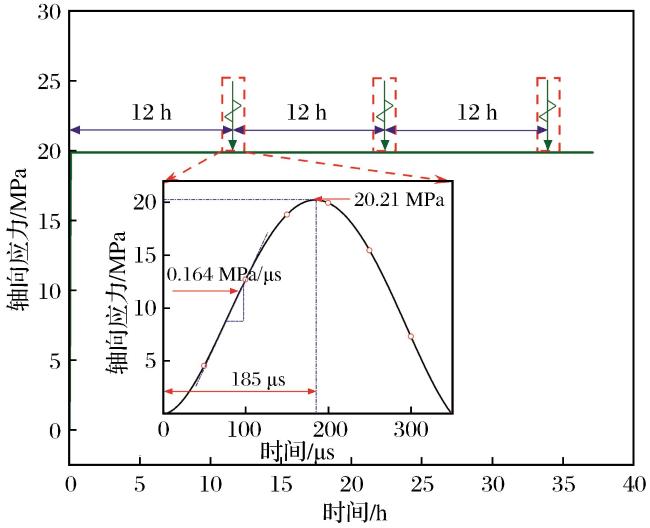
本次锚固节理试样蠕变—冲击试验在岩石流变—冲击试验机上开展,试样包括节理试样和全长锚固节理试样2种。试验方案具体实施步骤如下:首先将蠕变载荷加载至节理试样(全长锚固节理试样)单轴抗压强度的80%,待试样在稳定载荷下蠕变12 h后,通过落锤施加冲击扰动,冲击完成后在原蠕变载荷(单轴抗压强度的80%)下继续对试样进行蠕变加载,每隔12 h施加一次冲击直至试样发生失稳破坏。
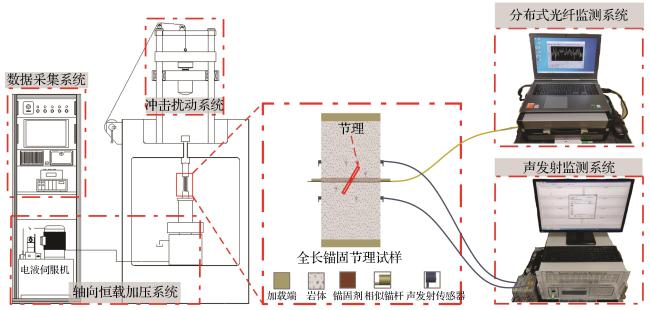
岩石流变—冲击试验系统可对试样的受力情况和轴向位移变化进行监测,利用声发射监测系统(Dong et al,2023)监测试样在蠕变—冲击过程中的损伤破裂,采用分布式光纤测量技术(朴春德等,2022)监测锚固体内部的锚杆变形,参数设置如下:空间分辨率为1 mm,传感精度达±1.0 ,采样频率为1 Hz。试验系统及设备如图3所示。
2 试验结果分析
2.1 锚固节理岩体的变形特征
对节理试样和全长锚固节理试样开展蠕变—冲击试验,每种试样设置3块,共6块。从两类试样中各选取一块试样进行对比分析,图4所示为蠕变—冲击试验过程中两类试样的轴向应变随时间的变化曲线。
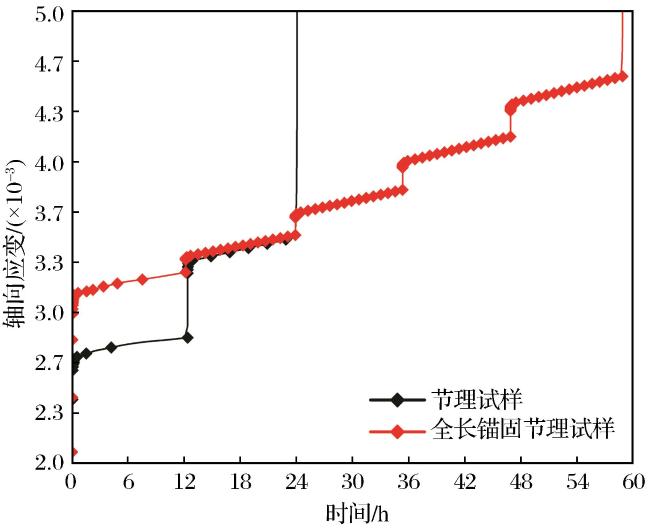
初步观察可知,试样在蠕变—冲击试验中主要发生冲击破坏。节理试样在2次冲击扰动后发生冲击破坏(时间为24.08 h),全长锚固节理试样经历了5次冲击扰动后发生冲击破坏(时间为58.88 h)。冲击扰动造成试样的轴向应变瞬时增大,扰动后随着时间的延长,试样的蠕变变形均经历了减速蠕变和稳定蠕变2个阶段。说明锚杆的安装增强了节理试样的抗冲击性能,降低了冲击过程中试样内部的损伤累积,使得锚固节理试样在蠕变—冲击试验中发生破坏的时间大于节理试样。
全长锚固节理试样在每次冲击扰动产生的瞬时应变依次为0.112×10⁻³<0.145×10⁻³<0.183×10⁻³<0.214×10⁻³,每次冲击扰动产生的瞬时应变均较上一次有所增加。锚固节理试样在前期蠕变阶段中岩体内部损伤较小,随着冲击扰动次数的增加,试样内部累积损伤越来越多,致使试样完整性降低,试样对锚杆的调动作用越来越弱。冲击次数越多,试样累积吸收的能量也越多。当施加第5次冲击扰动时,试样内部集聚的弹性能达到临界状态,并沿着损伤区集中释放,从而导致试样发生破坏。
2.2 锚杆变形特征
采用分布式光纤传感技术实时监测蠕变—冲击作用下锚杆应变特征,通过解析锚杆应变时空分布规律,揭示全长锚固节理试样中锚杆对冲击扰动的响应机制。以其中一个全长锚固节理试样为例,图5展示了蠕变—冲击作用下的锚杆应变分布情况,通过分段表示了前期蠕变阶段和每次冲击扰动后的锚杆变形。
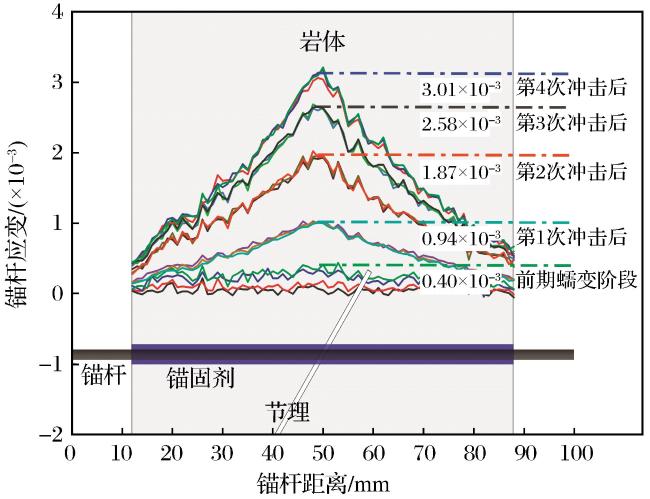
在前期蠕变阶段(施加冲击前),锚杆的整体变形较小,锚杆应变呈现中间高、两端低的分布特征,节理处锚杆应变最大值为0.40×10⁻³。第1次冲击扰动后,锚杆应变发生突增,节理处锚杆应变增长至0.94×10⁻³,说明冲击扰动瞬间激发锚杆的轴向加固及抗剪切作用。随着时间的延长,试样同样经历了减速蠕变和稳定蠕变阶段,由于冲击间隔时间较短,锚杆在此区间增长极为缓慢,因此主要讨论冲击扰动造成的锚杆变形。在蠕变—冲击过程中,锚杆的变形整体趋势呈现“等腰三角形”分布趋势(占赛等,2024),锚杆中段受节理剪切错动影响最大,两端受围岩约束较强,因此形成以节理为中心的对称应力场。第2~4次冲击扰动后,锚杆最大应变分别为1.87×10⁻³、2.58×10⁻³和3.01×10⁻³,说明随着冲击次数的增加,冲击扰动将进一步促使锚固节理试样蠕变损伤及锚固界面黏结性能劣化加剧,其中节理处锚杆应变峰值(3.01×10⁻³)为两端平均值的2.3倍,证明节理处为关键薄弱区。
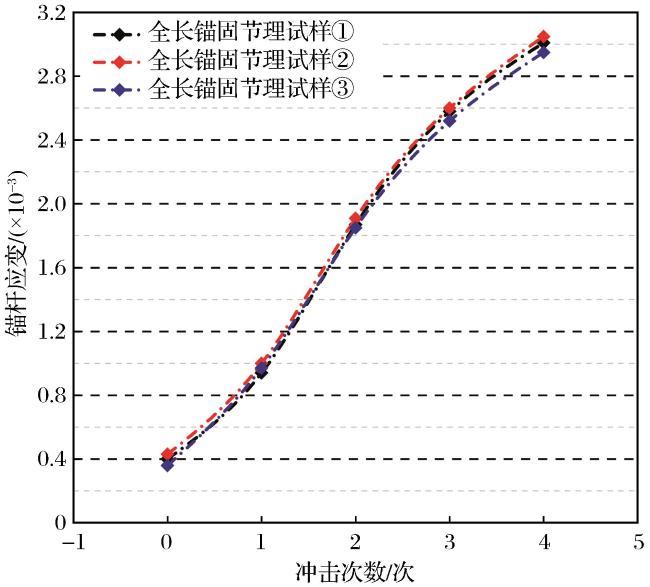
选取3个全长锚固节理试样位于节理中心处的锚杆进行变形分析,图6所示为不同冲击次数下全长锚固节理试样内部锚杆应变分布。由图6可知,锚杆在第1次冲击扰动后变形增量小于第2次冲击扰动,随着冲击次数的增加,锚杆变形增量呈现“小—大—小”非单调变化趋势。分析其原因,首次冲击前锚固节理试样完整性好且锚固界面黏结完好,第1次冲击主要起激发强化效应,荷载传递效率高,锚杆以弹性变形为主,锚杆变形增量较小;第2次冲击导致节理处发生剪切错动,能量分配转向界面摩擦滑移和微裂纹扩展,锚杆将承受瞬时剪切冲击载荷,节理处锚杆进入弹塑性过渡阶段,锚杆需承担更大的塑性变形,锚杆变形增量达到峰值;在后续多次冲击中,锚固界面因剪切应力集中发生渐进式脱黏,荷载传递效率随着冲击次数的增加而下降,节理处锚杆局部颈缩使得锚杆承载能力下降,锚杆变形增量逐渐减小,试样损伤累积进入饱和阶段,微裂纹逐渐贯通形成主裂纹,剩余强度主要依赖节理两侧区域的有限承载能力,导致锚杆变形增量再度减小,直至试样发生冲击破坏。蠕变—冲击耦合作用下锚固节理试样会经历“弹性强化—弹塑性过渡—锚固失效”3个不同损伤演化阶段。
2.3 声发射能率特征
在蠕变—冲击作用下,试样微裂纹的萌生、演化和扩展过程伴随着声发射事件的产生,故利用声发射监测技术对蠕变—冲击作用下各类试样内部破裂演化过程进行研究。图7所示为蠕变—冲击试验中试样的轴向应变、(累计)声发射能量与时间之间的关系。
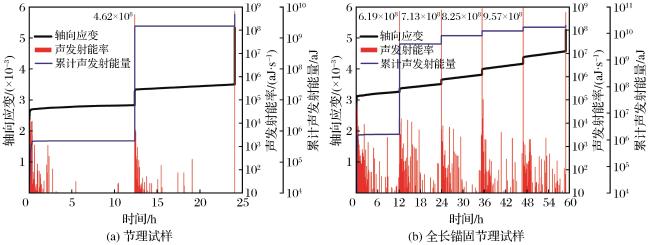
蠕变—冲击试验中各类试样的声发射能量释放具有一定的相似性,在前期蠕变阶段,试样经历了减速蠕变和稳定蠕变阶段。在减速蠕变阶段,随着压力逐渐施加至蠕变载荷,声发射能量释放呈现逐渐增大并出现峰值,之后在长期稳定蠕变载荷作用下,试样的蠕变变形速率逐渐减小,声发射能量释放也随之逐渐减少。这一过程反映了减速蠕变阶段中试样损伤增量先增大后逐渐减小且损伤不明显的演化特征。当试样进入稳定蠕变阶段后,试样的声发射能量释放维持在很低水平,表明此阶段试样的损伤累计较为缓慢且处于稳定增长状态。
2.4 声发射峰值频率特征
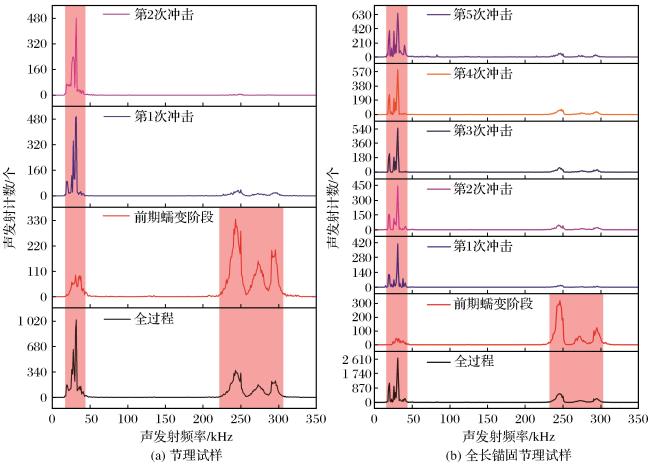
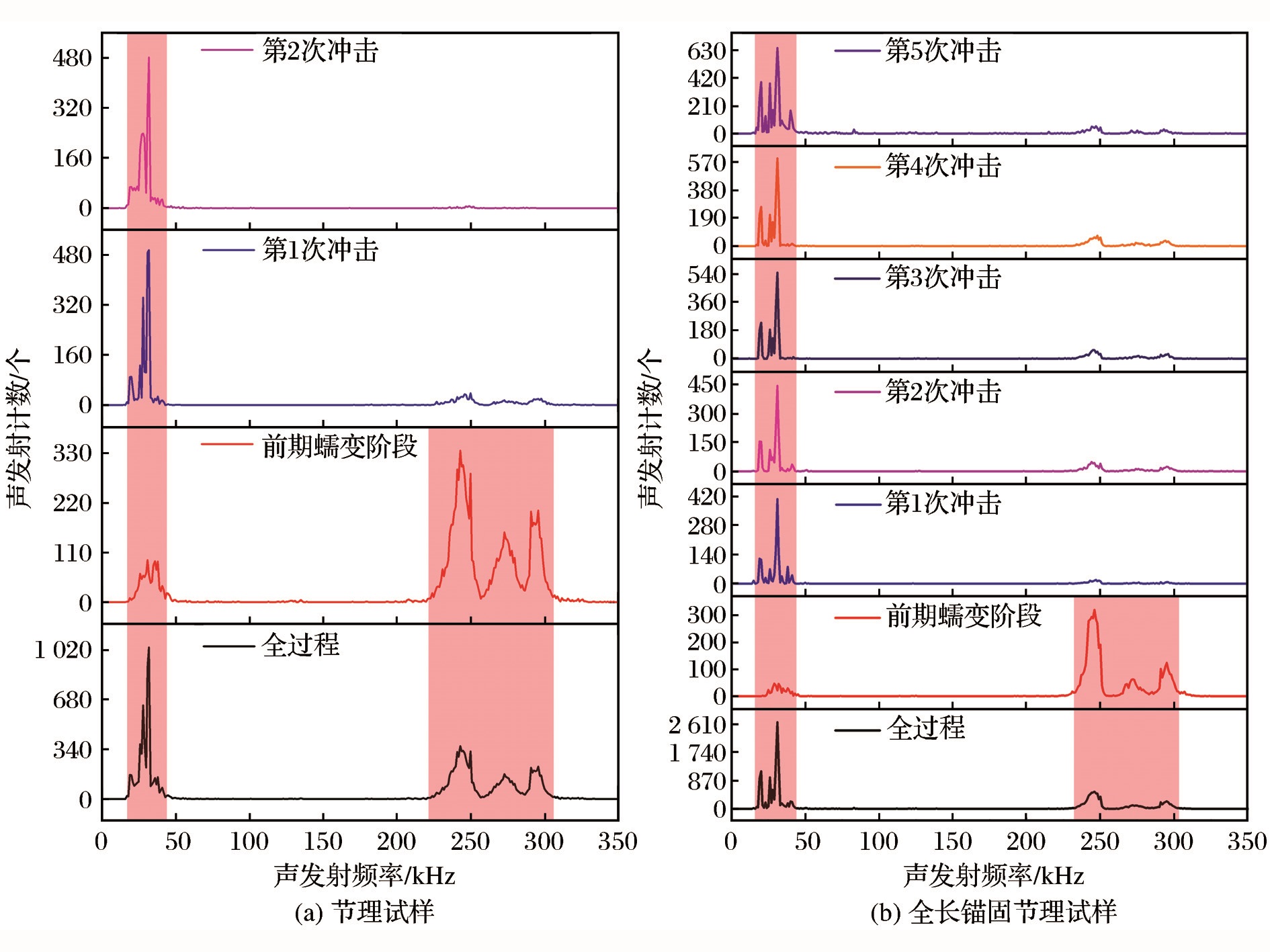
在前期蠕变阶段中,声发射峰值频率主要集中分布在高频段(225~300 kHz)上,冲击扰动产生的声发射峰频几乎都为低频信号,主要分布在20~50 kHz频段。试样在后一次冲击扰动下产生的声发射计数大于前一次冲击,随着冲击扰动次数的增加,试样内部损伤积累越大则微裂纹更为发育,声发射现象也越来越显著,各类试样在蠕变—冲击过程中的声发射峰值频率分布趋势相似,不同在于节理试样的声发射计数小于全长锚固节理试样。
试样发生变形及裂纹萌生扩展主要受节理影响,结合“锚杆整体变形—声发射特征”监测数据分析,发现试样在蠕变阶段以拉伸微裂纹缓慢扩展为主,而冲击扰动瞬间会触发试样发生剪切破裂并导致锚杆应变突增,说明冲击扰动使得节理被压缩并发生相对剪切错动,导致节理尖端处产生剪切裂纹。当节理试样被锚杆锚固后,锚杆的轴向加固可抑制节理处被压缩以及试样产生的横向变形,锚杆的抗剪作用可抵抗试样沿节理面发生剪切错动,锚杆的安装减缓裂纹的扩展,提高了节理试样在蠕变—冲击作用下的整体稳定性。
3 结论
针对节理试样及全长锚固节理试样开展蠕变—冲击试验,通过对蠕变—冲击过程中锚固岩体的应变—时间关系、锚杆变形特征和声发射特征进行分析,得到以下结论:
(1)蠕变—冲击作用下锚杆应变呈现“等腰三角形”分布趋势,锚杆中段受节理剪切错动影响最大,两端受围岩约束较强从而形成对称应力场,节理处锚杆应变集中系数达2.3,证明节理处为关键薄弱区。
(2)随着冲击次数的增加,锚杆变形增量呈现“小—大—小”非单调演化规律,冲击扰动将促使锚固节理试样蠕变损伤及锚固界面黏结性能劣化加剧,锚固体历经“弹性强化—弹塑性过渡—锚固失效”3个损伤演化阶段。
(3)试样在蠕变阶段以拉伸微裂纹缓慢扩展为主,而冲击扰动瞬间将触发剪切破裂并导致锚杆应变突增,锚杆的抗剪作用可抵抗试样沿节理面发生剪切错动,提升节理试样整体稳定性。
(4)锚杆全长应变分布特征及应变增量变化,能反馈岩体内节理具体位置和锚固界面黏结性能劣化程度,在实际支护工程中应加强锚杆动态监测,在节理处加密支护或采用高强度材质锚杆。

 甘公网安备 62010202000672号


